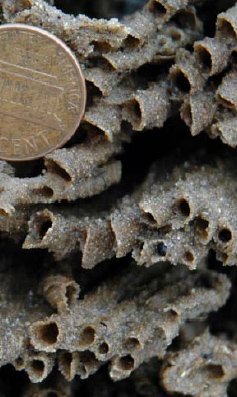
We are not the only species that builds homes and condominium complexes from sand. For example, some foraminifera construct shells from sand grains, as does the Trumpet Worm - and excellent artisans they are. A particularly clever worm which has been in the news lately is the so-called Sandcastle Worm, or Phragmatopoma californica to be precise, varieties of which live around the world, generally in the intertidal surf. To survive in this energetic environment, they build robust tube-shaped homes a few centimeters long from anything that’s around - which is mostly sand - and congregate together in large colonial apartment buildings. The construction process is meticulous. The worm’s tentacles select an individual sand grain and move it on to a remarkable appendage which puts two small dabs of glue on the grain and places it where the next piece of construction is needed. It holds it there for around 25 seconds, moving it a bit to ensure that it’s snuggly in place, just as we do when gluing two things together. By the time the glue is set, the next grain is ready for the project.
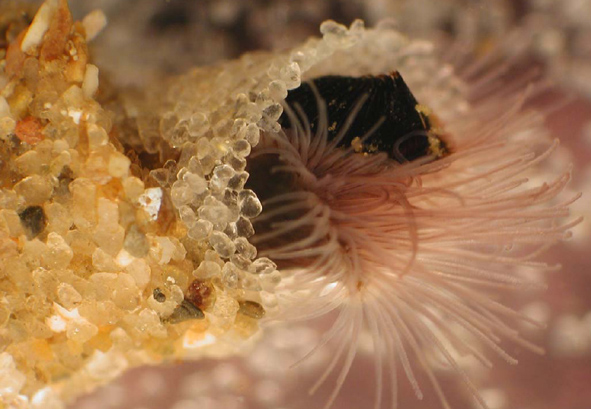
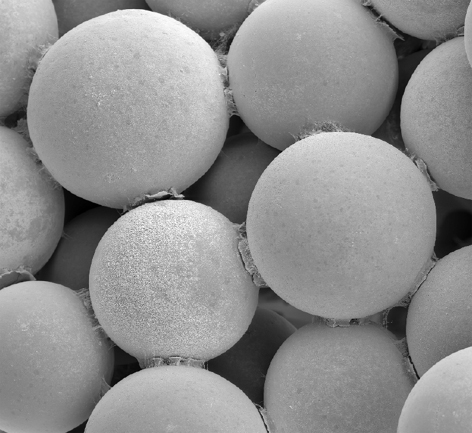
The glue is amazing stuff - based on proteins, natural polymers which can be negatively or positively charged, plus calcium and magnesium ions, all structured into complex chains that link together and, through a chemical conspiracy similar to that used by mussels and other marine creatures that like to attach themselves to things, make a very strong glue. And, of necessity, one that works in the wet. Russell Stewart, Associate Professor of Bioengineering at the University of Utah, together with his colleagues, recognized the potential medical applications of such a natural superglue and set about understanding how it works and how it might be synthesized. The Sandcastle Worm is perfectly happy to work with whatever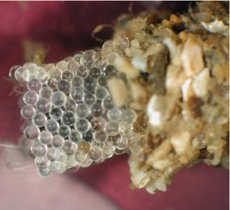 material is available and so, in the laboratory, Stewart provided the worms with sandgrain-sized glass beads which they proceeded to busy themselves with. The photo at right shows a worm tube started with natural sand and extended with the glass beads; below is a scanning electron microscope image of the extraordinary care and accuracy with which the beads are glued together.
Stewart used his detailed analysis of the glue to cook up a version that mimics the clever chemistry of the worm’s secretion using synthetic polymers that are more practical to make. The synthetic glue has the potential to put small fragments of broken bone back together, to attach tissue scaffolds that encourage the growth of new bone, and to carry drugs to deliver antibiotics, pain killers and perhaps even stem cells with precision. As Patrick Tresco, associate dean for research at the University of Utah’s College of Engineering, says in the press release: “Most current adhesives do not work when surfaces are wet so they are no good for holding together bone, which is wet and bloody. There is nothing like it [the synthetic worm glue] on the market today.”
It may not be too long before many of us are profoundly grateful to the brilliant chemical engineering of the humble Sandcastle Worm.
(images from the University of Utah news release, http://www.unews.utah.edu/p/?r=111008-1, where there is a link to an amazing video of a Sandcastle Worm at work with fragments of silicon chips, and http://education.cnsi.ucsb.edu/pages/ar/projects/projects2005/pdfs/Kristen_Mauricio.pdf.)
Comments
Mr. Welland,
In case you did not see this there is an article on sand in today’s Science section of the New York Times which I linked to courtesy Geology News. Dr Rob Holman,a coastal ocengrapher from OSU is a collector of worldwide sand samples.
http://www.nytimes.com/2009/01/06/science/06prof.html
http://www.nytimes.com/2009/01/06/science/06prof.html?pagewanted=1&_r=1