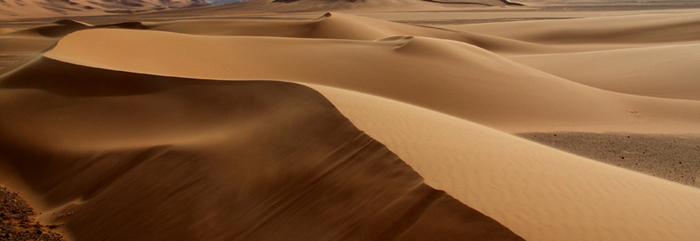
Among the many things that are intoxicating about the desert, the things that draw us back, I find the silence perhaps the most compelling. In a world where noise bombardment is the norm, the complete absence of sound is a shock and a fascination, the auditory equivalent of turning off your headlamp deep underground and experiencing, literally, a complete inability to see your hand held up in front of your face. Sit in the desert in the morning or at night and you can sense yourself straining to detect a sound, any sound - but there is nothing. Wilfred Thesiger, one of the great desert explorers and writers, wrote of “a silence in which only the winds played, and a cleanness that was infinitely remote from the world of men.” It is only the wind that breaks the silence, gently and subtly as the day warms up and the air is on the move, sometimes expressing itself with the fury of a sandstorm. Watching the first breaths of wind gather momentum and begin their game with the sand is hypnotizing - at first a few tumbling grains, then more, gathering themselves into swirling, shape-shifting, fluid sheets dancing over the desert surface. This is the desert at work, the wind is the engine and the sculptor, and, as Thesiger observed, the only thing that breaks the silence.
We can wonder at the glorious diversity of the results of the engine’s efforts - ripples, ridges, dunes in all their variety, sand seas, sandstorms, sand blasting - but our understanding of how the engine works is owed to one man, Ralph Bagnold. 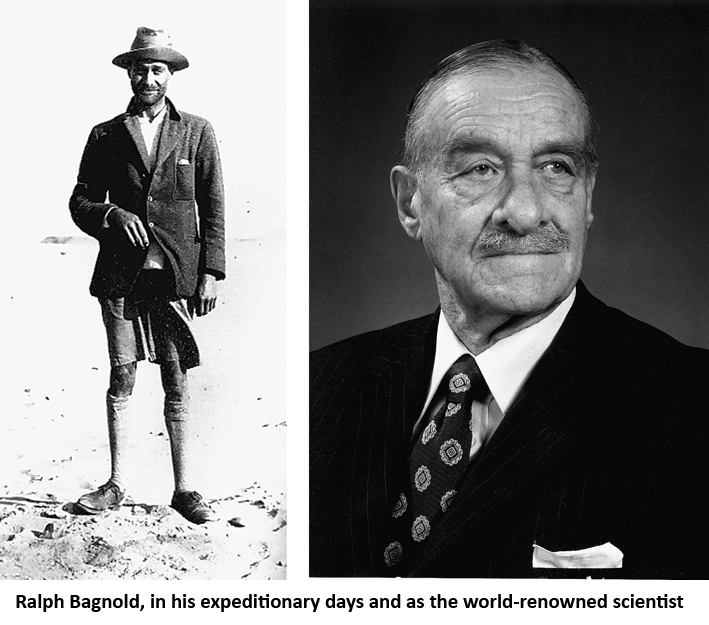 , and, later, Model A’s. He pioneered the means for extended automobile expeditions, desert navigation, and driving across sand - including the giant dunes of the Great Sand Sea. As a civilian in the late 1920s and early 1930s, he accomplished journeys that no-one had thought possible, and, along the way, became fascinated by what we didn’t know about the desert:
“In 1929 and 1930, during my weeks of travel over the lifeless sand sea in North Africa, I became fascinated by the vast scale of organization of the dunes and how a strong wind could cause the whole dune surface to flow, scouring sand from under one’s feet. Here, where there existed no animals, vegetation or rain to interfere with sand movements, the dunes seemed to behave like living things. How was it that they kept their precise shape while marching interminably downwind? How was it they insisted on repairing any damage done to their individual shapes? How, in other regions of the same desert, were they able to breed “babies”, just like themselves that proceeded to run on ahead of their parents? Why did they absorb nourishment and continue to grow instead of allowing the sand to spread out evenly over the desert as finer dust grains do? More basically, what kind of upward physical force must be exerted on the mineral grains to make them rise against the force of gravity, lifting them to such a height that they can strike one’s face like little hammers? No satisfactory answers to these questions existed. Indeed, no-one had investigated the physics of blown sand. So here was a new field, I thought, one that could be explored at home in England under laboratory-controlled conditions.”
And explore under laboratory-controlled conditions is exactly what he did. He was a highly-skilled engineer and designed and built his own wind tunnels and delicate measuring apparatus from scratch. He meticulously measured sand, its ranges of grain sizes and how they influenced (and were influenced by) transportation by his laboratory winds. He documented saltation, the process by which flying sand grains land and kick yet more grains into the air, and demonstrated that this is the main way in which desert sand moves, quantifying the physics and the aerodynamics. In 1938, he returned to the Sahara as a leader of a multi-disciplined expedition to the Gilf Kebir in the southwesternmost corner of Egypt, an area he and his colleagues had explored earlier. His aim was to take field measurements of moving sand and dune dynamics to test his laboratory results, an aim he accomplished with dramatic success. This was the first time that the desert’s engine had been scientifically measured and documented - many questions remain today, but the basis was set out by Bagnold.
A couple of years ago, I was lucky enough to be invited to join an expedition retracing, as far as we could, Bagnold’s 1938 itinerary - I was the sort of token geologist. And what an extraordinary experience that was - I became completely hooked on the desert. A visit to the site of his base camp revealed the extent to which his much-studied dune had overridden the scene. Challenges of logistics, navigation and vehicle travel in 2007 only emphasized how extraordinary had been Bagnold’s achievements nearly eighty years previously.
The Second World War saw Ralph Bagnold back in his military role. Exploiting his desert expertise, he established the legendary Long Range Desert Group, a highly mobile raiding force that wrought havoc by appearing out of nowhere behind enemy lines after journeys that were thought impossible. After the war, he returned to refining and compiling his work on desert sand, the result being The Physics of Blown Sand and Desert Dunes, a work which remains a classic reference today. He later published with Carl Sagan on the sands of Mars and provided advice to NASA in preparations for the first mission to the Red Planet. And, having exhausted what could be done at the time on windblown sand without reliable long term wind data, now Brigadier Bagnold turned his attention to revolutionizing our understanding of sand transport by rivers and waves.
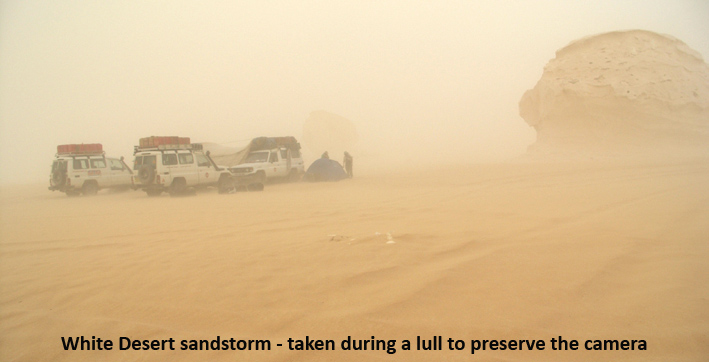
There is much to say about Ralph Bagnold, and I shall say more in later posts. But for now to conclude with a return to the engine, the desert wind… I took Bagnold’s writing with me through the Gilf Kebir and across the Great Sand Sea - an inspiration in an inspirational landscape, not just the science and the observations, but the resonance of his palpable love of the desert. I watched sand on the move, skittering across the desert floor under a gathering wind, avalanching spontaneously down the steep slope of a dune - and hurtling chaotically, viciously in a raging sandstorm. We had experienced minor sandstorms already, but the one that hit us in the White Desert was a monster. I have just now opened my notebook from that evening, scribbled in pencil because a pen became instantly non-functional, and some sand grains fell from between the pages. As I was blasted by the onslaught of flying sand, I felt a resonance with Ralph Bagnold who had written:
"A dense, stinging fog of low-flying sand grains wholly obscured not only our cars but ourselves up to our shoulders, while our heads stuck out against a clear blue sky. One after the other, our feet dropped an inch as sand was scoured from beneath.
The whole landscape was on the move."
On this occasion, my head did not stick out above the sand and there was no blue sky visible - until the following, incredible, morning which revealed “a cleanness that was infinitely remote from the world of men.”
[For further reading, Ralph Bagnold’s autobiography, Sand, Wind, and War - Memoirs of a Desert Explorer is fascinating and characteristically modest - but, sadly, out of print. The Physics of Blown Sand and Desert Dunes was reprinted in paperback by Dover in 2005. Bagnold photographs above by kind permission of Stephen Bagnold; other photographs are my own. More can be found on Bagnold throughout my own book, Sand: The Never-Ending Story, University of California Press - just published - only a few remaining - hurry!]
Comments
Michael,
Thanks for yours and Bagnolds vivid descriptions of the North African desert environment. I would love to experience the unique feeling of such remoteness and quietness as juxtoposed to the ambient noises we are surrounded with almost daily(at least for a brief interlude! After a while I have read that a place of utter silence can be almost maddening because you only hear your own heartbeat.)
Since those sands would damage your camera lenses, how well do the windows and paint hold up on those vehicles during such storms?
Jules
Jules - thanks (as always) for your interest and comments. To answer your question, windows hold up pretty well, but paint takes a battering. Given how incredibly penetrative sand is (I still use the backpack I had with me and it’s still “saturated” with sand grains), the way in which Bagnold and his colleagues were able to maintain Model T Fords and keep them going under such abusive conditions is really quite incredible. And I was pleased that I had thought to buy a pair of ski goggles before my trip - the guy in the shop asked where I was going skiing and was interested in the answer - I guess they were the first sand goggles he’d sold. Another quote from Bagnold’s account of his 1938 expedition:
“My work necessitated waiting for a sand storm to blow up…A heavy one blew up within a few days. I was well prepared for it except, alas, I had lost my sand goggles. I spent some very uncomfortable hours sitting in the open, directly exposed to a violent sand blast, trying to keep my eyes open while taking readings from an array of gauges and sand traps. The purpose of eyelashes was very evident. Fortunately, I managed to get some reliable measurements which nicely confirmed my wind-tunnel measurements made in London.”
Thanks Michael,
Just as Bagnold appreciated his own eyelahes,another animal,the camel uses those very long eyelashes to sift out sand, obviously an evolutionary adaptation to this harsh environment. These descriptions also make me remember the dramatic desert sand storm scences and others captured by the amazing cinematography of David Lean’s epic movie “Lawrence of Arabia”
More on adaptations of camels
http://www.search.com/reference/Camel
Got here via carnival of the arid. Bagnold sounds like an awesome guy. Enjoyed reading this affectionate post. Maria Brumm over at scienceblogs was recently lamenting the under-representation of geology blogs (and, of course, the over-representation of biology blogs) in the public perception of the science blogosphere, and I had made a mental note to check out more geology blogs. Will add yours to the list.
I am researching the use of “Going Maps” used in tank warfare by the British Army in the North African campaign of WW II. Does anyone know if (as seems very likely) Bagnold contributed to these maps via his knowledge of Saharan sand deposits and his activities with the LRDG.
Dave - by an odd coincidence, I’m in the middle of rooting around in some Bagnold materials and have dug up a couple of things that might be of use. It’s easier if I e-mail them to you.
Hello Michael
Am completely absorbed in Michael Ondaatje’s “The English Patient” and have never been more
fascinated by anything as I am by the desert and of course Herodotus! Thank you for the
excerpts from Bagnold! You have delightfully added to my journey of discovery whilst reading this book!!
Hi Catherine - thanks so much for letting me know! Yes, it’s a great book and a great film - for me, the opening scene shows some of the most stunning images of dunes that I’ve seen. I was lucky enough to visit the original “Cabe of the Swimmers” but saddened (well, disgusted, actually) to see it defaced by graffiti - I’m astonished that anyone who has the interest and the determination to visit it is then moronic enough to do this).
You might be interested in a fascinating non-fiction account of the characters, particularly Almasy, and the history behind Ondaatje’s book. I would thoroughly recommend “The Hunt for Zerzura” by Saul Kelly. Almasy was, in reality, an extraordinary and enigmatic character, and he and Bagnold had an enigmatic relationship.
Hi Michael
Thanks for writing! I have the screenplay by Anthony Mingella (sad to me that he has
passed on) whom I thought did a splendid job and I have the dvd. Thank you, I did look up details on Almasy and that he discovered the “Cave of Swimmers” in 1933,painful to read your words about the defacement of such historic beauty, and… I will get a copy of “The Hunt for Zerzura” I also think the desert,the wind and the people is all just so romantic as well! I loved the tales about the winds, “Aajej - against which the Fellahin defended themselves with knives” etc.
I must tell you that I have ordered your book (hard cover) and I am assured that it will be winging its way to me arriving in 3 weeks - can’t wait!
Hi Catherine - thanks for ordering the book - please let me know what you think!
I have to admit that I’m hooked on the desert and share your fascination. I included in the chapter on deserts a wonderful quotation from Wilfred Thesiger: “A silence in which only the winds played, and a cleanness that was infinitely remote from the world of men.”
Where are you based?
Hello again Michael
I live in the seaside city of Port Elizabeth, in the Eastern Province of South Africa.
I clicked on your site because I ‘sighted’ “Through The Sandglass” which caught my imagination
and I just knew that I would find interesting reading on Bagnold. It was the fascinating
sentence of Bagnold’s about dunes in “The English Patient” that lead me to google him and so also
stumble onto you, “The grooves and the corrugated sand resemble the hollow of the roof of a dog’s mouth.” and then Michael Ondaatje’s sentence thereafter, “That was the real man who would put his inquiring hand into the jaws of a dog.” -quite some writing, wouldn’t you agree!-
Now though, I have discovered your book after seeing that the one of Bagnold’s that I wanted is
out of print. Great Scott, lest I forget, I love the quotation in your book!! I enjoy this quote from Christopher Smart “For Echo is the soul of the voice exerting itself in hollow places.” I am sure that you will not disappoint! and I will share my thoughts once I have read it!
Yes, Bagnold was a quite extraordinary man - soldier, explorer, and scientist. You’ll read quite a bit about him in the book. I didn’t know the Christopher Smart quote - thanks for adding it to my collection.
So, Port Elizabeth, eh? As I sit here in icy London, I’m quite envious. If you ever feel like collecting a small plastic bag of sand, I would very much like to add it to my collection - I am a modest “arenophile” and have samples of a couple of hundred sands from around the world (there’s a piece on my blog about bottles of sand as interior decor)- but South Africa is not well-represented. I would, of course, re-imburse postage costs.
I look forward to hearing your thoughts on the book! My e-mail address is on the blog, so please use that if you’d prefer.
Good morning Michael
We are all sweltering in the heat and I’m afraid our water levels are dangerously low in dams. I would enjoy icy London right now! So, I am now officially frightened! I had no idea of the YOU that you are!! I went into some blogs this morning and what an exciting, magical life you lead!! I really enjoyed the one posted in May 2009 and also those cigarette cards, (what diverse reading in one blog- wonderful!) of which my favourite is what looks like could be Donald Campbell’s Bluebird on The Bonneville Salt Flats in Utah?? I was visiting my sister in 2005 and went to the Lakeland Motor Museum at Holker Hall where they have a fibreglass replica of the Bluebird and many TV’s showing his tragic death. I was rather taken with this Speed King! I’m pleased you like the quote but please replace “exerting” with “exciting”, sorry! I will with pleasure send you some sand. My sister will be here for the 2010 World Cup in June returning in July and she can take it back with her and post from Blyth, Northumberland to you, that’s if you’re willing to wait a few months mmm Must start working now. Au revoir
Hmm - exciting and magical - I’ll have to think about that, but thanks!
Yes, the image is of one of the Bluebird world-record holding cars, but this one is Sir Malcolm Campbell’s version from the 1930s - several records were set on Daytona Beach, and I suspect this what the card illustrates. The description on the back of the card refers also to “Ninety Mile Beach” in New Zealand - I’d never heard of this so it has set me off on another quest (and quite possibly a blog post).
As for the sand, I’ll be happy to wait - just pleased and grateful!
And, if you don’t mind my asking, what does working involve?
Cheers
Michael