You’re standing by the side of the road when a dump truck hauls into view, one of the big ones, filled with sand. It’s closely followed by another, and another, an endless procession. If you stay by the road until the procession has finally passed, you will have been standing there for forty days (and forty nights) as six million trucks have trundled by (assuming that they’re moving along at a good thirty miles an hour). And where were these trucks going? Well, it’s symbolic, obviously, but they were going to build New York City. And where had they come from? Long Island.
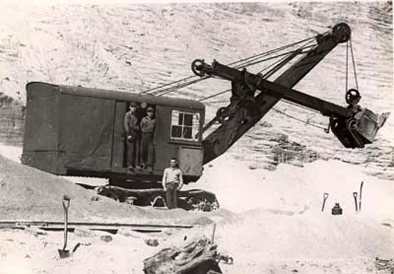
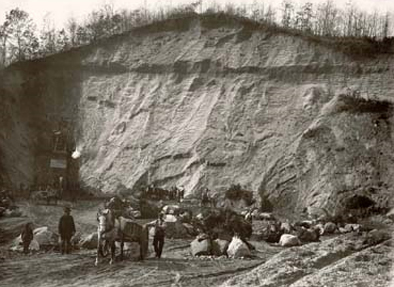 In 1865, mining began on the northern shore of Long Island, to collect sand washed out from retreating ice age glaciers. Immigrant workers from Europe, many from Sardinia, others from Poland, Ireland, and Scandinavia, first hauled sand with wheelbarrows; the excavations grew with mechanization, and eventually the cliffs and the landscape were levelled. Port Washington, and the peninsula jutting out into Long Island Sound only seventeen miles east of Manhattan, was the center of the business, as endless convoys of barges carried the sand to the city’s construction sites. At the peak of production, the equivalent of fifty dump truck loads of sand left every hour, filling fifty barges a day. The last sandpit closed in the 1990s, by which time more than 200 million tons of sand had been excavated to build the city—bridges, highways, the Empire State Building, the Chrysler Building, and the World Trade Center. The sand, typical of that left behind by the brutality of the glaciers, was poorly sorted, containing a range of grain sizes that packed together very effectively to
 .
.
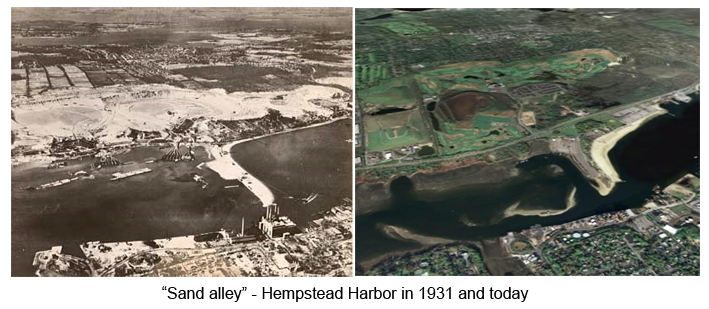
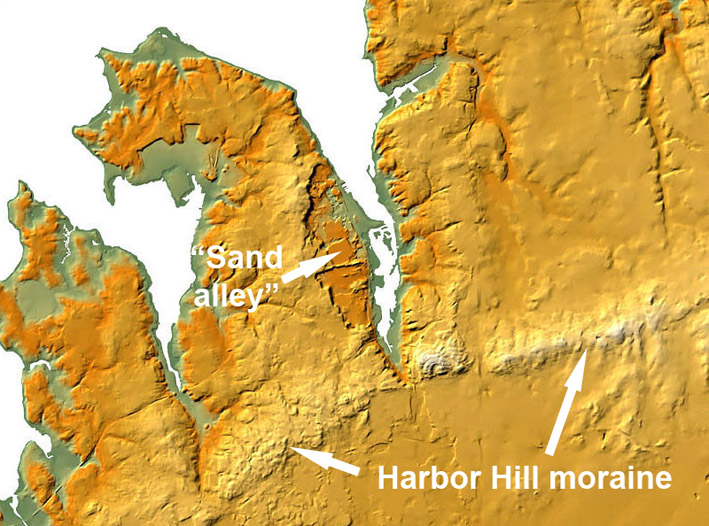
The operations were huge, and covered a vast area along the shore known as “sand alley.” Today, much of the land has been rehabilitated and it would be difficult to sense the scale of the mining history (see the images below); inevitably, a number of golf courses now occupy the sites of the old sand mines where movie companies used to come to film desert scenes. But sandbanks choke the harbor and the effect on the topography will last a long time. Dr J. Bret Bennington, at Hofstra University on Long Island, has used digital elevation mapping to reconstruct the comings and goings (mainly the goings) of the glaciers and the map images are available on his website - see http://people.hofstra.edu/J_B_Bennington/research/long_island/li.html. Look carefully at these, and the scar of the “sand alley” on the eastern side of the Port Washington Peninsula is dramatically visible (image below).
But to return to the people. At the height of the industry, there were dozens of companies and thousands of workers - and their families. It was hard and dangerous work - loosely consolidated granular materials behaving as they do, there were many collapses and cave-ins of the work face, burying the sandminers. The history of the Long Island sandminers and their communities is an extraordinary one. Many retired workers still live in the area, some in their 90s, and their oral history, as recorded by Elly Shodell, is a fascinating social document. And they are finally getting a memorial.
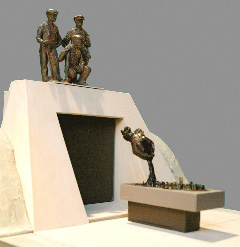
The idea of honoring the sandminers, the immigrant community who built New York, and their industry, originated ten years ago, and resulted in the forming of the Sandminers Monument Group (http://www.sandminers.com/index.html). Thanks largely to private donations, the idea has turned into reality and, last August, the ground was broken for the memorial around the last remaining shaft entrance. The monument will be by sculptor Edward Jonas, and will feature a group of sandminers and a hand pouring sand into New York City. Fitting indeed.
The story is told of the Italian immigrant in the late 1800s in New York who learned three things on arrival: "First, the streets aren’t paved with gold. Second, they aren’t paved at all. And third, you’re expected to pave them.‘’
[photographs from the Sandmining History Project, Port Washington Public Library (New York), Local History Center; satellite image from Google Earth. See also, from the New York Times, "Creating a Tribute to Men and a Mine, http://www.nytimes.com/2008/08/24/nyregion/nyregionspecial2/24peopleli.html]
Comments
Great blog, you’ve shown the almost complete detail of your article. That’s really nice. Thank you for a very excellent posting.