The posts this week have been celebrating Charles Darwin as a geologist and have therefore been a slight excursion from the underlying theme of this blog. But, inevitably, Darwin draws me back to my topic. Of course, in the course of his travels with the Beagle, he encountered and described sand bars, dunes, spits, hillocks, plains, and beaches, but among the large and eternally absorbing collections of his writing, I found, to my delight, items which link directly to subjects of my earlier posts - antlions and geowriting - and one that will, undoubtedly, be the subject of a later piece - booming and chirping sands. First, geowriting. I had sought ideas on geologists who write entertainingly on their subject, who convey some of the passion of the science - and Darwin was arguably one of those. The man was an enthusiast, filled with constant curiosity which fired a desire to ask the right questions and discover the right answers:
There is nothing like geology; the pleasure of the first days partridge shooting or first days hunting cannot be compared to finding a fine group of fossil bones, which tell their story of former times with almost a living tongue.
His ideas on the development of the Andes were radical, but well-founded on observation, documented in a delightful and compellingly readable way. Read - and enjoy - the following, from a letter to his sister, Susan in 1835:
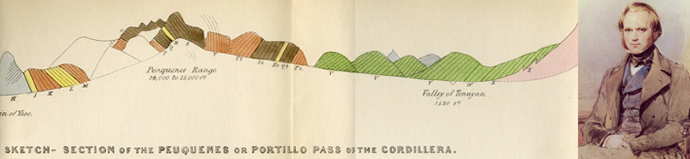
I returned a week ago from my excursion across the Andes to Mendoza. Since leaving England I have never made so successful a journey: it has however been very expensive: I am sure my Father would not regret it, if he could know how deeply I have enjoyed it.— it was something more than enjoyment: I cannot express the delight, which I felt at such a famous winding up of all my geology in S.— America.— I literally could hardly sleep at nights for thinking over my days work.— The scenery was so new & so majestic: every thing at an elevation of 12000 ft. bears so different an aspect, from that in a lower country.— I have seen many views more beautiful but none with so strongly marked a character. To a geologist also there are such manifest proofs of excessive violence, the strata of the highest pinnacles are tossed about like the crust of a broken pie. I crossed by the Portillo pass, which at this time of year is apt to be dangerous, so could not afford to delay there; after staying a day in the stupid town of Mendoza I began my return by Uspallata, which I did very leisurely.— My whole trip only took up 22 days.— I travelled with, for me, uncommon comfort, as I carried a bed!: my party consisted of two Peons & 10 mules, two of which were with baggage or rather food, in case of being snowed up.— Every thing however favoured me, not even a speck of this years Snow had fallen on the road.—
I do not suppose, any of you can be much interested in Geological details, but I will just mention my principal, results: beside understanding to a certain extent, the description & manner of the force, which has elevated this great line of mountains, I can clearly demonstrate, that one part of the double line is of a age long posterior to the other. In the more ancient line, which is the true chain of the Andes.—I can describe the sort & order of the rocks which compose it. These are chiefly remarkable by containing a bed of Gypsum nearly 2000 ft thick: a quantity of this substance I should think unparalleled in the world. What is of much greater consequence, I have procured fossil shells (from an elevation of 12000 ft) I think an examination of these will give an approximate age to these mountains as compared to the Strata of Europe: In the other line of the Cordilleras there is a strong presumption (in my own mind conviction) that the enormous mass of mountains, the peaks of which rise to 13 & 14000 ft are so very modern as to be contemporaneous with the plains of Patagonia (or about with upper strata of Isle of Wight): If this result shall be considered as proved it is a very important fact in the theory of the formation of the world.— Because if such wonderful changes have taken place so recently in the crust of the globe, there can be no reason for supposing former epochs of excessive violence.— These modern strata are very remarkable by being threaded with metallic veins of Silver, Gold, Copper &c: hitherto, these have been considered as appertaining to older formations. In these same beds (& close to a Gold mine) I found a clump of petrified trees, standing upright, with the layers of fine Sandstone deposited round them, bearing the impression of their bark. These trees are covered by other Sandstones & streams of Lava to the thickness of several thousand feet. These rocks have been deposited beneath water, yet it is clear the spot where the trees grew, must once have been above the level of the sea, so that it is certain the land must have been depressed by at least as many thousand feet, as the superincumbent subaqueous deposits are thick.— But I am afraid you will tell me, I am prosy with my geological descriptions & theories.
The image at the head of this post is from his cross-section of the Andes constructed after this trip. Elsewhere in Chile, Darwin encountered tales of that extraordinary phenomenon that is found in arid regions the world over - sands that make noises. The repertoire is hugely varied and the science controversial, but “dune tunes” (“the sand of music”) are certainly bizarre:
We gladly travelled down the valley to our former night’s lodging, and thence to near the Agua amarga. On July 1st we reached the valley of Copiapô. The smell of the fresh clover was quite delightful, after the scentless air of the dry sterile Despoblado. Whilst staying in the town I heard an account from several of the inhabitants, of a hill in the neighbourhood which they called “El Bramador,”—the roarer or bellower. I did not at the time pay sufficient attention to the account; but, as far as I understood, the hill was covered by sand, and the noise was produced only when people, by ascending it, put the sand in motion. The same circumstances are described in detail on the authority of Seetzen and Ehrenberg, as the cause of the sounds which have been heard by many travellers on Mount Sinai near the Red Sea. One person with whom I conversed, had himself heard the noise; he described it as very surprising; and he distinctly stated that, although he could not understand how it was caused, yet it was necessary to set the sand rolling down the acclivity. A horse walking over dry and coarse sand, causes a peculiar chirping noise from the friction of the particles; a circumstance which I several times noticed on the coast of Brazil.
On the return journey, the Beagle paused in New South Wales, and Darwin took time to relax and contemplate:
A little time before this I had been lying on a sunny bank, and was reflecting on the strange character of the animals of this country as compared with the rest of the world. An unbeliever in every thing beyond his own reason might exclaim, “Two distinct Creators must have been at work; their object, however, has been the same, and certainly the end in each case is complete.” While thus thinking, I observed the hollow conical pitfall of the lion-ant: first a fly fell down the treacherous slope and immediately disappeared; then came a large but unwary ant; its struggles to escape being very violent, those curious little jets of sand, described by Kirby as being flirted by the insects tail, were promptly directed against the expected victim. But the ant enjoyed a better fate than the fly, and escaped the fatal jaws which lay concealed at the base of the conical hollow. There can be no doubt but that this predacious larva belongs to the same genus with the European kind, though to a different species. Now what would the sceptic say to this? Would any two workmen ever have hit upon so beautiful, so simple, and yet so artificial a contrivance? It cannot be thought so: one Hand has surely worked throughout the universe.
Little had I realized that the humble antlion played a role in the evolution of Darwin’s thinking.
And there I will leave Darwin - except for one final comment. Darwin used capital letters in what, today, would be an idiosyncratic fashion. The “one Hand” that Darwin saw working throughout the universe was the hand of natural selection.
[more on the antlion in “From Bogart to Bugs - the Angle of Repose,” my 7 February post. For further references on Darwin, see earlier posts in this series, and for a comprehensive look at Charles Darwin, Geologist, see Sandra Herbert’s book of that title - http://www.cornellpress.cornell.edu/cup_detail.taf?ti_id=4296]
Comments
Well, I’m going to try this again! I just wanted to note that this is a great series on Darwin, and I was thinking, right before you posted this article, that it was quite an excursion from your regular sand-related subjects – when, you suddenly bring Darwin back around to sand - and to our friend the antlion or doodlebug! Quite elegant, really.
Thanks Michael for your excellent series on Darwin, another part of the abundance of discussion and essays, that has populated the internet the last week or so. Some of it attracting the inevitable controversy and obstinate denial from those who refuse to learn about and appreciate the awe and wonder there is in this deeper understanding of how nature operates.
It always puzzles(and frustrates)me why evolution is so repugnant and threatening to so many in our modern world. Evolutionary biology is based on the same foundational methodology that the other scientific disciplines use in providing us with the technological benefits we use daily yet it is seen my some as a intellectual fallacy and or a atheistic plot to subvert our children. To me evolution inspires a sobering humility when pondering how much nearly incomprehensible time and process has transpired in this universe and strongly re-inforces the inescapeable truth that all life is intimately connected.
I’m coming to this a bit late, but a superb series. someone on the internet, I forgot who, make the important point that Darwin’s greatest strength as a scientist was that he was a lateral thinker par excellence. Geology and economics played a big role in his biological theory.