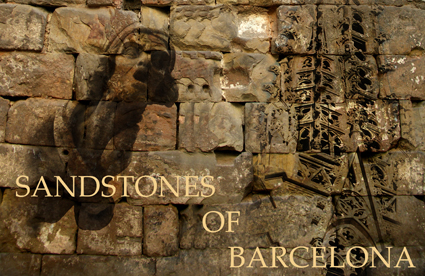
Two hills form the backdrop to the great city of Barcelona. To the southwest, overlooking the Mediterranean and the port, is Montjuic (the name ends in a “tch” sound in Catalan), a landscape that has played a role throughout the city’s history. It is the site of a Roman temple, an 18th century castle, the International Exhibition of 1929, many of the sites of the 1992 Olympics, and a vast cemetery containing not only the tombs of the rich and famous but also countless unmarked graves of those executed in the castle. But the hill is not what it once was, for Montjuic built Barcelona.
Twelve million years ago, the Mediterranean was taking on much of the shape it has today, still battered by the continuing tectonic turbulence of Africa’s repetitive sumo bouts with Europe. Sea levels were dropping, and it would not be long, geologically speaking, before the Mediterranean became isolated from the Atlantic and, literally, dried up. Rivers were working tirelessly at the erosion of uplands old and new, pouring gravel, sand, and mud down to the ever-shifting coast. A great delta formed close to where Barcelona is today, its sediments eventually heaved up to form the mass of Montjuic. The sands, although never buried very deeply, were nevertheless thoroughly cemented together with silica, turning them into tough and durable sandstones - and an ideal building and sculpting material.
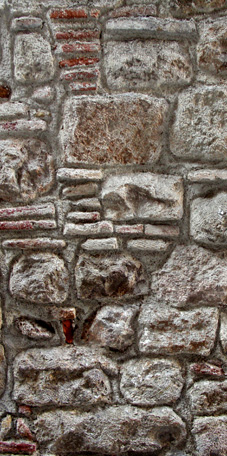 . Wandering around, as I recently had the pleasure of doing, brings into focus the materials of the city, and the ubiquity of the Montjuic sandstone. The Montjuic forms the walls of every street and alley in the old quarter, rough-hewn and irregular or finished and smooth, sometimes crumbling, sometimes fresh, browns, greys, purples, reds, oranges; its rough granularity becomes familiar to the hand and eye, solid, enduring, comforting. Look closely at the stones, and they reveal their tempestuous origins as rivers ripped through the ancient landscapes - they contain a wide variety of grains of all sizes and shapes, and grains made not only of quartz, but also rock fragments, granite, quartzite, the occasional glittering micas. The rivers had little time to bother with winnowing and sorting; they simply picked up their cargo, transported it, and dumped it.
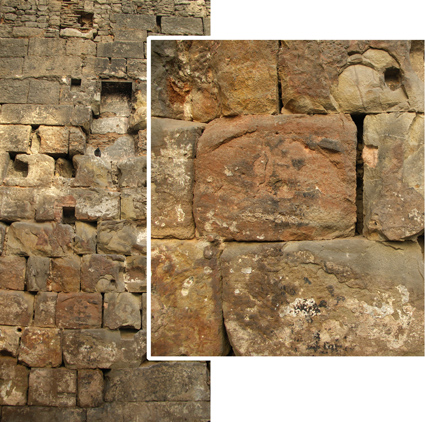
Venture below the historical museum in the medieval town and you enter an extraordinary other world - Roman Barcelona, now a couple of meters below street level, laid out before your eyes. Houses, temples, wine-making, dyeing, fish-processing works, walls, drains, and doorways, all constructed from Montjuic sandstone. Over the centuries, as new building was undertaken on top of, or in place of, the old, the valuable stone blocks would be reused, huge stones carved with Latin inscriptions lying on their side, incorporated in a later wall. Outside, the Roman city wall, built against the invading Franks and, later, unsuccessfully, against the Visigoths, formed the base of what would continue to be the walls of Barcelona, still today towering testaments to the fortitude of the Montjuic sandstone (below).
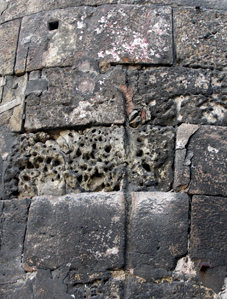
And, as if to echo my earlier post, there are even tafoni to be seen in the old city walls.
Old Barcelona has two great churches, the cathedral and the only slightly smaller Santa Maria del Mar: both are built of Montjuic sandstone. Santa Maria del Mar (Saint Mary of the Sea) was originally known as Santa Maria de les Arenes, Saint Mary of the Sands. It was built, in the astonishingly short period between 1329 and 1383, by the inspiration of a stonemason, Berenguer de Montagut, who personally chose, fitted, and carved every stone hauled from the Montjuic quarries. Today Santa Maria is a gloriously simple church, the soaring dimensions of the stone hardly hidden - but this is the aesthetic result of vandalism on an appalling scale. In 1936, anarchists burned the church, along with many others in Barcelona; the ornamentation of the interior interior was destroyed and the building itself barely survived. It was restored after the civil war by architects of the Bauhaus school who celebrated the simple magnificence of the original design.
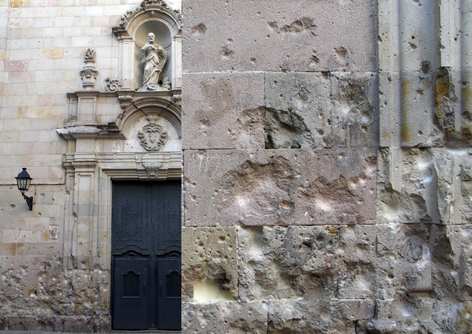
In a small, almost entirely enclosed and peaceful square, not far from the cathedral, the Montjuic stones of a small church have been blasted, pockmarked, disfigured by violent impacts. The guidebooks will tell you that this is damage from a civil war bomb, but the locals will describe how this hidden away place was a favourite for firing squads. Above human height, the walls are untouched.
The quarries on Montjuic have long been closed with the result that the building stones have been recycled even more. But one of the quarries had a gruesome role in the brutal history of the civil war. The bodies of thousands of those executed by Franco’s regime were buried in a communal grave in the quarry; in 1986, the site was converted into a memorial garden, the Fossar de la Pedrera or Cemetery of the Quarry.
In the art nouveau modernista quarter of Barcelona is the house regarded as Gaudi’s greatest contribution to civic architecture, Casa Mila. The house quickly gained its popular name, La Pedrera, because it was perceived as resembling a quarry - but more of that, and Gaudi’s works, in the next post.
Comments
Michael,
Wow! Sounds like a great place to visit, and I love the image of sumo wrestling continents. Thanks for the post.
Cheers,
David
Intriging and historic(some tragic)“stories in stone” of world class cities.
During a US Navy “Med” cruise in the late 1970’s, I spent almost two weeks during the Christmas holidays in Barcelona and loved it’s charm, walking down the Las Ramblas,the old architecture and the delicious paella! I also saw the interesting geology and abby at Montserrat. I was not aware though of the sad story behind some of the damaged churches in the city. I was recently looking at some of my old photos and the images reminded me of how family oriented the people were at that time with children, parents and grandparents filling the streets and parks.
There was a lot of warm,rich earth colors and chiaroscuro elements in the street scences and walls of sandstone(a distinction of rock nomenclature, I was not really aware of at the time!)as a result of the low position of the winter sun. I used a higher ASA rated color film which gave the images sort of soft focus graininess,also due to the low light. Good memories. Thanks Micheal for the geological travelogue.
Seems like the topic of Spain has been popping up often for me lately. Recently, I have watched some episodes of the food and travel show called “Spain,On the Road Again” on the cable network Create TV and would love to go back to some rustic and scenic areas I have not seen like Galicia. The diverse food and ambience is enticing also!
Jules - I completely agree. Barcelona is a very atmospheric city and one with endless discoveries to be made. Turn every corner, and there’s something new and different, look up and the sensation is repeated. Add the hustle and bustle of Barcelonans, the terrific food (and wines), and the variety of unique little shops, and it’s a random wanderer’s paradise. I definitely have to go back. And then, of course, there’s the contrast between the old town and the modernist quarter, the strange and fascinating works of Gaudi - but more of that later.
Thanks for the comment!
Thanks for the information. Very interesting. Do you know the name of the Square where the bullet holes are? I am travelling to el Escorial and Belchite before flying back from Barcelona in Novmber. I would like to visit Montjuic whilst I am there.
Best wishes
Geoff
Geoff - thanks for the comment and apologies for the delay in responding - I’m travelling again and have been unconnected for a few days.
The square is the Plaza de San Felipe Neri (Plaça Sant Felip Neri in Catalan.
If you shed any further light on the true story, let me know!
Enjoy your travels
Michael