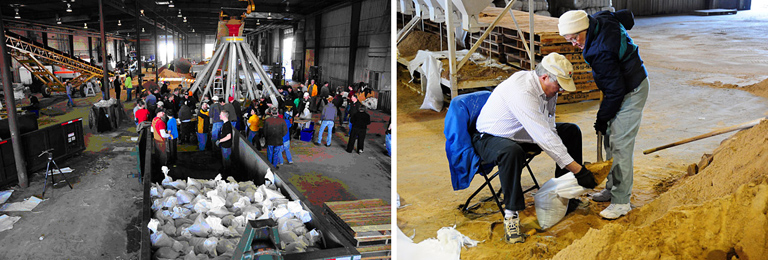
Last Sunday was World Water Day, highlighting the global issues associated with this precious resource. But one of those issues is, as with all natural resources, its distribution, and for the residents of the Red River Valley it’s a case of definitely too much of a good thing, battling as they are against rising flood waters. As I write this, predictions are varying, but the river, along the border between North Dakota and Minnesota and northward to Winnipeg (it’s sometimes referred to as the Red River of the North to distinguish it from the Texan one), is likely to crest up to 20 feet above flood level over the next few days. The residents of Fargo need to fill two million sandbags. It is, so to speak, all hands to the pump, with volunteers coming from all sections of the community - people who have delinquent fines or outstanding arrest warrants have been given a chance to get them withdrawn if they sign up for sandbag duty. Three “spider machines,” shown in the photo at left, above, have been set up to fill sandbags at a rate of 5,000 each every hour, but much of the effort still relies on traditional methods (photo right, above).
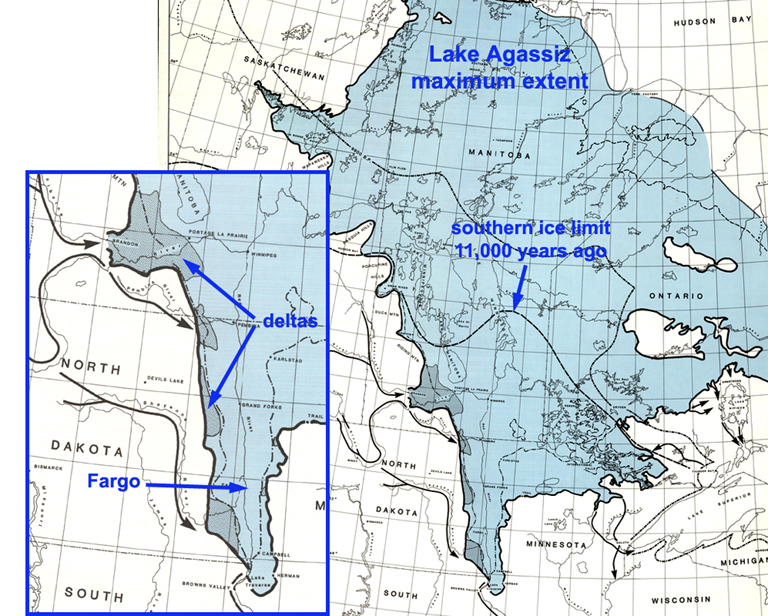
There is geological irony here, for the circumstances that make the valley prone to disastrous flooding (the 1997 inundation caused $3.5 billion in damages and required large-scale evacuation) also provide the sand for the sandbags. During the ice ages, glaciers marauded ponderously across North Dakota and Minnesota, scouring and sculpting the landscape and leaving vast swathes of geological debris in their wake. As they retreated and rivers (amongst them, the Red of the North) re-established their courses, a huge lake built up in front of the ice - Lake Agassiz, named for the great Swiss-American geologist who deciphered the stories of glaciation. The map below shows the maximum regional extent of the waters of the lake - they never covered the entire area shown at one time, but the position of the lake shifted as the ice retreated. Today’s Red River follows the western shoreline of the lake, and its wide flat valley reflects its origins as as an ancient lake floor. Rivers reworked the glacial sediments and poured huge volumes of sand and gravel into the lake; along the shoreline, deltas, beaches, and shallow water sandbars formed that today provide, among many other things, the filling for the sandbags.
President Obama has declared North Dakota a federal disaster area - let’s all hope that, for the communities of the Red River Valley, sand prevents the worst.
[sandbagging photos from http://minnesota.publicradio.org/display/web/2009/03/20/fargo_dikes/; Lake Agassiz map from the Geological Association of Canada, available from the University of Manitoba Libraries Map Collection, http://www.flickr.com/photos/manitobamaps/2091302531/in/set-72157603391175172/. For a good summary of Lake Agassiz, see the North Dakota Geological Survey document at https://www.dmr.nd.gov/ndgs/ndnotes/Agassiz/Lake%20Agassiz.asp]
Comments
No comments yet.