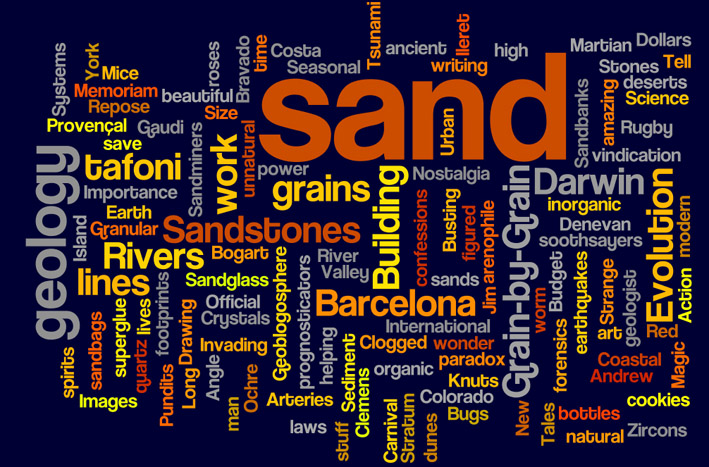
A brief break from my normally arenaceous topics to pause and reflect on the first four months of this blog. I’ve just finished a total of fifty posts - not exactly a frenetic rate, I know, but a landmark for me nevertheless. And while Through the Sandglass occupies a sort of blogoplanet of its own in terms both of its subject matter and the modest number of visitors compared to much of the rest of the blogosphere, it has developed a truly international reach. I have very much enjoyed it, learnt a lot myself along the way, and “met” all sorts of interesting people; I’m grateful to the regular visitors and commentators and look forward to the growth of this devoted band.
For anyone who happens upon this blog and is looking for a sense of what it’s about, here is a short list of posts that I particularly like, a sort of top eleven which, I hope, illustrate the intended diversity of topics (the celebratory wordle above includes the majority of key words):
- Evolution - organic and inorganic
- Sand, Earth Systems, and the Importance of Size
- Grain-by-Grain (1): worm superglue
- Grain-by-Grain (2): the amazing sand bottles of Andrew Clemens
- The man who figured out how deserts work
- Of Mice and Sand - Evolution in Action
- Building New York - the Long Island Sandminers
- From Bogart to Bugs - the Angle of Repose
- Magic Crystals - Tales Zircons Tell
- tafoni
- Sandstones of Barcelona (2): Gaudi (and tafoni again)
And, on a light-hearted note, there’s been another “meme” around the geoblogosphere over the last week - depictions of what a “fully-equipped field geologist” looks like. Started by The Lost Geologist with contributions from all kinds of sources, including Hypo-Theses, Nologic, Pools and Riffles, Looking for Detachment, and others from the blogroll on the right. So here’s my - distinctly archival - contribution to illustrate other necessities.
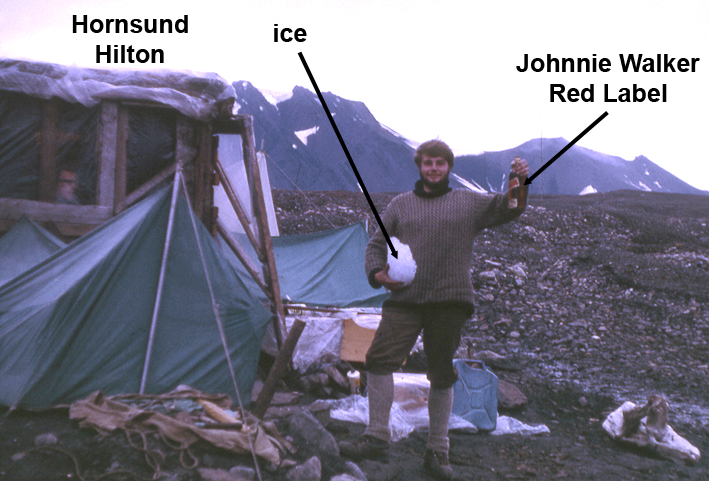
Perhaps a few words of explanation are needed. This was 1967, the first of two seasons of undergraduate fieldwork in the Arctic - Spitsbergen, or Svalbard, to be exact. The Cambridge expeditions were famous and famously frugal - the tents were named after Nansen and seemed to date from not long after him. The solution was to gather driftwood and pieces of blown-down trappers’ huts (including a stove) and rig up a communal shelter, the Hornsund Hilton. The Johnnie Walker scotch was the single bottle issued for the season, so its opening was an event - I discovered that sea ice still contains salt. There were, of course, other items of field equipment, including a rifle and a radio - but the generator blew up and we spent the entire summer out of contact with anybody. But now I’m in danger of launching into my series of “Welland of the Pole” stories that my wife so enjoys…
[a couple of years ago, Geoexpro had a piece on geotourism in Hornsund and kindly published a short historical piece I submitted - read more here if you wish]
Comments
I love the sandy wordle, and the well-equipped geologist photo. No one else has shown a picture of geologist with beer or liquor in hand! I didn’t know sea ice still has salt in it. A useful thing to know, if only for trivia-type conversations, if not for survival. Never tried tasting any.
Awesome. Congrats on 50 excellent posts!
What’s up with the legwarmer things in that photo? Do people still use that attire in Arctic exploration today?
Thanks Callan - the woolly things are actually long socks, worn inside another pair of short wool socks and extending above the knee so that they can be secured within the climbing “britches” (as they used to be called). This would certainly rank in the “costume drama” category these days, a remake of Shackleton perhaps - but it was over 40 years ago, I was an impoverished undergraduate, and the entire expedition was a “string and sealing-wax” affair - but we lived and the geology was fantastic.
Hi Silver Fox - yes, the salt was a surprise, and it detracted from the first swig! It’s not, of course, that alcohol is essential for fieldwork, but it does seem to feature quite commonly.
Congratulations Michael on the success of your blog and much thanks for providing us with your simulating essays that can lead to so many other places of interest on the web and in books.
Great photo from your past.
Thanks again, Jules!