Rivers are vital but also complex and dynamic systems - vital for the planet and vital for us. Civilization has always had an intimate relationship with rivers. They provide habitable areas, transportation and communication routes, food, power, and constantly replenished agricultural land. But river systems in their natural state are sensitive to slight changes in climate and sea level and change their courses routinely - when we interfere with this, things become even more complex and unpredictable and the course of history, as well as that of a river, can be changed.
I have just spent a very enjoyable couple of days in around the city of Narbonne, on the Mediterranean coast of France between the mouth of the Rhone and the Pyrenees. It was enjoyable in many ways - Roman history, great wines, mountain and coastal landscapes, excellent food. I had with me, for occasional reading, the March issue of Earth magazine, in which there is a fascinating article on the work of Franklin and Marshall College geologists Dorothy Merritts and Robert Walter. “Rewriting Rivers - did we get it wrong and what might that mean for river restoration?” underlines the complexity of river systems, and how much, putting aside conventional wisdom, we actually don’t know about them. The behaviours, geomorphology, and sedimentology of Countless rivers in the eastern US are controlled by the history of dam building. By 1840, more than 65,000 mills had been built, each with a dam and a millpond collecting sand and silt. After the dams are removed, it is those “legacy sediments” that influence the river’s development. The pre-settlement sediments tell a very different story of the river systems - and one that does not necessarily fit with conventional wisdom. And around Narbonne, I found myself in the midst of another historical drama of man and rivers.
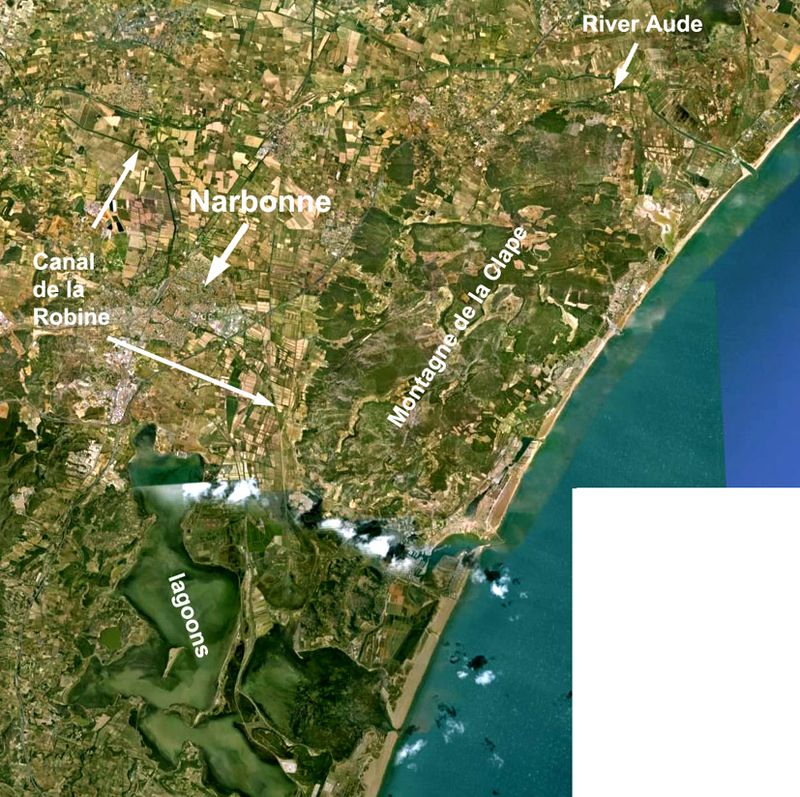
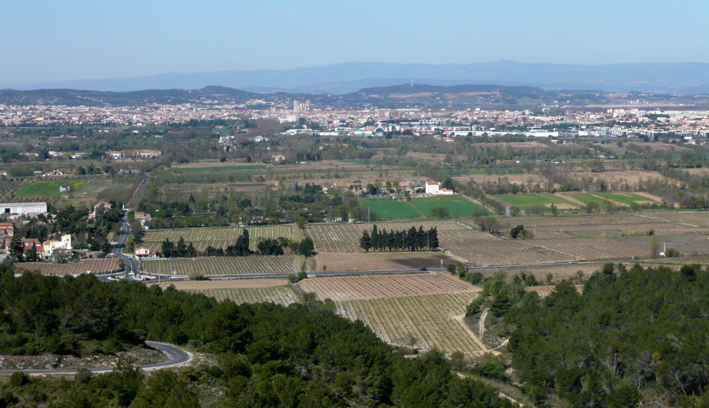
To the east, between the city and the coast, is the limestone massif of the Montagne de la Clape (please resist any temptation to indulge in sophomoric humour). The photo at the beginning was taken from there, looking back towards Narbonne in the distance, the great bulk of its unfinished cathedral visible against the dark hills of the Corbieres. The massif is rugged and dry, a fault-bounded up-thrown block that hosts what are reputed to be the hottest and driest vineyards in France - but the gnarled and dessicated-looking vines thrive in this terroir, and produce some wonderful syrah-rich wines. If, however, the view from this spot was that of eight hundred years ago it would have been dramatically different - I would have been standing on an island and looking east across the shallow waters of a branch of the Mediterranean, and Narbonne would have been a commercially thriving port. It had indeed been a port since its glory days as the major capital of the Roman Empire west of Rome, at the crossroads of major Roman roads (a section of the Via Domitia can be seen today, eerily and evocatively, in the town square). It exported to the Empire linen, hemp, oil, wood, pottery, cheeses and meat - and, yes, of course, wine. Building stones from all parts of the Empire were shipped into the harbour to build the great city. The port was at the northern end of a branch of the sea where the River Aude then emptied into the bay - but the Montagne de la Clape was not an island - another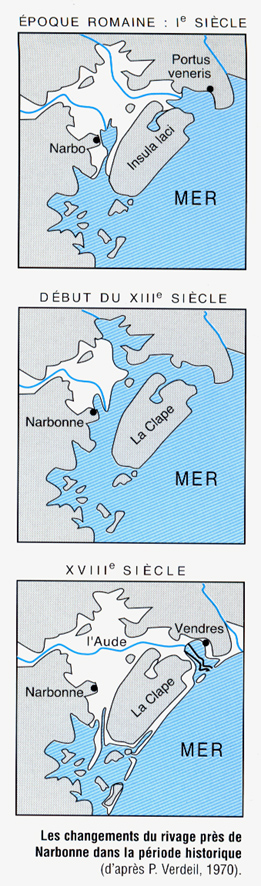 .
.
But the good times were coming to an end. To compound the effects of the Black Death, the assaults of England’s Black Prince, and the expulsion of the flourishing Jewish community, Narbonne suffered a natural disaster - the Aude shifted again. The harbour was filled with silt and sand, and sand bars blocked off the southern branch of the sea, forming the lagoons we see today. The main branch of the Aude chose the northern route, emptying into the Mediterranean north of la Clape and supplying the volumes of sand that were swept down the coast to form today’s tourist beaches, and the spits and sandbars that continue to block the lagoons. Narbonne sank into terminal decline.
By the late seventeenth century, commerce to the north was being resuscitated by the completion of the Canal du Midi, the extraordinary feat of engineering that linked the Atlantic with the Mediterranean. This was immediately followed by an attempt by Narbonne to plug itself back into the communications network, and the Canal de la Robine was constructed, following an abandoned course of the Aude, to link northward into the Canal du Midi system. But this conspiracy of the Aude’s natural options with the complexities of the canals linking with the river and each other, permanently changed the sediment budget for the region. The lagoons became increasingly isolated from the sea and the Canal de la Robine was extended southwards through the sand barriers to provide a link with the Mediterranean. The lagoons provided an ideal setting for the salt industry that continues today.
When I took the photo that heads this article, I studied the local topographic map, one of the superb 1:25,000 series that the Institute Géographique National produces. In the fields and vineyards that today fill the middle distance, the site of the old branch of the Mediterranean, local names still record, for example, the Ancien Étang du Cercle (“étang” is a lagoon), and l’Étang Salin - names that come down to us through history recording dramatic changes to the landscape that occurred, not in geological time, but our time.
[maps from Géologie du Languedoc-Roussillon, Jean-Claude Bousquet, BRGM, France]
Comments
nice piece of history and geology. I often think there is a false dichotomy between what we perceive as geological time and our time. geological processes occur on the scale of seconds, minutes, weeks, centuries. the problem is one of preservation and resolution, we usually end up seeing a time averaged sample.
but examples like these I think should make us aware that geological time is also our time.