Darwin and Lyell
**
**
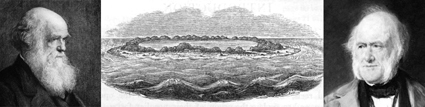
Today is the 200th anniversary of Darwin’s birth. It may have been Sedgwick who gave Darwin his crash course in geology, but it was Charles Lyell who was to become Darwin’s close geological companion, mentor, and champion, and so I have selected some choice quotations for a joint celebration. Darwin had taken Lyell’s Principles of Geology with him on the Beagle and the two men were to share radical views of how the earth works - together, they revolutionised science and our understanding of our planet - and ourselves.
In 1844, Darwin wrote:
I always feel as if my books came half out of Lyell’s brains & that I never acknowledge this sufficiently, nor do I know how I can, without saying so in so many words—for I have always thought that the great merit of the Principles, was that it altered the whole tone of one’s mind & therefore that when seeing a thing never seen by Lyell, one yet saw it partially through his eyes
In 1838, Lyell sent Darwin an early copy of his Elements of Geology or the Ancient Changes of the Earth and its Inhabitants as Illustrated by Geological Monuments. Darwin wrote immediately to Lyell:
My dear Lyell
I did not write to you at Norwich for I thought I should have more to say, if I waited a few more days.— Very many thanks for the present of your elements, which I received, (& I believe the very first copy distributed) together with your note.— I have read it through every word & am full of admiration of it.— as I now see no geologist I must talk to you about it. There is no pleasure in reading a book if one cannot have a good talk over it.— I repeat I am full of admiration at it.— it is as clear as daylight,—in fact I felt in many parts some mortification at thinking, how geologists have laboured & struggled at proving what seems, as you have put it, so evidently probable.— I read with much interest your sketch of the secondary deposits.— you have contrived to make it quite “juicy”, as we used to say as children of a good story.— There was also much new to me, & I have to copy out some fifty notes & references. It must do good;—the hereticks against common sense must yield— Phillips will not surely go on saying that the metamorphic schists are disintegrated granite redeposited. By the way do you recollect my telling you, how much I disliked the manner Phillips referred to his other works, as much as to say, “you must, ought & shall buy everything I have written”. To my mind, you have somehow quite avoided this.— your references only seem to say “I cant tell you all in this work, else I would, so you must go to the Principle,” & many a one, I trust, you will send there, & make them like me adorers of the good science of rock-breaking. You see I am in a fit of enthusiasm; & good cause I have to be, when I find, you have made such infinitely more use of my journal than I could have anticipated. I will say no more about the book, for it is all praise.— I must, however, admire the elaborate honesty with which you quote the words of all living & dead geologists.
The two men were to collaborate on the successive editions of Lyell’s Principles; the index of my own edition, the ninth, published in 1853, contains nineteen references to “Darwin, Mr. C.”, ranging from “on vegetation required for support of large quadrupeds” to “on extinction of animals,” via earthquakes, South American drought, “oolitic travertin,” and, of course, coral islands. The book contains several pages on the last topic, essentially all describing Darwin’s work and quoting him directly. In 1837, Lyell had written to Darwin:
I could think of nothing for days after your lesson on coral reefs, but of the top of submerged continents. It is all true, but do not flatter youself that you will be believed, till you are growing bald, like me, with hard work & vexation at the incredulity in the world.
Lyell would be one of the great supporters of The Origin of Species, defending Darwin and incorporating natural selection into later editions of his books. In November 1859, Darwin wrote to his old friend:
My dear Lyell
You seem to have worked admirably on species-question: there could not have been better plan than reading up on opposed side. I rejoice profoundly that you intend admitting doctrine of modification in your new Edition.Nothing, I am convinced, could be more important for its success. I honour you most sincerely:—to have maintained, in the position of a master, one side of a question for 30 years & then deliberately give it up, is a fact, to which I much doubt whether the records of science offer a parallel. For myself, also, I rejoice profoundly; for thinking of the many cases of men pursuing an illusion for years, often & often a cold shudder has run through me & I have asked myself whether I may not have devoted my life to a phantasy. Now I look at it as morally impossible that investigators of truth like you & Hooker can be wholly wrong; & therefore I feel that I may rest in peace.
Thank you for criticisms, which, if there be 2d. Edit. I will attend to.I have been thinking that if I am much execrated as atheist &c, whether the admission of doctrine of natural Selection could injure your Works; but I hope & think not; for as far as I can remember the virulence of bigotry is expended on first offender, & those who adopt his views are only pitied, as deluded, by the wise & cheerful bigots.
I won’t comment on the continuing resonance of those words 150 years later. Rather, I shall end with a quotation which some readers may find amusing, others perhaps not, but it illustrates the human side of the two men. In January 1839, Charles wrote to Emma Wedgwood shortly before their wedding:
…it will give you hopes, that I shall gradually grow less of a brute, it is that during the five years of my voyage (& indeed I may add these two last) which from the active manner in which they have been passed, may be said to be the commencement of my real life, the whole of my pleasure was derived, from what passed in my mind, whilst admiring views by myself, travelling across the wild desserts or glorious forests, or pacing the deck of the poor little Beagle at night.Excuse this much egotism,I give it you, because, I think you will humanize me, & soon teach me there is greater happiness, than building theories, & accumulating facts in silence & solitude.
…The Lyells called on me to day after church; as Lyell was so full of Geology, he was obliged to disgorge, & I dine there on Tuesday, for an especial conference. I was quite ashamed of myself to day; for we talked for half an hour, unsophisticated geology, with poor Mrs Lyell sitting by, a monument of patience. I want [lack] practice in illtreating the female sex.I did not observe Lyell had any compunction: I hope to harden my conscience in time: few husbands seem to find it difficult to effect this.
Comments
No comments yet.