The Urban Stratum is the provocative stratigraphic name that Jan Zalasiewicz gives to our remains in The Earth After Us - What legacy will humans leave in the rocks? Perhaps reflecting the current global issues that cause us to contemplate our mortality and vulnerability as a species, there are several books around (Year Million, The World Without Us) that focus on the post-human earth. However, this one is written by a geologist, a paleontologist and stratigrapher, and it perhaps addresses the question I raised in the earlier post on science writing by professional geologists (December 29). His perspective is from 100 million years hence - without doubt long post-human. The structure is from the point of view of future geologists/archeologists/anthropologists - re-evolved editions of ourselves or alien, it doesn’t matter - attempting to discern and reconstruct the nature of the species which dominated the planet for a brief time in the distant past. Along the way, there is a highly readable narrative of the methodologies and the trials and tribulations of stratigraphy and paleontology.
To geologists, the fact that this account is a humbling one will come as no surprise, but the poverty of our legacy, thoroughly thought through and documented in the book, is, nevertheless, exactly that. While, in this year of Darwin festivities, the imagery of the “tree of life” is under profound revision, our view of our superiority and dominance at the head of that tree is enduring, the arrogance of our species seemingly in-built (if cockroaches were to construct their tree of life, guess who would be perched at the top). Zalasiewicz cleverly examines our understanding of life 100 million years in the past - and its many limitations - to shed light on how thin, paltry, discontinuous and incomplete the “Urban Stratum” will be. Even if we assume, heroically, that our species will accomplish more than few thousand years on the planet, how thick will the stratum representing that period be in the stratigraphic section of 100 million years hence?
Essentially none of our infrastructure, creations, and artifacts will survive 100 million years of erosion, burial, diagenesis, and tectonics in their original compositional and structural form, and we ourselves, inhabiting the erosional land rather than the depositional marine realms are poor fossil candidates - think of the extent (or lack of it) of the record of our ancestors in the African Rift Valleys. And, given that the final circumstances of personkind may well have led to the mass evacuation of cities, there will be relatively few of us potentially preserved in the arguably more durable cellars, basements, and subways of today’s subsurface levels. And direct evidence of our social structures, our thinking, our arts will be entirely lacking - what, after all, do we really know of the daily life of a dinosaur family? Furthermore, as Zalasiewicz points out, while we may regard the mighty dinosaurs as icons of the Jurassic, there was much more to life at that time and perhaps the future investigators will take a similar view: “They may well regard the myriad tiny invertebrates, or the bacteria of the world as much more important to that (in planetary terms) rare phenomenon, a stable, functional, complex ecosystem. … Take away humans, and the present world would also function quite happily … Take away worms and insects, and things would start seriously to fall apart. Take away bacteria and their yet more ancient cousins, the archaea, and the viruses too, and the world would die.”
Zalasiewicz entertainingly explores the idea that trace fossils, the evidence of creatures’ activities rather than the creatures themselves, will be potentially preservable and informative. The remains of an interstate highway might be fragmented and discontinuous in a future outcrop, but they will have stories to tell. And, an intriguing idea: perhaps the most durable trace fossils will be the thousands of deep oil and gas wells, lined with corrosion-resistant steel and penetrating deep into the geology - equivalents of fodinichnia or domichnia? Trace fossils fall into various classifications, depending on whether they represent tracks, burrows, feeding paths and so on, but all reflect the Greek for a track or a trail, ikhnos. Zalasiewicz proposes a new class: frivolichnia, pleasure traces of movie theatres, baseball diamonds and cricket grounds, museums, libraries, all of which might be completely inexplicable to our future investigators. Given that this blog is primarily about sandy topics, what might be made of the traces of a golf course? Strange, isolated bodies of sand distributed unnaturally in a soil horizon. And I must point out, as the book does, that, while much of our concrete will physically and chemically disintegrate over a hundred million years, the quartz sand grains will endure - because quartz sand grains, more often than not, do.
Overall, it’s a great, beautifully written and thought-provoking book, but, while each chapter is introduced by a fragment from the reports of our future investigators, I found myself wishing that it had concluded with an outright foray into science fiction - a longer selection from those journals, illustrating the challenges and pitfalls involved in the reconstruction of things long gone. What if, for example, the most likely survivors of our artistic efforts would be stone statues (made, as they are, from already long-lasting geological materials)? What if, as a result of differential preservation and the general serendipity of discovery, rather than an idealized human form from classical Greece, our future investigators excavated one of the figures below? How would this influence their other interpretations? Or what if they unearthed a Henry Moore or Salvador Dali statue?
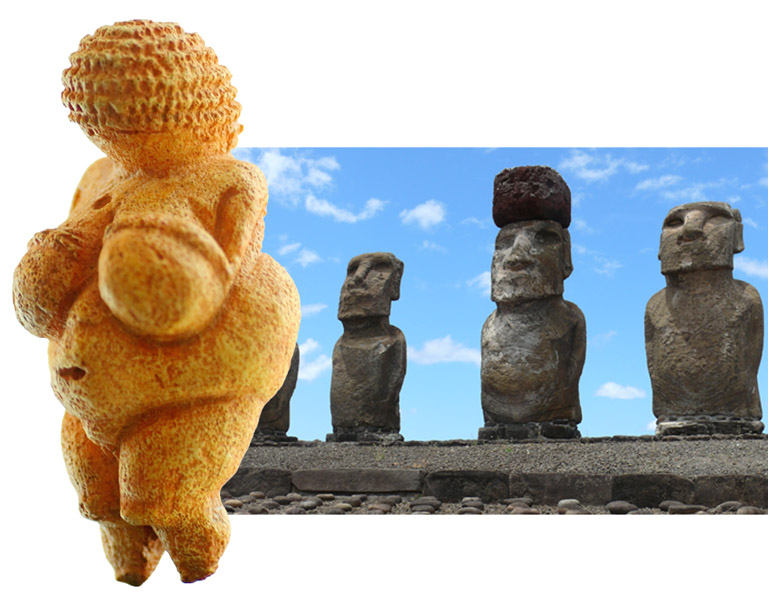
Now that we are firmly in the realm of science fiction, here’s another thought experiment, an opportunity for geological speculation. Plate tectonics will grind to a halt, probably not in the next hundred million years, but eventually. The earth’s engine will seize up, for any number of reasons. Internal radioactive heating will diminish, thickening and immobilising the lithosphere. Or, changes to the atmosphere and the sun’s thermal activity will drive off all water from the planet and the lubrication of plate tectonics will be gone. Or, plate tectonics may cause its own demise, adding sufficient new continental crust that, eventually, there will be no more room for manoeuvre. Or, as Ray Siever pointed out in his book on sand, atmospheric toxicity will kill off land plants, the continents will be rapidly eroded, the oceans will fill up with sand and … Or, any conspiracy of the above.
So, here’s the question, given that our appreciation of plate tectonic processes was a long time coming, difficult, and highly controversial even while their work was going on all around us, in a post plate tectonics world, how would we discern that those processes had ever happened? What would be the evidence revealed to and by geologists of the future that plate motions and plate margin dynamics had sculpted the appearance of our planet? Something to think about as we gaze more closely at other planets?
[images of the Venus of Willendorf and the Easter Island Moais reproduced under creative commons license, thanks to Matthias Kabel and Paweł Drozd. Ray Siever’s Sand, published by the Scientific American Library in 1988, is unfortunately no longer in print. Peter Ward and Donald Brownlee’s The Life and Death of Planet Earth is another good read on this entertaining topic.]


Comments
Thanks Micheal for a very thought provoking post on the future of our species and the planet. I am reading The World Without Us and it is a sobering exploration of what would endure if we suddenly disappeared as well as how nature would re-establish it’s dominance over the the works of humans even if required hundreds of thousands of years,if not more in regards to radioactive materials that were left.
I think(and hope)that humans,out of pressing necessity in this century,will have to learn to better appreciate and protect the so-called “lower” forms and ecological processes of life that have contributed to all other species evolution and without which we could not exist.
Not sure if you intended it as such, but this post would be perfect for inclusion in the upcoming geoblogospheric carnival The Accretionary Wedge,hosted by Clastic Detritus.
http://clasticdetritus.com/2009/01/27/reminder-accretionary-wedge-posts-due-this-friday/
Indeed. Zalasiewicz makes exactly these points in his concluding chapter:
“… conserving living organisms is far more important than conserving fossils…The Earth, in sustaining and harbouring these organisms is by far the most intricate, the most subtle, the most complex and valuable object in space for many, many billions of miles in any direction.”
and, with respect to the Urban Stratum:
“Best to leave as small a message as we can, to impress today’s human footprint as gently as possible into the strata of tomorrow: to diminish, as far as we can, the stratigraphic signal that we leave behind us.”
Well put, I think!
very interesting perspective.
…His perspective is from 100 million years hence - without doubt long post-human. The structure is from the point of view of future geologists/archeologists/anthropologists - re-evolved editions of ourselves or alien, it doesn’t matter - attempting to discern and reconstruct the nature of the species which dominated the planet for a brief time in the distant past.
Reconstructing something that happened 100 million years ago will no doubt pose all the problems you describe provided there has been no one to record earth events through those 100 million years. But what if there has been a continuity in intelligent life on earth for those 100 million years? Then even if earlier physical footprints will be destroyed through plate tectonics , won’t there be a continuous knowledge base present?
Good point. For the timescale of a hundred million years there are, after all, almost infinite possible futures and pathways. Zalasiewicz addresses this, accepting that, under optimistic scenarios, our species may well persevere for a long time (by our standards)but in all likelihood a short time geologically. He chooses a relatively short-lived scenario, on the basis that the way we are going extinction is a natural outlook hastened by our own activities. It’s a “what if” exercise among many possible “what ifs” and it’s an entertaining one. A continuity of intelligent life is indeed a whole other story, firmly rooted in science fiction. And alternatively, our future investigators may be the result of re-evolution of intelligent life.
Of course some may argue that the foundation for the continuation of “intelligent life” has yet to emerge - it’s only us who are around to describe ourselves as intelligent. I’m reminded of Gandhi’s response when asked what he thought of western civilization - “I think it would be a very good idea.”
I’m with Jules and Callan, this would be a natural for the current Accretionary Wedge at Clastic Detritus, link above, due January 30.
Will do - thanks, and I’ll make sure that I advertise the Accretionary Wedge Fest!