 , one of the six sons of German and Prussian parents whose shipboard romance began as immigrants to the U.S. His father was a locksmith and wagon-maker who moved the family to McGregor, Iowa, to take advantage of the business provided by the gold-rush and settlement of the west. At the age of five, Andrew was struck by “brain fever,” encephalitis as we now know it; lucky to survive, he lost his hearing and speech. He was sent to the Iowa Institute for the Education of the Deaf and Dumb in Council Bluffs, but as a young teenager he most enjoyed his time in McGregor, working in his father’s business - and visiting Pictured Rocks.
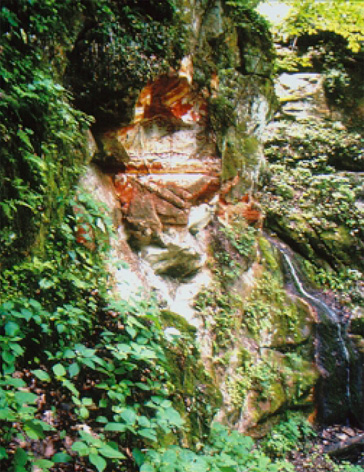
In what is today Pikes Peak State Park, the classic Paleozoic formations of the central U.S. form bluffs and gullies along the Mississippi River, among them the Ordovician St. Peter Sandstone. This classic sandstone is famously pure and white, its well-rounded quartz grains providing the raw material for glass-making and other applications. But at Pictured Rocks, waters percolating down through the overlying limestones, charged with a variety of minerals, have stained the St. Peter with a dazzling palette of natural colours (photo from Iowa Geology 2001, 26, Iowa Department of Natural Resources).
 .
.
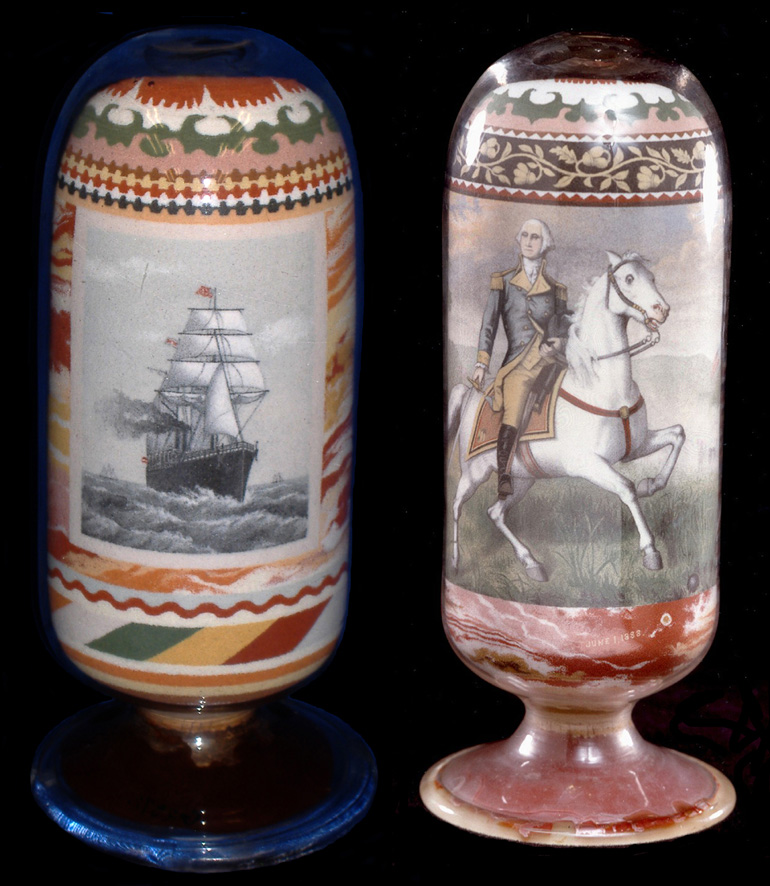
The image of George Washington on his horse is perhaps the most famous, but the designs range from personalized greetings to dramatic eagles, via ships, floral designs and documentation of local events, often with words and mottoes. His pieces, of necessity, were constructed upside-down, each bottle later sealed; he used no glue, no pigments, nothing except naturally-coloured sand grains and his patience and genius. How many bottles he made is unknown, for they are fragile and many have been broken over the years, a work of art becoming just a pile of coloured sand on the floor. Indeed, for a while Clemens worked at the South Side Museum in Chicago, constructing simple designs as the public watched, which were then dramatically smashed with a hammer to demonstrate that no magic was involved; understandably, Clemens did not find this activity to his liking and soon returned home.
Clemens’s extraordinary skill and creativity became recognized, but only modestly. The Editor of the North Iowa Times wrote in 1888 that “McGregor has an artist nowhere equaled in this world in his line of artistic work. He invented and became skilled in an artistic work all unaided and alone. He invented and made his own tools. He has thus brought to a surprising perfection an art of which he alone is the inventor, the master. We refer to the pictures wrought from sand from Pictured Rocks by Andrew Clemens. Our people do not properly appreciate this art. The master doesn’t seem to know its worth nor does he seem to realize his exalted position among the inventors of the world. Mr. Clemens lately completed what may be regarded as a masterpiece. He has made many fine efforts before. This last one is a perfect picture of General Washington on horseback. The artist has surpassed the copy, he gives the coloring, shadowing, form, all complete and perfect and all done in sand. The work shows a Mississippi River steamer running at full speed, a group of Indians in camp, the flag of our country, fields, harvest scene, all perfect and wrought with natural colored sands in a glass jar. The jar is open at the bottom and the work is commenced at the top of the picture. But to appreciate this wonderful work one must see it as we have seen it. It is one of the wonders of the age and ought to have a place among the great art of the world.”
Clemens died, tragically young, in 1894, probably of tuberculosis. His bottles had sold for fifty cents or a few dollars but today the survivors sell for thousands.
(quotation and information from http://members.tripod.com/clipclop/andrew/, a site which has detailed information and pictures of many of the surviving works. For the geology of Pikes Peak State Park, and further material on Clemens, see http://www.iowageology.org/gb70/stop-05.htm, the source of the picture of Clemens, above).
Comments
Good to see that Andrew Clemens’s extraordinary creations are getting a bit of publicity! DEAF LIFE Magazine is featuring a cover story about him, and I wager that it will come as a surprise to many of our readers. Until a bit ver a month ago, I didn’t know about his story, either.