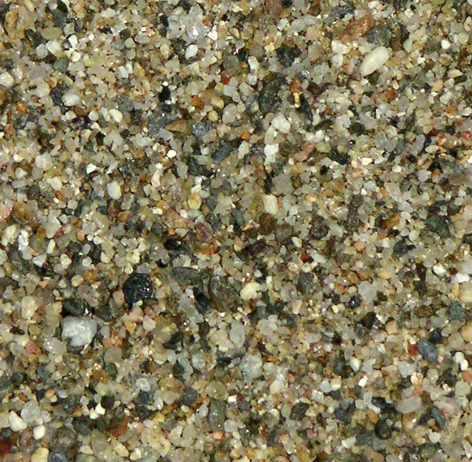
 Now, back to the subject of this blog, but still following the global theme. In the course of researching and writing the book, I learned a lot and came across a wide range of topics that were new to me, many of them thought-provoking. Here’s one particularly provocative example.
Sand, strictly, is defined only by its size range, its composition being of secondary importance; the size of sand grains determines how they behave and that behavior is unique and sometimes downright bizarre. Size is important.
Although born in Scotland, Philip H. Kuenen was an internationally-renowned Dutch sedimentologist in the last century, a great geologist with a passion for sand. Thanks to Kuenen, our understanding of turbidity currents, submarine canyons, and their associated depositional systems was set firmly on its feet. I came, essentially by accident, across the publication* of a talk that he had given in 1959 when he was invited by the Geological Society of South Africa to give their annual lecture in memory of Alex du Toit, a South African geologist who gave early support to the ideas of continental drift. Kuenen chose for his title “Sand—its origin, transportation, abrasion and accumulation.” In the talk, he strode boldly across the landscapes of sand on all scales, from how long it takes a grain to become round to mass transport in the desert, his “back of the envelope” calculations illustrating the dramatic scales and frequencies of our planet’s processes. He concluded his talk with a statement that I find particularly thought-provoking:
The size of the sand grains determines the mode of transportation. If the particles were much bigger they could not be moved by the wind and there would be no coastal dunes or sand deserts…The denudation of mountain chains would be a more laborious process…The all-important part played by sand in protecting coasts from wave attack would be largely suppressed, because rivers would not carry the pebbly quartz to the coast. Not much quartz would reach positions where turbidity currents could carry them to the deep-sea floor, and the few that were carried by such flows would travel less far. In fact dry land would be smaller, higher, and more siliceous.
On the other hand, if quartz left the parent rocks in much smaller particles than actually happens, these would be carried more easily by rivers and marine currents and also suspended in the air. A higher percentage would be lost from the continents to the deep sea. The continents would be less siliceous and thinner…and in general the protective cover of sand shielding more vulnerable material from weathering would be absent. Marine planation of the continents would be more active, because protective sands would have been wasted into the deep-sea. It thus appears probable that if quartz grains in granites were significantly bigger than they actually are, the continents would be smaller and steeper than we now find them. If granite quartzes were much smaller, the land would also be smaller but lower than at present.
This seems to me very much an anticipation of the yet-to-be-coined “earth systems” approach. Putting aside biogenic sands, the majority of sand grains in the world owe their origins to igneous activity and lithospheric process, their size range determined by plate tectonics, uplift and cooling rates, geothermal gradients and so on. Yet, as Kuenen suggests, there is feedback at work here, lithospheric processes being themselves influenced by the games that sand plays across the Earth’s surface, games whose rules are determined by the size range of the grains. The size of sand grains makes the Earth look the way it does. Interesting and thought-provoking?
*Kuenen, Ph. H. Sand: Its Origin, Transportation, Abrasion and Accumulation. Annexure to vol. 62. Johannesburg: Geological Society of South Africa, 1959.
Comments
Yet, as Kuenen suggests, there is feedback at work here, lithospheric processes being themselves influenced by the games that sand plays across the Earth’s surface, games whose rules are determined by the size range of the grains.
Has there been any computer simulation work done on lithosphere evolution with a variety of sediment size ranges as inputs?
Also any idea what the sediment size ranges on Mars are? It would be interesting to see whether Martian crust has broken down to sediment size ranges of similar proportions to earth and how that has influenced features on Mars in at least the environments we are identified so far.
Suvrat - thanks for the comment and good to find your blog (since we’ve been talking about the international geoblogosphere).
Re your question on lithosphere evolution simulation, I really can’t answer, since I’m not intimately plugged in to what research projects might be relevant. Does anyone else out there know of this kind of work?
As for Mars, it’s an interesting point (I was thinking of continuing the post with extraterrestrial systems, but decided to leave that for another day). Anything that I’ve seen (and of course there’s not a lot of hard data) suggests that grain size distributions on Mars are similar to Earth’s. But while the processes that operate on Martian sand are the same as on Earth, the circumstances, and therefore the results, are different. Today, lower gravity and a much thinner atmosphere have a strong influence on sediment transport. However, in the past on Mars there was clearly liquid water, a thicker atmosphere, and volcanism; whether or not there was ever anything like plate tectonics remains the subject of debate - there is little evidence other than one way of interpreting the structure of the magnetic field. It’s possible, that before the planet cooled off, some kind of tectonics was operating (see, for example, http://www.colorado.edu/news/r/6c0a44b4e94740d96f138d039f28718f.html, from just a few days ago).
If the distribution of sand grain sizes on Mars is similar to Earth’s, then that would suggest, in the past, a similar conspiracy of sand sources. There has been a lot of work done on today’s Martian sand transport, using the extraordinary results from the Rovers, the Orbiter and Phoenix. Martian dunes and dunefields are similar but different - see, for example, http://www.mars-dunes.org/uploads/abstracts/1486.pdf, http://www.lpi.usra.edu/meetings/7thmars2007/pdf/3048.pdf, and http://www1.nasa.gov/vision/universe/solarsystem/mer-011105_prt.htm.
It’s also fun to remember that, in 1974, Ralph Bagnold, the “father” of the analysis of sand transport mechanisms, and Carl Sagan, were predicting the behavior of sand on Mars before the first NASA missions.
Michael-
thanks for that Martian discussion and the links. looking forward to reading more on your site.
Hi Michael and seasons greetings too - it’s your erstwhile neighbour checking in with some sandy stories and queries related to current whereabouts (Australia). We’ve been hotfooting around the Outback examining rocks large (including Uluru. Mt. Connor and the Olgas) and small, enjoying the scenery, avoiding close contact with the wildlife and drinking plenty of the local liquor. Top pick for sand was probably King’s Canyon, eastish of Alice Springs. It’s a dramatic sandstone formation rising out of the flat bush where wind and water erosion has created a whopping great cleft with dramatic cliffs to match. At the top are some attractive beehive shapes, and in places the ripple patterns of a long-dry seabed. If you break open some of the reddish-brown fragments of sandstone, you are rewarded with a small explosion of white sand, although this behaviour is discouraged by the visitor signboards, which claim that the sand is an eyesore!
The blurb says said sand is 330-440 million years old. How old is that, in sand terms?
Have to sign off for now - off to a trivia quiz at the Rugby League Club with my Ma and Pa - but look forward to more sandblagging later.
Love to Carol,
Kieron
Hi Kieron and Jo - thanks for the comment and it’s good to know where you are, or, at least, were! And, of course, I’m envious of both. I have to say that I take great exception to sand being designated an eyesore.
The sandstones of King’s Canyon are old, but not very in the grand scheme of things. Not far from there (well, in fact quite a long way, since nowhere in Australia is close to anywhere else)are the Jack Hills of Western Australia that are constructed out of sandstones that are around 3 billion years old. But that’s not the end of the story - there are individual grains in those sandstones, made of the durable mineral zircon, that are the oldest home-grown (i.e. not extra-terrestrial) things that we have ever found. At close to 4.4 billion years old, they were formed within a million years or so of our planet’s birth. Through clever geodetective work, they tell us extraordinary stories of the Earth’s early days.
Enjoy - and keep us posted, so to speak!