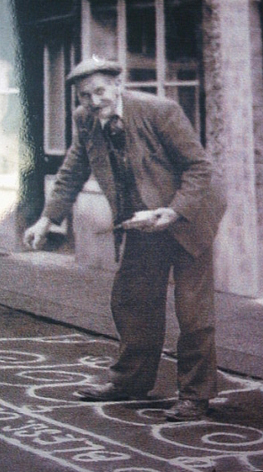
 In Knutsford, Cheshire (the UK one), the first Saturday in May is “Royal May Day,” the “royal” referring to King Knut (or popularly, Canute), the Viking King of England a thousand years ago. Tradition on Royal May Day recognizes sand as symbolic of large numbers and fecundity - it’s scattered in patterns around the houses of brides and small sand castles are built outside (the picture is from a sign in Knutsford and shows “sanding the streets” from around 1920). Legend has it that Knut, on meeting a wedding party after fording a river, emptied his shoe of sand and wished the couple as many children as there were grains - a prospect that might have caused the bride some alarm. Now of course this was the King Knut (or Canute) now famous for the legend of his sitting on the beach and failing to stop the waves and tides, but the story has become reversed from the original. Far from being a vain attempt to demonstrate his powers, Knut was intentionally demonstrating his lack of them. Either through piety, or to put the flattery of sycophants and flunkies to rest, or possibly both, he was conducting a graphic experiment to show that his powers were mortal.
Recent headlines in the British press, and his local community, have dubbed Peter Boggis the “modern King Canute.” Boggis has the misfortune to live in the target zone of the most rapidly eroding piece of coastline in Britain. The low cliffs north of Southwold in Suffolk face the wrath of the North Sea (although “wrath” is a little unfair - the North Sea simply does what it always has done with no hidden agenda), and the result is that the cliffs are retreating at a rate of several meters every year - on average. Technically, Peter Boggis lives in the hamlet of Easton Bavents, but in reality the once-thriving market town, the most easterly parish in England, no longer exists - its remains are a couple of miles to the east under the North Sea and have been there since the seventeenth-century cliffs collapsed. A recent storm in 2001 put Boggis’s house ten meters closer to the cliffs than it had been the previous day, and this dramatic erosional event spurred him and other local residents into action. Over a period of time, the 77-year-old retired engineer organized the delivery of 250,000 tons of soil and arranged its emplacement along the beach to protect the cliffs. The North Sea clearly regarded this as an affront and most of the material has now been moved on - but it was also deemed illegal activity - “unauthorised tipping” in the words of English law.
The problem was that the cliffs and their contents had been designated as an SSSI, a protected site of special scientific interest (for the details, see http://www.english-nature.org.uk/special/sssi/sssi_details.cfm?sssi_id=2000508). The interest is in the sands in the cliffs, which record in detail the story of that part of England during the glacial and interglacial periods of the Pleistocene era. Not only do the sands document how the climate changed, but they contain key marine fossils and the remains of mammals that roamed Suffolk as sea-level dropped - mammoths, mastodons, giant deer, hippopotami, beavers, and so on. It’s a unique record which, thanks to the activity of the North Sea, is being further revealed every day (the SSSI has had to be redefined, since it is no longer where it was).
A legal battle ensued between the latter-day Knut (also known as the “clifftop crusader”) and English Nature, the Government’s conservation agency which had designated the SSSI, and it has just been announced that Mr. Boggis has won his two-year battle in the high court of the UK (see, for example _The Times, “_The Clifftop Crusader wins his fight to repel the sea - by a technical knockout” - http://www.timesonline.co.uk/tol/news/environment/article5295682.ece). Mr. Boggis’s understandable determination to battle both nature and English Nature highlights some important questions - which I shall raise, but not presume to answer. Putting aside for the moment the science dimension (although it’s worth pointing out that the Easton Bavents cliffs are a source of real data for understanding today’s climate changes), how much effort, time, and money should we put into the inevitably forlorn attempts at “preventing” natural coastal processes? The eastern coastline of the UK is littered with the battered remains of such attempts and huge amounts of money and sand are poured into “beach nourishment” projects all over the world - all of them temporary. Any stretch of coast anywhere on the planet has, at any given time, a sediment budget - sand and mud are carried from somewhere to somewhere else; disrupt that budget, either positively or negatively, and the whole thing is destabilized. Mr. Boggis himself used this principle in his defence: “Unusual winds and groyne problems for cliff man” ran one headline. While this may sound like a distressing conspiracy of medical problems, I should hasten to point out (to American readers) that a “groyne” in our bizarre English parlance is a structure (rock, wood, 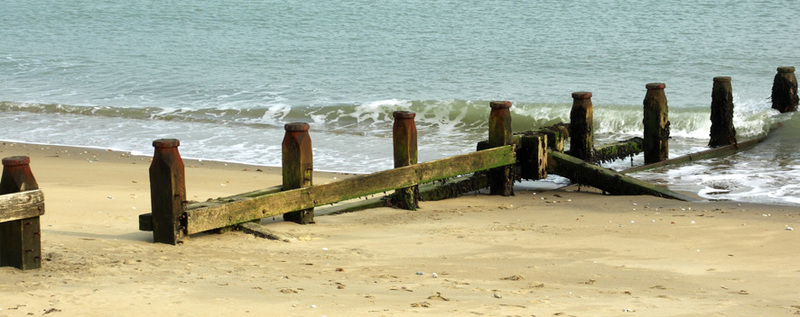 groyne on a different part of the coast. But groynes, inevitably, disrupt the sediment budget - they trap sand and prevent it being supplied to where it would normally be. Mr. Boggis cited the extension of groyne construction in the bijou artist colony village of Southwold as causing sand starvation, and hence aggravated erosion, along the shore beneath his house. He has a point - but it doesn’t necessarily mean that his 250,000 ton disruption to the sediment budget is the answer. I pointed out in my November 23 post the invasion of Pensacola Beach by too much sand - the other side of the budget. The fact is that coasts are among the most dynamic environments on the surface of the Earth - when do we come to terms with the fact that attempting to fight or subdue or prevent that dynamism is an extraordinary waste of time, money, and other resources that, more often than not, could be better devoted elsewhere?
Comments
As you are probably aware, the same sort of ultimately fruitless and ecologically damaging beach nourishment is done constantly to the expensive beach real estate along the over developed coasts of the Carolinas. Our federal and state taxes are wasted by subsidizing those who foolishly choose to “literally” build expensive houses and busineses on the shifting sands.
There are local scientists and conservationists who have criticized the damage and futility of these actions, but of course their pleas are generally ignored by the local business communities,developers and government officials who are too absorbed with short term economic growth to consider the long term consequences of their activities.