Back in London, and time to catch up a little on documenting the examples of the world’s sands that friends have sent. Yes, I confess, I’m an arenophile (or psammophile if you prefer not to mix your classical languages). Given the dazzling variety and unique character of every sand, it’s no wonder that collecting it is a global occupation. I succumbed in the process of writing the book, an old friend starting me off by providing the examples which eventually formed the first color plate, and then I was fortunate to receive the enthusiastic help of Loes Modderman, a Dutch collector, one of whose stunning images formed the second plate and who generously gave me a large selection of her sands (see http://www.scienceart.nl/ for some superb examples).
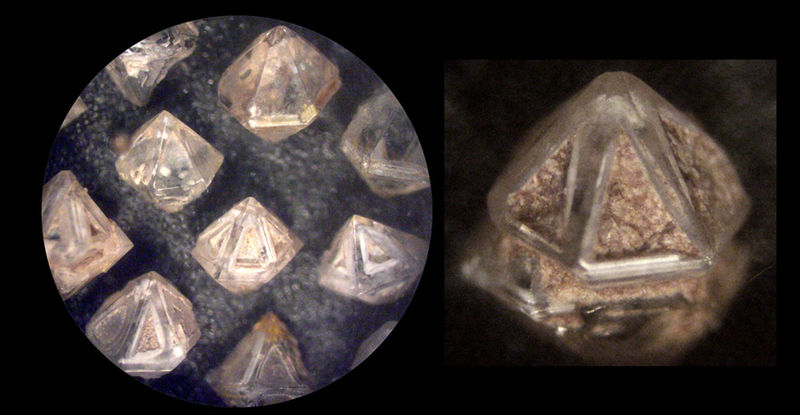
The old friend had also sent me some particular treasures that I must now return to him, and I spent some time ensuring that I had good enough photographs. One example struck me again as being beautiful and mysterious - coarse quartz grains that he had plucked out from river sands in East Kalimantan. Here are a couple of photographs of these (amateur, I’m afraid, simply a home microscope and a camera adapter). They are all doubly-terminated little diamond-like crystals, but the odd thing is that they appear to be zoned, this internal structure being picked out by abrasion during transport. But I am no expert mineralogist - can anyone shed light on the origin of these extraordinary natural works of art?
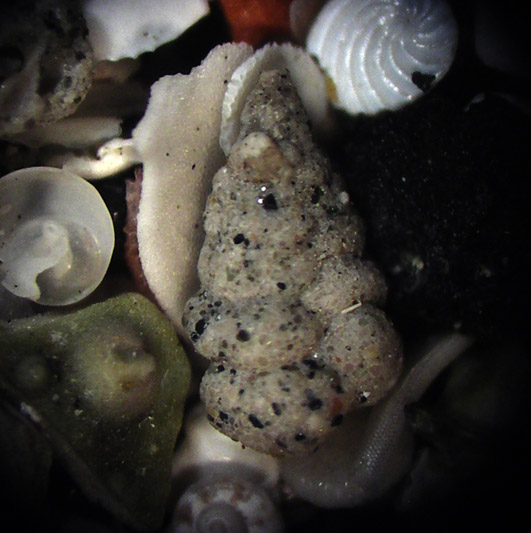
And, while I’m organizing sands here’s a crittur that illustrates my last post - a foram that constructs its shell out of sand grains.
And, what the hell, while I’m at it, here are a few more examples of the stunningly beautiful world of the microscopic.
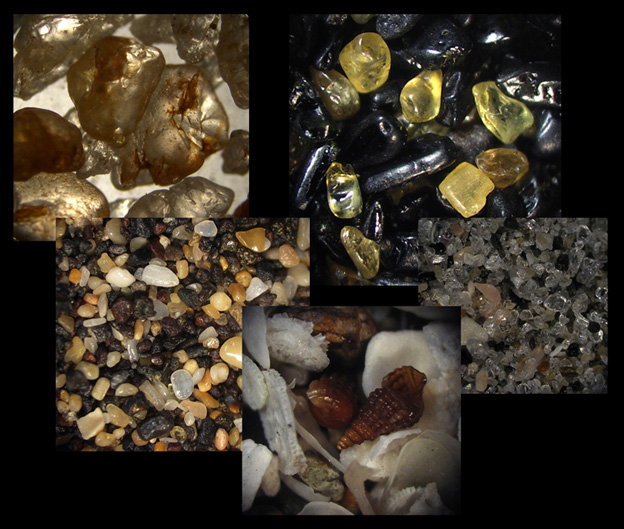
[for professional and expert microphotography of sand grains, see Gary Greenberg’s dazzling illustrations in A Grain of Sand: Nature’s Secret Wonder]
Comments
No comments yet.