Sometimes you have to wonder. And the good tax-paying citizens of Bournemouth are certainly wondering. An article in yesterday’s UK Guardian newspaper highlights the latest episode of another sorry story of expensive coastal meddling: “Shifting sands swell the cost of UK’s first artificial surf reef.”
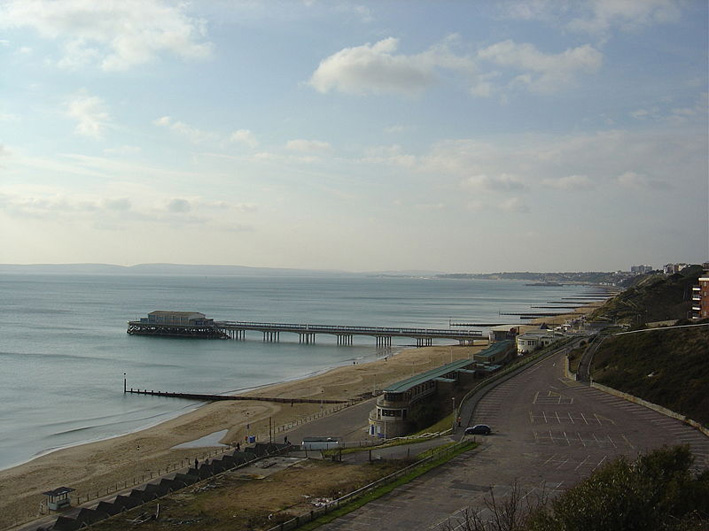
Bournemouth, and its sandy suburb of Boscombe (pictured), is a classic British seaside holiday resort on the south coast, with piers, Winter Gardens, beach huts and many of the other weird and wonderful cultural manifestations of the coastal resorts that flourished in Victorian times when the therapeutic value of sea water and air were much-heralded. But Bournemouth is determined to participate in the 21st century, and a couple of years ago it proudly declared that “Europe’s first artificial surf reef is being built in Boscombe, Bournemouth this year and is set to put the holiday resort firmly on the UK surf map.” The “UK surf map”? Well, yes, there are places around the UK, particularly further west in Cornwall which faces the full force of Atlantic weather, where surfing is feasible and popular, but the map is not a densely annotated one, and Malibu we certainly are not. But the officials of Bournemouth were determined, and approved construction of an artificial reef to amplify existing surf and generate surfer-seducing waves, together with onshore redevelopment (including “surf pods,” whatever they might be, and a “surfing academy”) that would bring people and money pouring in.
Other such reefs have been constructed - in Australia and New Zealand - and a company from down under was contracted for the construction. The reef itself is built of gigantic sand bags, made from specialty “geotextiles” and each weighing around 2500 tons. Sand (brought from the Isle of Wight further along the coast) is piled up onshore, processed, and then pumped and piped offshore to barges which fill the bags and place them on the sea floor, 200 meters from the beach - which has, therefore become a rather large construction site for some time. The small building in the left hand photo, below, is the same as seen in the bottom left of the picture above.
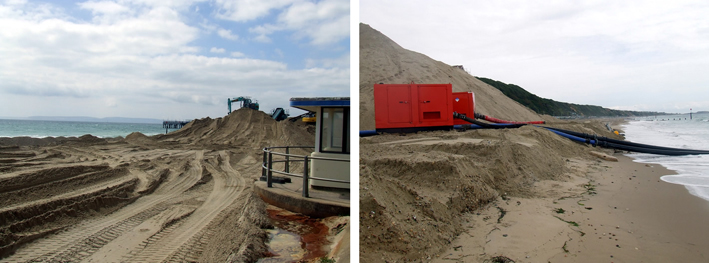
The project was scheduled to be completed last year, but was, of course, dependent on reasonably good weather. However, this being the British Isles, the weather last summer was distinctly uncooperative, the work had to be suspended and the contractors returned to more balmy southern hemisphere climes (although their accommodation is still being paid for). Inevitably, thousands of tons of unused sand remains stockpiled on the beach, an eyesore for residents; but at least the eyesore is diminishing as, during the course of British coastal winter, the sand is being, shall we say, redistributed.
The original budget for the reef was impressive - £1.4 million. With the delays and the estimated costs of replacing the redistributed sand (the council has, with some precision, set aside £169,000 for this), the costs are now exceeding £3 million. The financial budget is busted, and one has to question the effects on the sediment budget. Every segment of coast anywhere in the world has a natural (or unnatural) sediment budget, incomings and outgoings, net profits, net losses, a granular balance sheet. Excavating the sand from the Isle of Wight will have altered the budget there. And, as the work of Rob Holman has demonstrated (see my January 6 post), the nearshore environment is even more dynamic and shifting than we had realized, dramatic sand movements varying with the season. Now it would seem to me, looking at it in a simple-minded way, that we have absolutely no idea what an artificial reef of this magnitude will do to the local sedimentary budget for Bournemouth - but that it will certainly do something. Similar structures both trap sand and stimulate scouring, and the very fact that the reef is designed to modify the waves might surely mean that it will also modify their effects?
One can only wonder - in a dynamic economic environment and a dynamic sedimentary environment, is this really the best use of public money? The taxpayers of Bournemouth are certainly wondering.
[coastal photograph: http://commons.wikimedia.org/wiki/File:Boscombe_Pier_November_2005.jpg; construction photographs: http://www.bournemouthsurfreef.com/tag/construction/]

Comments
Without looking into this matter more than you wrote - I wouldn’t be surprised if the current beach starts being eroded and sedimentation increases in other areas ultimately ruining the nice beach environment.
I agree! I (and plenty of us) wouldn’t be surprised either. But we continue to pursue these lunatic schemes. Do you know Cornelia Dean’s excellent book “Against the tide - the battle for America’s beaches”? This was written in 1999, but somehow or another, we still don’t seem to have learned anything (also, see my “Knuts ancient and modern” post - same theme of meddling with natural processes).
It all depends if they did their homework and studied the environment … that doesn’t mean it will necessarily work, but hopefully they reduced uncertainty as well as they could and have a few predictions of what could happen and why based on their research. In short, it’s important to do research!!
You’re absolutely right, Brian - it all depends. My problem is that, in a hunt around the web, I’ve not found any references to the research, and you would think that, if the science had been done, it would be cited. The “feasibility study” was conducted by the same company that was awarded the construction contract, and much of the literature that shows up on artificial reef studies originates from the principals of that company. The main references to influences on sediment movement are the potential benefits for “coastal protection” - for example from the official Bournemouth local government “information pack”:
“What environmental impact will the reef have?
The environmental implications are at worst, neutral. It’s likely that marine life will thrive on the reef and there will be no damaging effects to the beach. Although our reason for building the reef is for regeneration and leisure, expert opinion says that it may also help with coastal defences.”
I just can’t help coming back to the dramatic videos on Rob Holman’s website (real research) which reveal how extraordinarily complex nearshore sand body movements are - the whole system is inherently unpredictable. A Bournemouth local councillor who is sceptical about the scheme commented that the environmental impact of the reef cannot be predicted accurately … “The sea is a mysterious thing. We don’t know how it will affect the coast.” Presumably this particular councillor was not one of the three who spent a vital eighteen days in New Zealand gathering crucial facts on artificial reefs!
Great post, thanks for the information.
I comes from Indonesia, I’ve written many articles about jewelry We suggest you check out his other guide on SILVER, GOLD & DIAMOND Tips & Guide