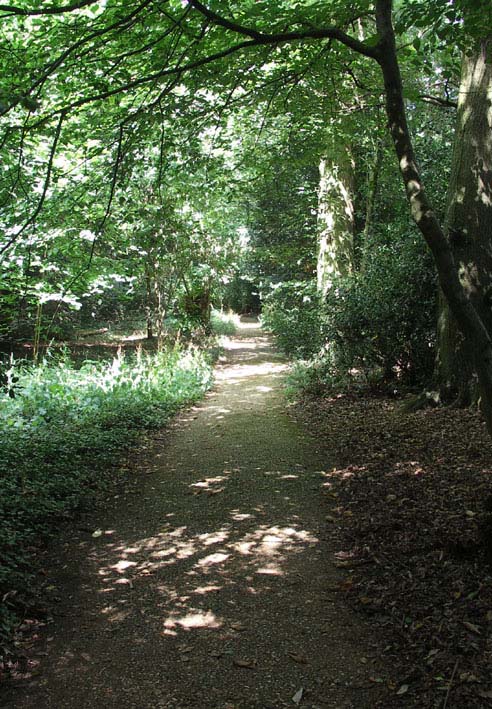
 is, for many of us, an intellectually spiritual experience. Walk the sand walk, and the sense of place is resonant. What is arguably the greatest idea ever was formed here. It is the place where our understanding of ourselves and our place, and the place of every living thing in the natural world, was born.
The process of natural selection, illuminated today so brilliantly and so subtly by genetics, is a natural wonder, the place where the scenes of life’s history, as revealed through geology, develop into the dramas of today’s biosphere. Sand, being the ubiquitous and hyperactive player in the games of our planet’s past has, of course, always influenced evolution. Granular materials, whether in the desert or the surf zone, are not the easiest places to live, and the challenges have driven endless adaptations. But what I want to focus on here is an example of evolution in “real time,” changes that are happening at a pace that we can comprehend on our timescale.
The coastline of Florida as we see it today is young. Quite apart from the fact that the coast today is not what it was yesterday, the major features, however they are constantly changing, were sculpted a few thousand years ago as sea levels rose after the last Ice Age. The barrier islands of the Gulf Coast and the sweeping beach and dune systems of the Atlantic side are works in progress. As are their populations of mice. Peromyscus is the most widespread mammal in North America, a species that has adapted to and enjoys a wide range of habitats, including the mainland of Florida, its Atlantic beaches, and its recently formed barrier islands off the Gulf Coast. But the mice that live on the light sand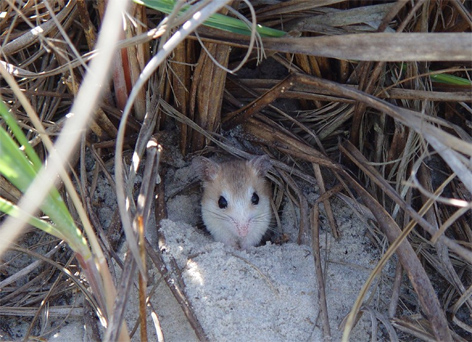 reports the latest results from a project that has been going for some time. Not only does their work reveal some of the complexity of genetic switches, nucleotides, and amino acid mutations that choreograph evolutionary change, but it importantly sheds new light on the thorny and much-debated topic of convergent evolution, showing that, like so many things, it’s not as simple as we might like to think. Now, when I say “we,” I am not really referring to myself - as a geologist, the time it takes me to be out of my depth in the field of molecular biology can be measured on the nanoscale, so I shall return to the influence of sand.
Hoekstra’s project has studied beach mice in diverse habitats, among them Santa Rosa Island, one of the longest barrier islands in North America, and the site of a Civil War battle. The mice forage on the white sands and among the dunes, eating mainly sea oats, and trying to avoid predators from the skies - owls, herons, and hawks. And, nature being red in tooth and claw, mice with lighter-coloured coats are less visible and more likely to survive. As natural selection, it’s as simple as that (putting aside the complexity of the genetic mechanisms that actually allow it to happen). Completely distinctive subspecies have evolved and it’s all happened in just a few thousand years - as Hoekstra says, “It’s a large effect mutation. And what it says is that adaptation does not always occur gradually, but may happen in these relatively large jumps.” The barrier island beach mice are genetically more similar to (but still different from) their Atlantic Coast relatives hundreds of kilometers away than they are to their nearby mainland cousins.
Unfortunately, avian predators are not the only threats that the beach mice have to deal with. Our lunatic obsession with beach front property development is destroying their habitats, and, barrier islands being where they are, hurricane damage is frequent and extensive; Hurricane Ivan excavated a completely new breach in Santa Rosa Island as seen in the image below - a great example for fans of storm-generated overwash sand deposits.
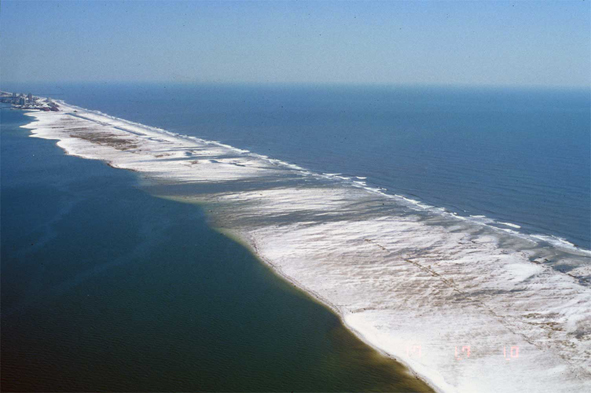
The beach mice are disappearing rapidly - since Hoekstra’s project began, one subspecies has become extinct and six of the seven remaining are endangered.
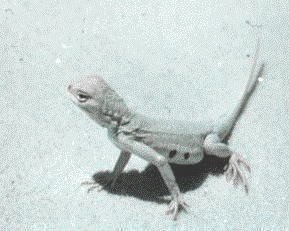
There are other examples of sand habitats actively driving evolutionary change. The gloriously named bleached earless lizard lives among the stark white gypsum dunes of the White Sands National Monument, again formed only a few thousand years ago. The lizard is thus named because it is bleached - compared to its darker relatives beyond the dunes, it has lost its colour as a protective adaptation (it has been shown that this adaptation is not driven by temperature regulation). Spiders, scorpions, toads, and mammals living in the dazzling dunes are all paler than their brethren beyond the sand.
[see Hopi Hoekstra’s site: http://www.oeb.harvard.edu/faculty/hoekstra/Links/ProjectsPage.html. Beach mouse photo from
http://www.oeb.harvard.edu/faculty/hoekstra/Links/ProjectsPage.html, credit J.B. Miller, Santa Rosa hurricane damage photo from
http://coastal.er.usgs.gov/hurricanes/ivan/photos/florida.html. For more on evolution at White Sands, see http://www.nps.gov/whsa/naturescience/white-animals.htm; lizard photo from that site.]
Comments
No comments yet.