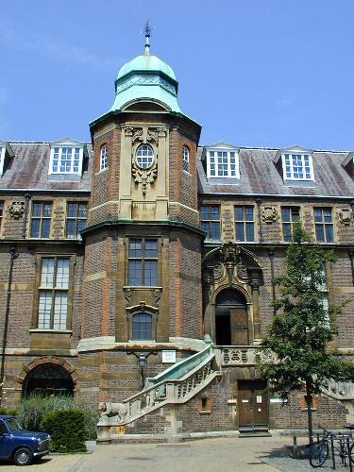
 , but there are good reasons for the enduring ambiance of the ground floor. The large space is lined on three sides with magnificent glass-fronted wooden cabinets containing a unique collection of building and decorative stones, installed in 1911 not long after the building was opened, and the space is clearly and unalterably the collection’s home. I may have moved around and onward in the intervening years, but the same solid chunks of Millstone Grit remain in the same place and unchanged since I walked past them every day a long time ago.
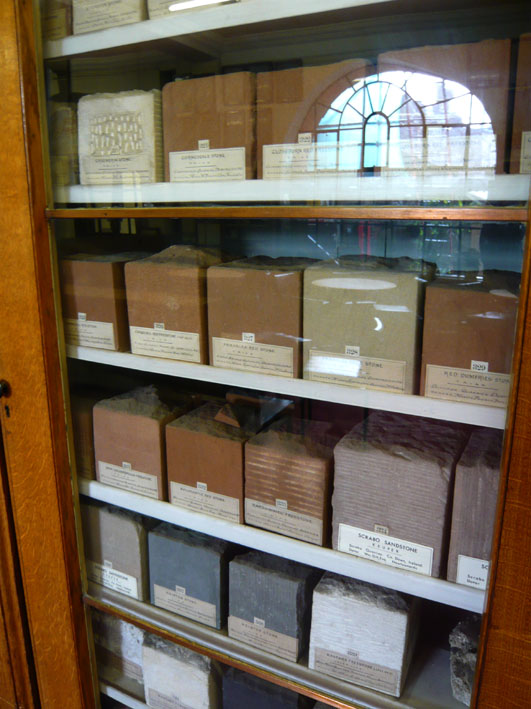
The collection is one of the treasures of the museum and is a unique reference collection, of continuing value to architects and building conservation experts. It contains around 2,500 specimens, largely from Great Britain, but several cases advertise “Colonial and Foreign” examples. It was put together for the Sedgwick by John Watson, himself a building stone merchant, whose son was a student at the university. Each example is a perfect cube, around 20 cms on a side, and dressed or polished in a way typical of its use, and each with its original label. Many of the stones revel under exotic names reflecting the local origin and nomenclature: you can study examples of the Bastard and Windy Nook Freestones, Kentish Rag, Stink Stone, Blue Liver Rock, and Clunch.
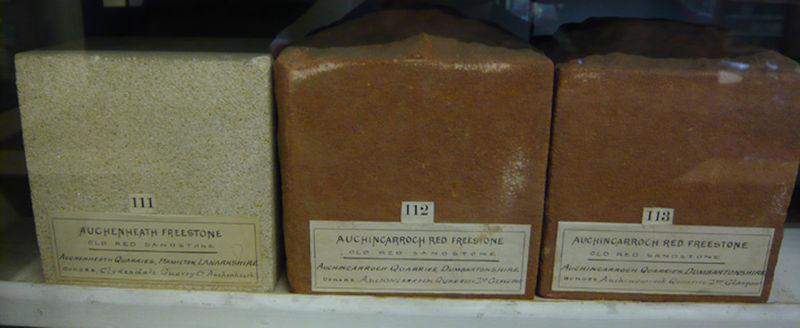
And, naturally, many of the samples are of the classic sandstones. The Devonian Old Red Sandstone stars widely, including the Caithness Sandstone from the northernmost reaches of Scotland, out of which the Sedgwick’s fine external double staircase is built. John Watson’s entire catalog of the collection can be found, thanks to the American Universities Internet Archive and the University of California, on the web (http://www.archive.org/details/britishforeignbu00watsrich), and in it, the Caithness Sandstone is described as follows:
Still further north is found the celebrated Caithness Flagstone, which is one of the most important economic products
of this[the Devonian] system. It is used locally for general building, but it is in special repute more as a material
for flagging,and for staircases, both external and internal, for which purposes it has long been employed not only in
the British Isles but all over the world. Baron Liebig’s great establishment on the River Plate, in South America, for
the manufacture of his well-known meat extract, is floored throughout with Caithness flags. Sir Roderick Murchison, in
his third edition of Siluria published in 1858, writes, "The Flag-stones of Caithness, which were first described by me
in the year 1827 under the name of Bituminous Schists … are in many places impregnated with bitumen, chiefly resulting
from the vast quantity of fishes embedded in them. The most durable and best qualities, as flagstones, are derived from
an admixture of this bitumen, with finely laminated, siliceous, calcareous, and argillaceous particles, the whole forming
a natural cement more impervious to moisture than any stone with which I am acquainted." A good practical illustration
of this useful stone, employed for steps, can be seen in the staircase leading from the ground floor to the first floor
of the Sedgwick Museum, Cambridge, connecting the economic and palaeontological sections. This example, as well as other
specimens, shew that by no means all the rocks of the Old Red Sandstone are “red.”
The collection includes a modest sampling from North America, including the Potsdam Sandstone and the “Warsaw Bluestone,” a classic representative of North American Old Red building stones, a field trip for which can be easily accomplished by a stroll around Yale University or some of the classic buildings of Manhattan, including the Dakota Building, home of John Lennon and the scene of his death.
Mark Twain seems to have had a great fondness for the Old Red, describing in an 1868 newspaper article, “that poor, decrepit, bald-headed, played-out, antediluvian Old Red Sandstone formation which they call the Smithsonian Institute.” In actual fact, Twain had his old, red, sandstones mixed up - the Smithsonian is built from the “New Red” Triassic Seneca Sandstone [thanks Callan Bentley for the comment pointing this out].In his 1903 essay, Was the World Made for Man?, Twain wrote:
So the Old Silurian seas were opened up to breed the fish in, and at the same time the great work of building Old Red Sandstone mountains eighty thousand feet high to cold-storage their fossils in was begun. This latter was quite indispensable, for there would be no end of failures again, no end of extinctions—millions of them—and it would be cheaper and less trouble to can them in the rocks than to keep tally of them in a book.
Comments
Michael,
What a wonderful post about building stone. I hadn’t seen the Twain quote and I can’t wait to visit the Museum and all of those building stones. Here is one my favorite quotes about another type of old red sandstone, or brownstone, as it is also known. It is from Edith Wharton, although I completely disagree with her. She called brownstone a “universal chocolate-coloured coating of the most hideous stone ever quarried.”
Oh well.
David
www.stories-in-stone.blogspot.com
David - I’m with you - I didn’t know the Edith Wharton quote, and she was clearly looking at the brownstones in the wrong light. A lot of the brownstones are the “New Red Sandstone,” Triassic in age, and this conflict of red sandstones has led to the terms being abandoned in geotechnical use but they linger - nostalgically and resonantly. In the UK the New Red Sandstones are famous as the foundation of Nottingham (where I was born)and excellent reservoirs for water, as well as building stones. I go on a bit about both the Old and the New reds in the book - they are both classics in the history of our continents and the history of geology.
Thanks for the comment - and I’m pleased to have found your blog.
Michael
I’m confused by the Twain quote. Is he implying that the Smithsonian Institution castle in Washington, DC, is built from the Old Red Sandstone? It’s not – it’s the Seneca Sandstone, a Triassic stratum from the Culpeper Basin, a Triassic/Jurassic rift valley about 15 miles up the Potomac River from DC. I guess that means it’s equivalent to the “New Red Sandstones” of the UK. Are they rift-related sediments too?
Good point, Callan. I guess Twain was not a meticulous geologist and any old, red, sandstone could be capitalized, thus creating stratigraphic confusion. The Smithsonian is indeed “New Red” and typical of the Triassic rift basins around the Atlantic and further afield as Pangaea began to break up (see clarification in the post).