Back in November, in my post on the sandglass, I commented that watching avalanches of sand in a sandglass is to witness one of nature’s most fundamental laws in action. The relationship between avalanche size and frequency is an example of a power law. A single grain falling on the pile may simply nudge another further down or set off a catastrophic avalanche - the system is dominated by large numbers of small events and occasional large ones. Prediction is impossible, but the size versus frequency relationship is consistent and follows a power law. Power laws are everywhere: gravity is an example and these relationships can be found in biological systems and communities, the stock market, population behaviours - and, perhaps most famously, earthquakes. The Gutenberg-Richter relationship between earthquake magnitude and frequency is a power law.
The weird and wonderful world of granular materials seems dominated by power laws and here (thanks, again, to Jules) is another fascinating example, shedding light (quite literally) on the details of seismic events. Two post-doc researchers at Duke University, Nick Hayman and Karen Daniels, created an innovative means of modelling and quantifying small-scale events along a moving fault, looking at the way in which granular materials determine fault zone development. They took tiny plastic discs and put them, one layer thick, in between two Plexiglas plates, the lower of which was split, one side being incrementally displaced by a weighted spring to mimic fault displacement. The experimental events obeyed a power law. But the really clever thing, the experimental magic, was that the optical properties of the discs changed according to how much strain they were undergoing and putting the whole contraption on a light table and imaging it through a polarizing filter, yielded some extraordinary results (http://www.jsg.utexas.edu/news/resspotlights/2009/tabletop_earthquakes.html).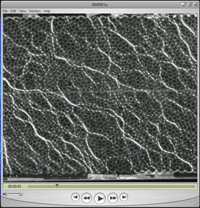 and this may account for the sudden, catastrophic, failure of grain silos and allow the sand in the sandglass to flow smoothly.
This direct imaging of micro-processes and deformation in a fault zone is amazing, and the technique will undoubtedly produce further suprises. And it allows quantitative analysis of what is going on - Hayman and Daniels describe how subtracting one image before an event from one immediately after, allows measurement of exactly what changed - the illustration below (taken from their paper at http://www.agu.org/journals/jb/jb0811/2008JB005781/) shows an example of this “image differencing” technique; “the image is white where a force chain strengthened, black where a force chain weakened, and gray where no change occurred. A chain that is lined with a white strip on the left side and dark on the right slipped sideways as a unit; a chain structure that is completely white formed during the slip event; a chain structure that is completely dark disappeared during the slip event. Finally, particles that slipped sideways appear as faint rings.”
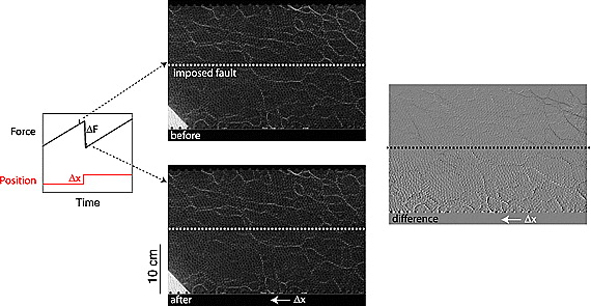
“What our experiment is showing is that some of the fundamental distributions of earthquakes that are known in nature can be mimicked using just granular materials,” said Hayman. “And the fact that we can observe the state of stress enhances the point of view that these materials are important in faults.”
Tabletop experiments, direct imaging of geological processes, granular materials, power laws - what fun!
[For an entertaining and accessible discussion of sand piles, power laws, self-organized criticality etc., read Per Bak’s How Nature Works]
Comments
www.yahoo.com