Tafoni - the decorations on a festive cake? An ancient grave-robbing cult? The cosmetically enhanced follicles on the head of the Italian Prime Minister? Nope, pits, holes and convoluted caverns in weathered rock.
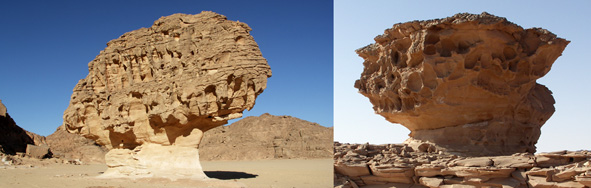
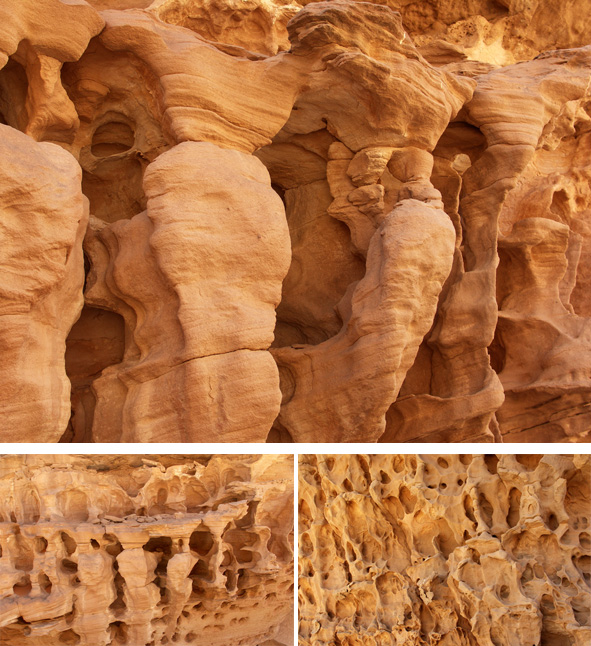
The origin of the term is perhaps lost in the mists of time, perhaps Sicilian (where there are spectacular examples in granite outcrops on the coast), but the phenomenon is an extraordinary example of the diversity of nature’s art. Tafoni can be found in many different types of rock and in many different environments (including Antarctica and Mars), but they are very common in sandstones and in the deserts of the world, and so it those that I shall focus on here - particularly since I can use my own photos. There has been a great deal of scientific pondering and analysis on exactly how tafoni are formed, but the general opinion is that the process of salt weathering is the influential sculptor. Water, even in minute amounts, pools on the surface or finds its way in between the rock grains and dries. If the water is carrying salts - minerals dissolved in the water than can include sodium chloride but also a host of other chlorides, sulphates, and carbonates - then they will crystallize out as the water dries. Crystallizing salts increase their volume as they form, which produces significant pressures between the grains, forcing the solid rock to crumble. The chemical and physical solidity of any rock is not uniform and some parts will be more vulnerable than others; the process continues through cycles of wetting and drying, chiseling, excavating, and smoothing. The results can be relatively simple “honeycomb” pits or incredibly ornate sculptures, reminiscent of Gothic cathedrals or the more extravagant works of Antoni Gaudi. The examples here are in Lower Paleozoic sandstones from the Western Desert of extreme southwest Egypt. The “stalks” of the mushroom-shaped rocks illustrate the height of sandblasting by sandstorms (see also my previous entry on 21 January - The man who figured out how deserts work).
There is much more that can be said about tafoni, but best to visit Jon Boxerman’s comprehensive and entertaining site, http://tafoni.com/Welcome.html and, as always, Andrew Alden, http://geology.about.com/library/bl/images/bltafoni.htm. Or go to Stalking the Wild Tafoni at the Zymoglyphic Museum blog, http://zymoglyphic.blogspot.com/2007/01/stalking-wild-tafoni.html - and once you start browsing around the rest of this wonderful blog, allow some time.
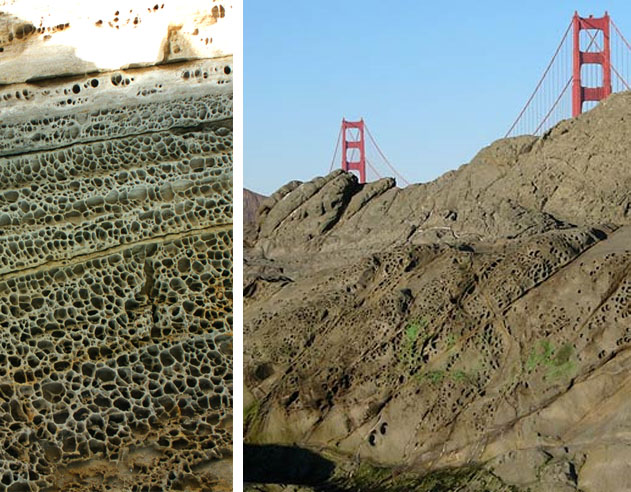
And finally, just to prove that tafoni do not just haunt the deserts of the world, an example from Scotland’s Isle of Skye (which, I can assure you, is not an arid place) and, the one photo that isn’t mine, San Francisco (courtesy of the National Park Service).
[p.s. I’ll be away from my laptop for a few days (a blessing and a curse) celebrating my wife’s birthday in Barcelona (speaking of Gaudi); I will try to schedule a new post to appear, but have no great faith in this happening - don’t go away!]
Comments
I love tafoni, but only learned the word last year when someone posted about it - maybe Dave Schumaker or Brian at Clastic Detritus. That’s a neat photo of the rocks near the Golden Gate bridge - I really do associate tafoni with deserts! Nice examples in sandstone - are those columns in the reddish sandstone partly formed first by water and then tafoni-ized by wind? (Sorry about the made-up word!)
To be quite honest, I’m not sure exactly how that tafonization takes place - but (as shown by the mushrooms), sandblasting only operates up to a couple of meters or so above the ground and these examples were higher than that, so the dominant process, I suspect, is water. Another key question is age - were these actually formed when the Sahara was wetter than today??? Wonderful mysteries!
Two hours north of the Golden Gate, at Salt Point State Park, there are mind-blowing tafonis in very homogeneous quartz arenite. Older, deeper tafonis on uplifted terraces also exist inland from the current shore. It looks like a real “moonscape.”
This is really interesting - I’ve seen rock formations like this many times, but never knew that there was a specific word to describe them, let alone one that’s so fun to say! Thanks for the informative post!