A couple of weeks ago, Sunday sand exhibited some portraits of foraminifera (forams). I will readily admit that I find these critters entrancing, and utterly fascinating in their diversity and ingenuity. And, of course, given their ubiquity in the world’s oceans, they play leading roles as biogenic components of our planet’s sands; and recent research suggests that there are perhaps 20-50 times as many foram species as previously thought. So I was delighted when Michael Hesemann took the trouble to comment at length and point readers to the Foraminifera.eu Project. I have spent some time browsing around this great site and its beautiful images, and have hardly scratched the surface; however, I was particularly attracted to the gallery of type specimens of agglutinated foraminifera, those clever little (and not so little) critters that build their homes out of any stuff that is available – sand grains, silt grains, other critters’ shells.
I wrote a post a year ago on forams, and, in particular, the agglutinating ones, with an emphasis on the spectacular collection derived from the pioneering voyage of HMS Challenger. I have made a selection from Michael Hesemann’s site for exhibition today (including the original descriptions scales, and credits), and a number of them come from the Challenger collections at London’s Natural History Museum; most are from today’s oceans, but the collection finishes with examples from the Late Jurassic of Switzerland – forams have been agglutinating for more than 150 million years.
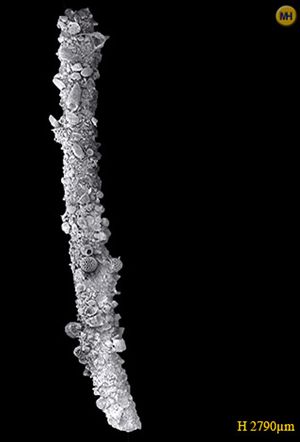
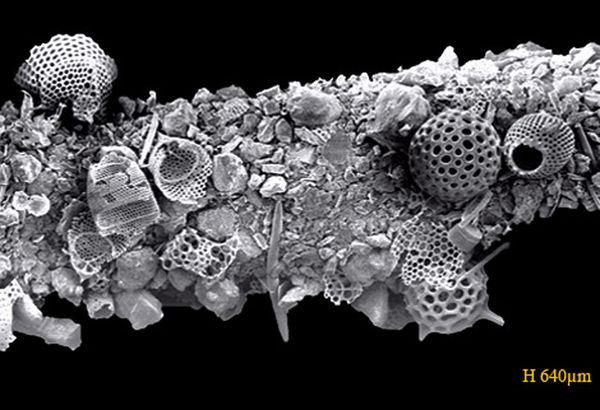
Rhabdammina abyssorum M. Sars, 1869
Class: Astrorhizata Subclass: Astrorhizana Order: Astrorhizida Family: Rhabdamminidae
Taxon Profile; found at South China Sea off territorial waters from 3465m depth
Geological Time: recent
specimen provided by Prof. Jenö Nagy
Collection: Prof. J. Nagy
View of one specimen of Rhabdammina abyssorum M. Sars, 1869
detailed view with diatoms as construction material (image at the head of this post)
Hormosinelloides guttifer (Brady, 1884)
Class: Nodosariata Subclass: Hormosinana Order: Hormosinida Family: Hormosininae
Taxon Profile; found at Challenger Station 323 off territorial waters from 3475m depth, at 50.47 W, 35. 39 S
Geological Time: recent
Images are shown with permission and thanks to Michael A. Kaminski, the Natural History Museum London (copyright-holder) and Grzybowski Foundation. The images are made with the NHM Palaeontology imaging system.
HMS Challenger Collection
View of one specimen of Hormosinelloides guttifer (Brady, 1884)
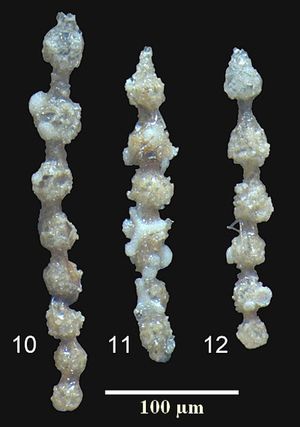
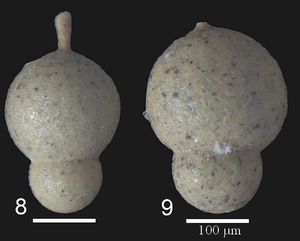
Hormosina globulifera Brady, 1879
Class: Nodosariata Subclass: Hormosinana Order: Hormosinida Family: Hormosininae
Taxon Profile; found at Challenger Station 246 off territorial waters from 3749m depth
Geological Time: recent
Images are shown with permission and thanks to Michael A. Kaminski, the Natural History Museum London (copyright-holder) and Grzybowski Foundation. The images are made with the NHM Palaeontology imaging system.
HMS Challenger Collection
View of one specimen of Hormosina globulifera Brady, 1879
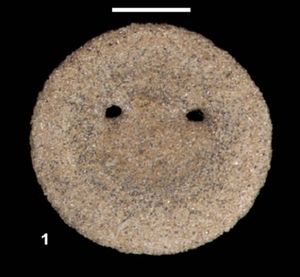
Discobotellina biperforata 1
Holotype of a specimen of Discobotellina biperforata
in the Collections of the Natural History Museum, London.
from Moreton Bay, Queensland, Australia, a station at 4-6 fathoms Taxon Profile
Images are shown with permission and thanks to Michael A. Kaminski, the Natural History Museum London (copyright-holder) and Grzybowski Foundation. The images are made by Andrew S. Henderson with the NHM Palaeontology imaging system.
Holotype specimen of Discobotellina biperforata Collins, 1958, W.J. Parr collection at the NHM, Moreton Bay, Queensland, 4-6 fathoms, 1958.11.7.810, Scale bar = 6.34 mm
Thuramminopsis canaliculata 1
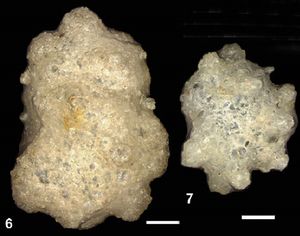
Syntypes of Thuramminopsis canaliculata
Taxon Profile: in the Collections of the Natural History Museum, London.
labeled as from “Zone of A. transversarius, Upper Jurassic, Canton Aargau, Switzerland, ex Haeusler Coll.”
Images are shown with permission and thanks to Michael A. Kaminski the Natural History Museum London (copyright-holder) and Grzybowski Foundation. The images are made by Andrew S. Henderson with the NHM Palaeontology imaging system.
Syntype specimens of Thuramminopsis canaliculata Haeusler, 1883, from Brady collection (ex Haeusler Collection). 6. ZF 5197, Scale bar = 125 µm; 7. ZF 5198, Scale bar = 125 µm
Thanks to Michael Hesemann and the foraminifera.eu project for these wonderful images.
Comments
“Infinite riches in a little room.”