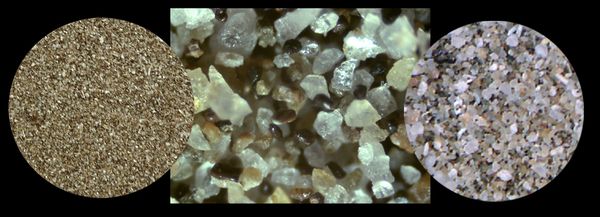
For Nature is the noblest engineer, yet uses a grinding economy, working up all that is wasted to-day into to-morrow’s creation; not a superfluous grain of sand, for all the ostentation she makes of expense and public works.
(Ralph Waldo Emerson, The Young American)
Ashes to ashes, sand to sand – recycling is the name of the game on our planet. Essentially every sand grain that you might encounter washing along the beach, rolling in a river, skipping along the surface of a dune, is on but the latest of many journeys, travels punctuated by long periods of entombed repose, cycles of incarceration and liberation that have gone on for tens, hundreds, of millions of years. This week’s Sunday sand is a great example of this, from the Bako National Park on the coast of Sarawak, Malaysian Borneo.
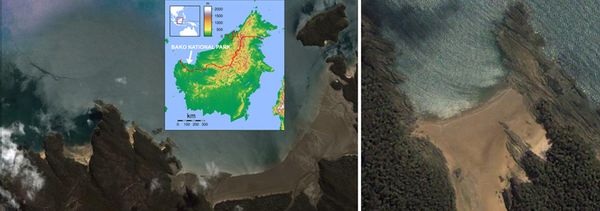
Thirty million years or so ago, great rivers carried cargoes of newly-liberated sand down from the mountains and dumped them in deltas along an old shoreline quite unrelated to today’s. Geochaos and geochemistry buried and lithified the sediments, turning them into sandstones that would later be unceremoniously heaved back up to the surface; for the moment, they play a starring role in the dramatic and colourful coastal scenery of this small National Park, but they are constantly exposed to the assaults of waves and the steamy tropical climate, disintegrating to release their grains back onto the beaches and launching them on their next journey. This sand is a perfect example of the recycling of local ingredients. But those ingredients include a little something extra. Over time, mineral-charged waters circulated through the sandstones, leaching and depositing minerals as the acidity of the local microenvironment changed. Most common among these minerals are iron oxides and hydroxides that provide the palette of pigments for the chemical artistry on display in these cliffs:
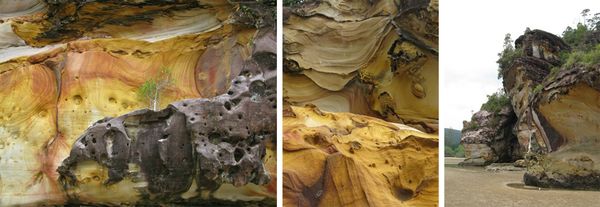
[Photos thanks to Bob Meredith’s travel journal at Bugbitten.com]
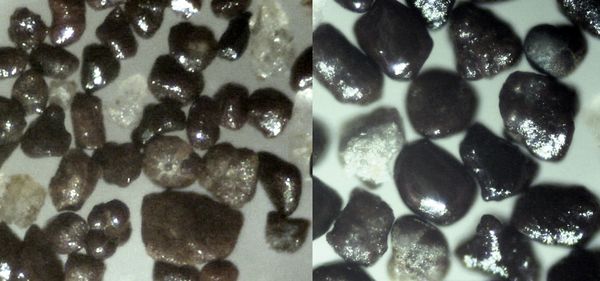
But in these photos, it’s clear that this geoalchemy has gone even further – bizarre steel-black crusts seem to drape over the outcrops, as if something molten had been poured on them. Molten, no, but chemical, yes. The conspiracy of mineral-laden water infiltration, fluctuations in the water table, and original heterogeneity of the sandstones, has caused the formation of duricrusts, hard, irregular, iron-cemented bodies of sandstone, sometimes also called ferricrete (i.e., ferruginous concrete). The primary mineral is probably limonite, itself a mixture of hydrated iron oxide minerals; there may well be other components in there too, quite possibly manganese, for example. And this explains the strange appearance of the beach sand when scrutinised in detail (see the image at the head of this post). It looks as if one of those waiters who lugs around an unnecessarily huge pepper mill had stopped by and sprinkled his wares in the sand – myriads of little black grains. Look more closely, and there, in amongst the sharp and angular quartz grains, are what look like little rounded pellets. They are not magnetic, but they are relatively heavy – a little amateur panning in the kitchen easily separated them out. I am almost a hundred per cent sure that these are limonite grains, further smoothed and rounded from their original shape by the wear and tear of the waves; here are some of them in isolation (plus a free foram):
All this chemical activity has created huge variations in the hardness of the sandstones, and thus their resistance, or otherwise, to weathering and erosion. And it is this that has enabled the sculpting of the weird, wonderful, and artistic shapes of the cliffs of Bako National Park. An icon of this area is a magnificent isolated sea stack, along the base of which can be seen another weathering phenomenon common here – tafoni again (one of my favourite topics and an inspiration for the works of Gaudi).
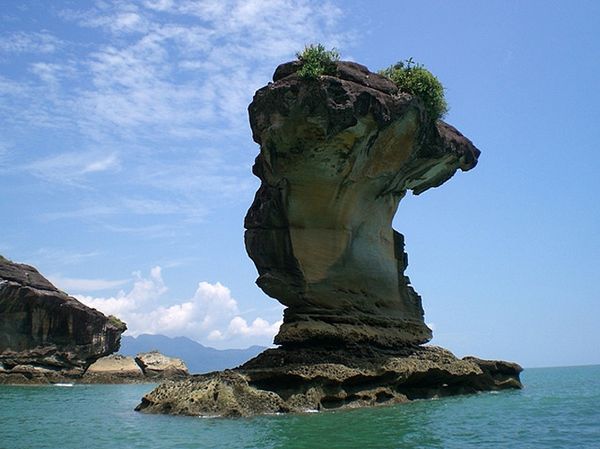
This photo comes from a superb series on Flickr by duke88. And, since all of the images are generously available for use through a Creative Commons License, I will leave you with another, patterns in the sand, nature’s sculptures, limonite and quartz.
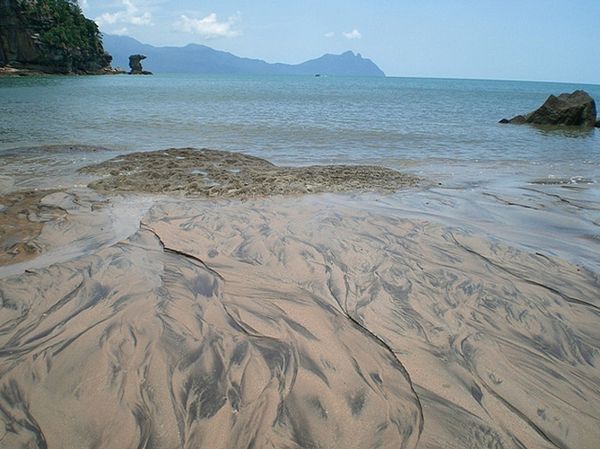
[Thanks to Patricia, the latest recruit in my army of arenokleptomaniacs, for collecting this sand from Bako for me.]
Comments
Great Emerson quote, thanks, a new one to me. Interesting to compare his sense of physical processes with his interest in Hinduism, reincarnation, and other metaphysical processes.
(e.g., http://www.bartleby.com/101/672.html)
This post provides a wonderful example of uniformitarianism in physical processes, because I’ve seen these forms–in Michigan: Pictured Rocks National Lakeshore.
(e.g., http://www.flickr.com/photos/jimbrekke/239786510/)
Limonite is very much part of those formations, but I can’t find any mention of duricrusts there. The weather’s probably nicer in Bali, but Pictured Rocks in snow is quite a sight.
Great post!
Liquid minerals are by far the best. They have been dissolved in a liquid, usually water and are in much smaller forms that powdered minerals.
I have only published your comment because it is a perfect example of the sort of spam that shows up regularly on my blog (and, I presume, others). Please market your rubbish elsewhere.