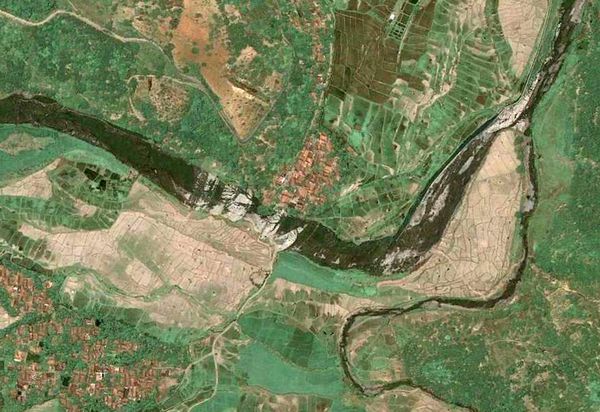
Continuing with my day out in Java, and geo-story-telling along the Cipimingkis River. The outcrops in the river are spectacular, a continuous tale of Miocene seas coming and going, leaving behind a sedimentary testament. The layers of rock crossing the river can easily be seen as the channel winds through the rice paddies in this Google Earth image:
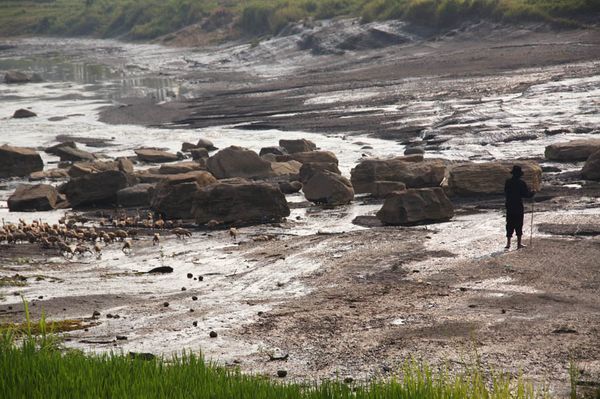
I noted what a strange river the Cipimingkis is, a river not only bereft of sediment, but one whose channels have been mutilated by the excavation and removal of that sediment – sand and pebbles – leaving only pools between bare rock and the huge boulders that bear witness to the power of the river in flood.
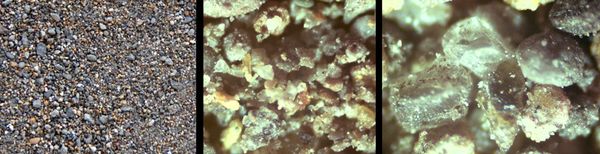
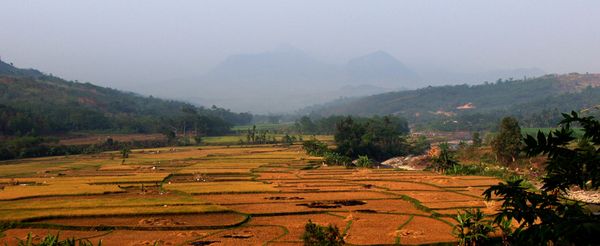
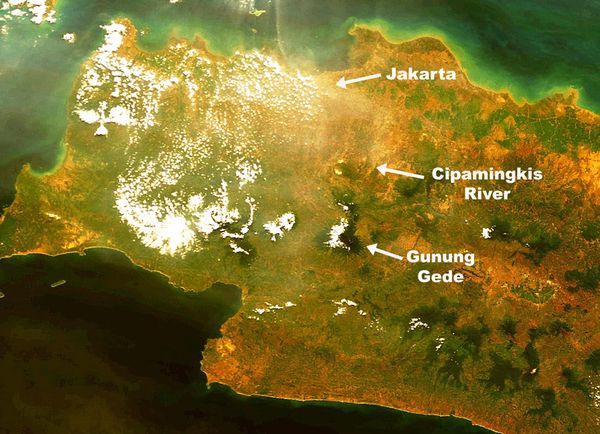
It took me a while, but I eventually found small accumulations of sand that had not been stolen from the system, and there it is at the head of this post. A fairly nondescript-looking grey-brown sand that nevertheless tells, as usual, a tale. Typical of an immature river sand, there are grains of every size (it’s poorly-sorted), and, with the exception of the occasional grain of pale limestone, is made up entirely of bits of volcanic rock. Which is hardly surprising, for the Cipimingkis drains northward down from the slopes of one of the great volcanic edifices of western Java, Gunung (Mount) Gede. Looking upstream in this photo, in the distant haze (the contrast enhanced so as to make it visible) looms the huge – and active – volcanic massif, its location shown in the satellite image.
So these sands record one side of the battle of the mountains – destruction by erosion versus rejuvenation by eruption. The other thing to note about these young sands, only recently torn from the volcanic hinterlands and transported but a short distance, is that the grains are little worn, and preserve their sharp edges and angular character. They make an ideal ingredient for concrete and hence the thriving business in their wholesale extraction: the roads leading to this area are lined with piles of sand and laden trucks constantly labour ponderously along those roads. Volcanic ashes to alluvial ashes, to concrete – undoubtedly to be, one day, liberated again.
[Satellite image of Java from http://www.geoinfo.ait.ac.th/modis/modday2008.php]
Comments
Is the sand young enough, and poorly sorted enough, to contain volcanic ash pozzolans as well? Truly ideal for concrete. And fertile volcanic soil alongside the river, it appears. Plentiful, the crumbs from the giant’s table, so long as the giant sleeps.
I suspect that you’re right - young and poorly sorted enough to contain the ingredients necessay for the chemical reactions of cement and concrete - amybe that’s why these sands seem to have become an unsustainable resource!
Considering the source, the consumers are perhaps just as glad to be spared the production process of a renewable resource. But what will future alien geologists make of sand so far from its congeners here, in Cambodia, and elsewhere? Even beavers act locally.
I hope you’ve been having a good adventure.
Its very handy to have these kind of resources available close to infastructure. I wonder if it will be taken advantage of.