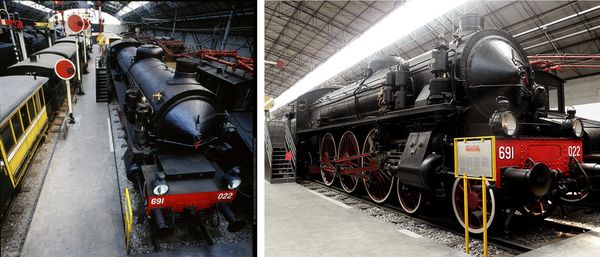
On the opening night of the AAPG International Conference in Milan, I was lucky enough to be invited for a guided tour of the Museo Nazionale della Scienza e della Tecnologia "Leonardo da Vinci," followed by dinner in the part of the museum that was once an old priory. It was an altogether enjoyable experience, and one that started off with one of those odd, random, and entertaining convergences. The first stop on our tour was the transport hall, a cavernous space filled with diverse means of locomotion, and we spent a while examining a serious piece of engineering in some detail – steam locomotive 691-022, built in 1914, and retired from the Milan to Bologna route. It of course caused nostalgic conversations amongst those of us of a certain age, the personal archives of sight, sound, and smell being stimulated and re-lived.
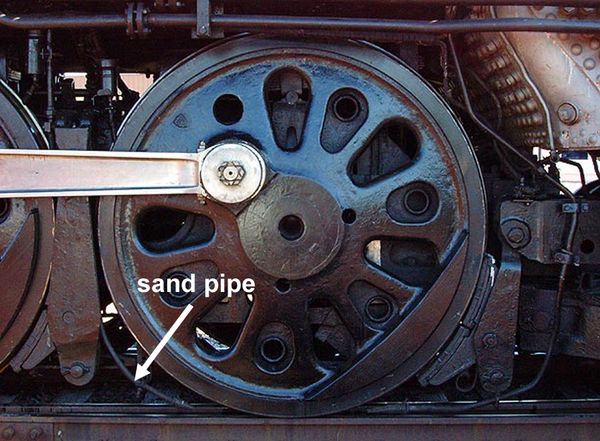
Towards the end of his description of this leviathan, our guide posed a question: “given the lack of friction between the wheels and the track, how was the monumental momentum of this locomotive countered when trying to bring the thing to a halt?” Rather modest brake shoes were observed, but it was agreed that they would be quite ineffectual since the whole thing would simply continue to slide. It was, inevitably, yours truly who felt compelled to shout out “sand!” The dome on the top of the boiler (visible in the photos above) was the sand box from which a pipe can be seen leading downwards to feed the sand onto the track. Of course, yours truly had failed to bring a camera for the occasion, but here’s a photo (courtesy of this website) of the same mechanism on a US locomotive of around the same vintage – the brake shoe is also clearly visible.
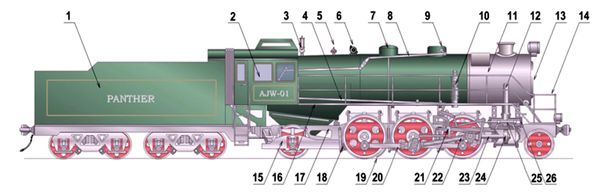
Go to Wikipedia for the workings and components of a typical steam locomotive, and on the associated diagram, number 7 points out the sand dome (or sand box) and number 19 the sand pipe:
Look up “sand box” on Wikipedia and you will find the following:
A sandbox is a container on most locomotives and self propelled multiple units, or trams, (a type of train that runs on roads) that run on tramways and adhesion railways. The container holds sand, which can be dropped on to the rail to improve rail adhesion under very wet or steep conditions.
The sand may be delivered by gravity, by a steam-blast (steam locomotives) or by compressed air. Gravity sanding requires that the sand is dry so that it runs freely. Steam locomotives in the USA had a single sandbox, called a “sand dome” placed on top of the boiler where the rising heat helped to dry the sand. Even with this arrangement, sand pipes tended to clog, and by the 1880s, pneumatic sanding systems were being proposed. On diesel and electric locomotives and railcars, sandboxes were and are fitted close to the wheels so as to achieve the shortest possible length of delivery pipe. Depots may have a sand drier installed to warm and to dry the sand before it is used.
Our guide at the museum pointed out that that even this method of slowing down the train was hardly rapid – he told us that, from a speed of 120 km’/hr, it would take 100 kms to halt this train. We found this hard to believe – but he did point out that the distance from Milan to Bologna is 300kms.
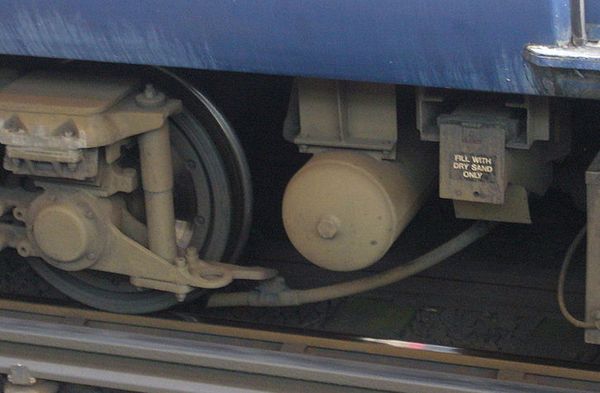
Now, this may seem like old technology, but it isn’t. The Wikipedia page on on the sand box includes the following image from a current UK train; note the reminder to “fill with dry sand only” – the assumption must be that the engineers responsible for maintaining this piece of kit have never built a sandcastle.
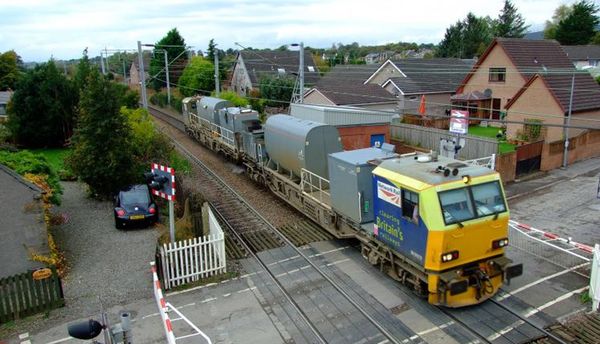
And, this is not the end of the story with respect to the value of arenaceous materials in the running of the railways. There is a standing joke here in the UK that originates from our illustrious rail network’s explanation of timetable disruptions by “the wrong kind of snow.” This is second in infamy to the excuse of “leaves on the track.” It seems that autumnal shedding by the arboreal borders of much of this country’s rail system comes as something of a surprising inconvenience. But, yet again, sand comes to the rescue – through a material that I had never encountered before looking into the background for this post, a material that should be elevated to a prominent position in the arcane world of arenophilia: SANDITE!
Please consult scot-rail.co.uk, “Scotland’s online railway community,” to learn about methods that “are used to improve track conditions during the leaf fall season. This is done using a combination of water cannons and the application of sandite (a thick sand based paste that improves adhesion) to the rail surface.” Here’s the delivery system - the tanks are, presumably, full of…sandite.
I never cease to be astonished……
[Photos of the 691-022 from http://www.viaggivacanze.info/newsite/2011/02/milano-se-la-conosci%E2%80%A6-te-ne-innamori/ and http://commons.wikimedia.org/wiki/Category:FS_691; modern sand box image licensed under the Creative Commons Attribution-Share Alike 3.0 Unported license. Attribution: Roger W Haworth]
Comments
Wow, I had no idea! thanks, I will look for the sand equipment the next time our big steam locomotive (historical) comes through.
Astonishment is definitely a feeling to hold on to. I hope to always contain the capacity for astonishment. Far superior to jaded boredom.
I very much enjoy learning this information about the sand, because I have friends who hop trains. One even calls himself “Brakeshoe.” If I hopped trains, I would name myself “Sand Dome.”
Absolutely - astonishment is something to be treasured and sought, a daily dose…
And should you ever take on the mantle of “sand dome,” you might like to choose your style from the selection inspired by classical architecture - see http://www.pacificng.com/ref/locobuilders/docs/sand-box-orders.gif
But this is the glory of a great idea, subject, insight–it reappears everywhere.
http://en.wikipedia.org/wiki/The_Hedgehog_and_the_Fox
You are a classic hedgehog success story, Michael. If perhaps not to this extent of involvement with your material:
http://www.youtube.com/watch?v=a2Mn_ic-0K4
Blaize, if you see this, enormous thanks for that link to the sand box orders. The human desire for dignity is endlessly touching.
I like your assonant title. A possible alternative occurs to me: Sand, Steam, and Loss of Speed
http://www.nationalgallery.org.uk/paintings/joseph-mallord-william-turner-rain-steam-and-speed-the-great-western-railway