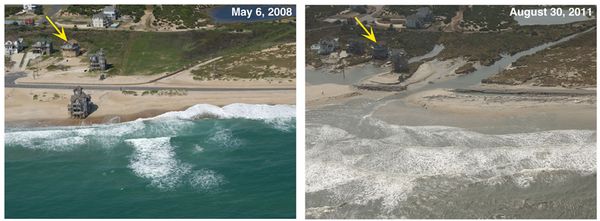
I hardly need comment – before Irene, I wrote the “Nourish or Retreat?” post and then she proceeded to underscore the validity of the question. The USGS has, of course, some provocative images, a number of which I have reproduced here, and we all look forward to their more detailed analysis. I shall simply introduce a gallery of selected images with some pre-Irene words from Orrin Pilkey, guru emeritus of coastal processes, extracted from an article in the Los Angeles Times in which he described how sand supplied by large magnitude storms is essential to the survival of barrier islands:
The storm that is coming up the coast here is just what the islands need. We are going to see an awful lot of buildings destroyed and an awful lot of buildings damaged, and because it’s so slow-moving, there are not only going to be high winds and big waves, but they are going to last a long time. A naturalist living on a barrier island knows that protecting your house is not a good thing, because protecting your house ends up destroying the beach.
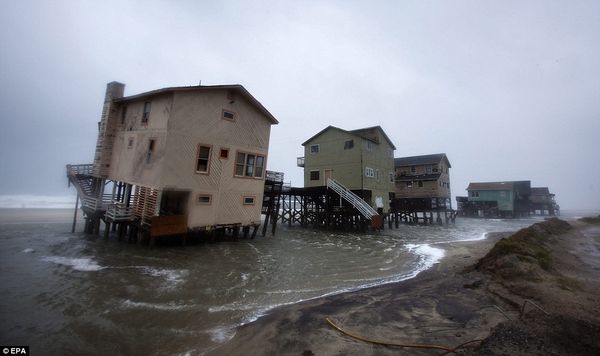

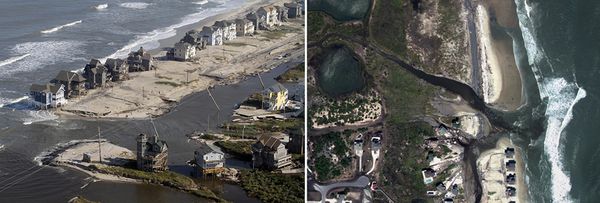
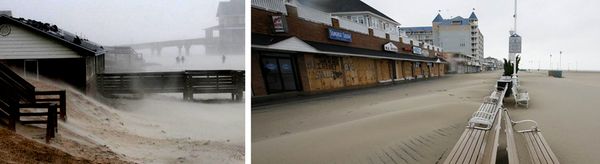
I’ll end with a piece from Live Science, during Hurricane Ike back in 2008 and titled “Ike Underscores Foolishness of Building on Barrier Islands.” Note that Pilkey had a few words of wisdom here too:
“Barrier islands are exposed to the open ocean, and the waves and storm surges generated by hurricanes,” said Bob Morton, a geologist at the U.S. Geological Survey’s Center for Coastal and Watershed Studies in St. Petersburg, Fla. “As a storm makes landfall they’re the ones that are going to receive the strongest winds and the highest wave actions.”
Barrier islands like Galveston are particularly vulnerable to storm damage because they are made of sand, as opposed to the hard bedrock that underlies larger islands and the mainland. They also tend to have very low elevations, making it easy for water to wash over and submerge the island.
Many have questioned the wisdom of choosing to build on and develop barrier islands, given their risks.
“Every year there’s reporting on the foolishness of building on barrier islands, but people are going to do it anyway,” Morton told LiveScience. “We don’t learn from the past. If you look at the barrier islands on the Mississippi coast in particular, after both Hurricane Camille in 1969, and Katrina, what did they do? They rebuilt. It’s a perfect example of a coastal area that did get hit as bad as it can get, and they just go back and rebuild.”
Barrier islands tend to be even riskier places to live than coastal areas, because they bear the brunt of any approaching storm impact.
“If you think about their location, they’re basically lonely sentinels that serve as barriers for the mainland,” said Clark Alexander, a marine geologist at Georgia’s Skidaway Institute of Oceanography. “Basically you’re in a vulnerable spot, because you’re located where you get the first effects of anything coming in off the ocean.”
Setting up residence in these vulnerable spots is particularly perilous.
“From a safety standpoint, it’s silly,” Alexander said. “Because the lifespan of a typical house is something like 60 years. But if you live on a barrier island, you can’t guarantee you’ll have land under your house in 60 years. It’s trying to put something permanent in a place that’s very dynamic.”
As a result of Hurricane Katrina, a number of barrier islands off the Mississippi coast were completely wiped off the map. Even when storms aren’t enough to raze islands completely, barriers often suffer severe damage from storms.
The 1989 Hurricane Hugo wreaked massive havoc on Pawleys Island in South Carolina. Isles Dernieres off the coast of Louisiana was devastated by Hurricane Andrew in 1992. Often, after these storms, people move back and set themselves up for disaster again.
St. George Island on Apalachicola Bay off the Florida coast “has been washed away five or six or eight times and people just keep building back their houses,” Alexander said.
For many people living on barrier islands, there is no amount of structural support that can ward off the worst.
“It’s important to note that in the big storms, the category 4 or 5 hurricanes, it really doesn’t matter how well-constructed your building is,” said Orrin Pilkey, a professor emeritus of geology at Duke University, of homes on barrier islands. “And it doesn’t matter whether you have a seawall or not. The chances are pretty good that if you have beachfront property, it’s history.”
Isn’t it about time we seriously addressed the question of whether further expenditure of money and resources in a futile and puny effort to battle natural processes is actually worth it?
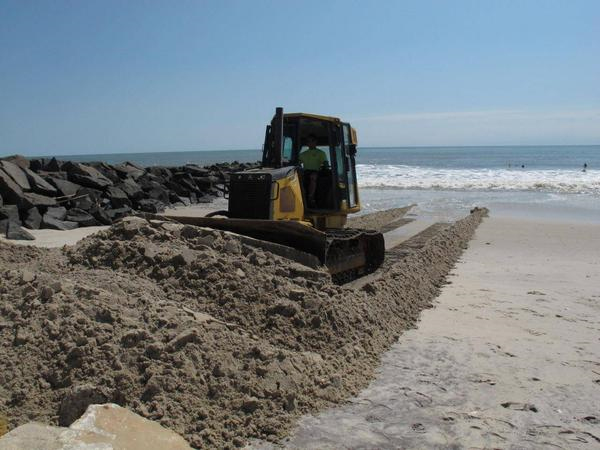
But here we go again, shifting New Jersey sand around just days after Irene.
[Thanks to the USGS, AP, CNN and other sources for the images. For more on barrier islands, just put “barrier” into the search function on this blog.]
Comments
There is a well known technique to preserve a city on a barrier island, that Galveston did after 1900, raise the city 15 feet, and put in a sea wall. Recall that the 1900 storm is still the worst natural disaster in US history. But of course today you could not do it the environmental impact statements and the court proceedings would drag on longer than a lifetime. Back then it was done by the locals without a lot of federal aid. Of course other towns on the Texas barrier islands died due to storms Indianaola being an example. Where 2 storms about 11 years apart did the town in. Basically these are the two options, but since #1 can not be done abandonment is the only way to go.
Tom Robbins imagines the reaction of California Indians to the San Francisco earthquake of 1906:
“It was when the fires were at last controlled and the citizens began to rush back into the still-warm ashes, praising the Lord, and shouting to one another their plans for rebuilding their metropolis, that Indian eyes widened in disbelief. They simply could not comprehend what they were witnessing. They realized that the white man lacked wisdom, but was he completely goofy? Couldn’t he read the largest and most lurid of signs?..Rebuild the city? They shook their heads and muttered.”
A Peter Cook skit character says, “Yes, I have learned from my mistakes–and I believe I could repeat them exactly.”