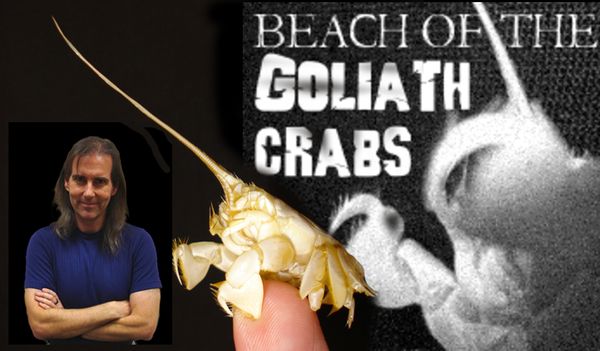
We don’t much think about sand as an environment, a home for critters that can be more or less welcoming, its inhabitants more or less thriving. But of course sand is home to a mind-boggling menagerie of critters on a mind-boggling range of scales; I have written, for example, about bubbler crabs, sandfish, the beast of Bali, the Southern Stargazer, and our good beach companions, the meiofauna (whom we should appreciate even more given the recent report on the hazards of building a sandcastle).
But today, it’s back to crabs, the variety of sand crab known as Lepidopa benedicti to be precise. Back in January, Zen Faulkes, otherwise known as “Dr. Zen,” a researcher at University of Texas-Pan American, wrote a fascinating guest post here on these retiring and unheralded critters. He talked about the mysteries of colour differences amongst his sand crabs, but now his focus is on size. It seems that Lepidopa benedicti on the Atlantic coast of Florida are substantially bigger than their relatives along the Gulf Coast, and Dr. Zen wants to know why.
To help him with the fieldwork, he has this project up for (very modest) funding from the innovative “crowdfunding” initiative, RocketHub. Here’s his description from that site – which is well worth visiting to watch a video of him talking about his “Beach of the Goliath Crabs” project, and, should you wish, to make a contribution.
They say, “Everything is bigger in Texas!” But that’s not always true.
Sand crabs are hipster crustaceans: you probably haven’t heard of them. They live submerged in sand and leave no traces where they are that you can see from the surface.Lepidopa benedicti live in the Gulf of Mexico, and on the Atlantic side of Florida. Museum records claim this sand crab is 50% longer in Florida than in Texas. This would be like finding a group of people who are 8-9 feet tall!
Why are Atlantic sand crabs bigger than those from the Gulf of Mexico?
One possibility is that the Atlantic environment is much better for sand crabs. If so, sand crabs might be a good species to monitor beach health.
Another possibility is that no animals move between the Atlantic and the Gulf. They might be drifting apart genetically and starting to form new species. This can be tested using DNA to see how similar the populations are genetically. Sand crabs might be a good species to study a big question in marine ecology: how do small, slow-moving animals spread from place to place?Your donation will buy supplies (sample jars, alcohol to preserve samples, DNA sequencing supplies) pay travel for a student to come with me to gain research experience!
I am already going to Florida later this year as part of my first SciFund project (Doctor Zen and the Amazon Crayfish Civilization). Your contribution will allow me to tackle a second project on the same trip, giving me more bang for your buck!
Comments
No comments yet.