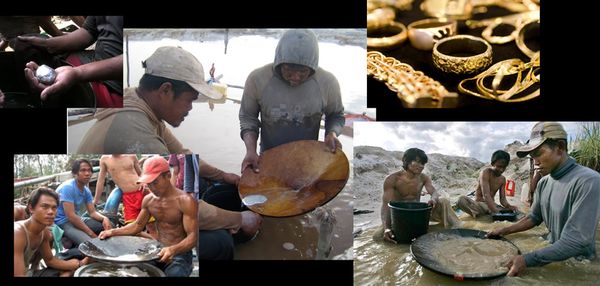
The Mad Hatter was mad as a result of poisoning from the mercury used in curing felt. Today’s artisanal gold miners are poisoned by the mercury used to extract the precious metal. Perhaps 15% of gold production today still comes from the small-scale activities of more than 50 million people in seventy countries around the world (see http://www.artisanalgold.org/home). And one of those countries is Indonesia, where, as is commonly the case, the gold is mainly extracted from placer sands and gravels by the age-old process of panning. Gold panning may be back-breaking work, but the real health hazard comes with the mercury used to further purify the product: mercury attracts the gold, forming an amalgam, and the mercury is then burnt off to leave the gold behind:
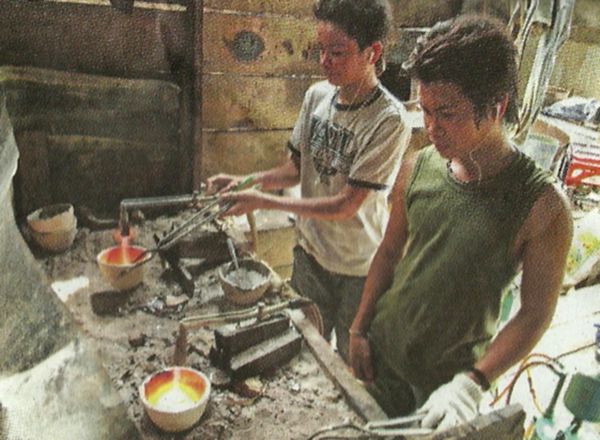
There are relatively simple and effective devices that can prevent the mercury vapour escaping into the air – and the bodies of the miners and all around them – but they remain the exception rather than the rule. I had not appreciated the extent of this problem and was recently horrified to read (and see the images from) the following piece in the Jakarta Globe:
**Indonesia’s Poisonous River of Gold: The Mercury Dilemma
**March 29, 2012Esrum has always gone to the river near his house when he needs something for his family.
“Our ancestors always had two things to sustain them: the jungle and the river. The jungle provided us with our basic needs and the river with gold, so we could buy what we could not get from the jungle,” Esrum said.
For decades, villagers in Tumbang Anoi in Central Kalimantan have panned for gold in the Kahayan River, and for generations the system worked well. But at the end of the 20th century, a relatively cheap and efficient way of extracting gold was introduced that used mercury.
A deadly combination
**
Mercury binds particles of gold together, forming an amalgam of metals that miners are then able to burn to remove the extraneous mercury. The process works well, but what Esrum and his fellow small-scale miners did not know was that this deadly toxin can enter the air, water and ground, poisoning the fish they eat, the water they drink and the air they breathe.
Even in small quantities, mercury can cause severe health problems like miscarriages, brain damage, tremors, kidney, skin and eye problems and even death. These symptoms can appear quickly, or over a long period of time. Mercury is especially dangerous to young children and pregnant mothers, who can pass on the poison to the unborn child.
As background levels increase in the environment, more people, even outside of the mining community, are threatened.
The worst recorded case of mercury contamination was in Minamata, Japan, where thousands of people were poisoned by methylmercury as a result of eating fish. The mercury was released in the industrial wastewater of a Chisso Corporation chemical factory, taking place over decades from 1932 to 1968.
The mercury accumulated in sea life in Minamata Bay and the Shiranui Sea, and while human, cat, dog and pig deaths continued for some 30 years, the government and company did little to prevent the pollution. As of March 2001, 2,265 victims had been officially recognized — 1,784 of the victims have died — while more than 10,000 other related parties have received financial compensation from Chisso.
By 2004, Chisso had paid $86 million, and was also ordered to clean up the contamination. In 2010, a settlement was reached to compensate as-yet unverified victims.
“We want to prevent the Minamata incident from appearing here in Indonesia,” said Sumali Agrawal, head of the Mercury Project, part of a nonprofit foundation based in Central Kalimantan.
“But mercury contamination is already widespread in Kalimantan and Sulawesi, as well as other islands, including Java. Small-scale gold mining is by far the greatest cause of mercury emissions in Indonesia. Even in Bogor, near Jakarta, 17,000 kilograms of mercury are emitted by gold processors every year. In Central Kalimantan, over 50,000 kilograms are emitted into the environment each year in one location alone.”
The Mercury Project was implemented by Yayasan Tambuhak Sinta, a nonprofit foundation set up by Kalimantan Gold Corporation, a minerals exploration venture that supports sustainable mining practices. Its mercury remediation program receives support from the Blacksmith Institute, the United Nations Environmental Program and the US Environmental Protection Agency.
**
A way out
The foundation works with local miners and introduces recycling technology that reduces mercury emissions by up to 95 percent. But it’s not just the miners who need to understand the dangers of using mercury; the entire community must be made aware of the risks in order for real change to occur.
“I really didn’t understand how mercury could hurt my family,” said Nyai, who lives in the mining area. “My kids even played with it. We would burn the amalgam in the open. I never thought breathing the smoke could harm us.”
Getting mercury recycling equipment to gold miners and processors is just one way to help reduce the impact of mercury on the environment. Each of the cheap and simple retort devices supplied by YTS recovers mercury directly and immediately reduces the quantity that escapes into the environment.
In January 2007, YTS created a water-box condenser as a low-cost solution to prevent pollution from gold shops as part of efforts from the United Nations Industrial Development Organization and the Global Mercury Project. UNIDO provided these mercury recovery systems to 36 gold shops in a village in Katingan district. Their mercury-pollution program has since been extended with funding from the Blacksmith Institute, and now covers six districts in Central Kalimantan.
The water-box condenser traps mercury fumes inside a plastic box filled with water. Equipment distributed last year directly prevented 3,400 kilograms of mercury from being released into the air.
YTS is also working to introduce mercury-free methods such as gravity separation and direct smelting with borax. This method has been used successfully in the Philippines for decades but has not yet been implemented in other areas.
A 1967 law on mining practices prohibits small-scale mining except in designated community mining areas. However, the rising price of gold, decentralization, lack of natural resource management and unclear regulations have contributed to the rapid spread of mining with mercury across Indonesia over the last 15 years.
There is also a lack of alternative employment for many of the people in these new gold mining communities. In 2006, 570 mining hot spots were identified that involved 50,000 miners and 300,000 ancillary people who depended on small scale mining activities.
By 2010, more than 800 hot spots were found throughout the archipelago.
**
A global issue**
Nearly a third of the world’s gold production comes from more than 15 million small scale miners, including one million child laborers. The mercury problem affects many developing countries in Latin America, Africa and Asia. In many countries, small-scale mining is an important driver of economic development, but one that brings unacceptable health and environmental consequences.
Experts from MercuryWatch estimate that small-scale mining releases at least 1,400 tons of mercury into the environment every year. For every kilogram of gold mined, at least three kilograms of mercury are released into the ecosystem.
The international effort to ban mercury has caused a sharp rise in the price, which is having a beneficial impact, limiting some of the worst practices such as pouring mercury into rock-crushers.
Indonesia is one of 140 countries that has agreed to outlaw the use and production of mercury by entering into a legally binding international treaty on the toxic liquid metal.
“Now, more than ever before, it is vital that artisanal miners are empowered to change their practices in order to prevent further mercury contamination of our environment,” Sumali said. “This will require a coordinated effort from all stakeholders in this sector, working hand in hand with the government and the global community.”
Yayasan Tambuhak Sinta
Jl. Badak VII No.2, Bukit Tunggal
Palangka Raya
Central Kalimantan
[email protected]
www.tambuhaksinta.com
So, our desire for bright, shiny, precious stuff provides a livelihood for tens of millions of people around the world – but, at the same time, poisons them. Nevertheless, there are solutions and these are being actively addressed by organisations on all scales, from the local YTS in Kalimantan, to the UN Development Programme. May they be successful. Let’s hope that toxicity can be eliminated, and, just as “blood diamonds” became part of our terminology, “dementia gold” becomes part of our consumer awareness.
[Images from the Artisanal Gold Council, the Jakarta Globe, and the Jakarta Post. For further excellent resources, see, for example, http://www.blacksmithinstitute.org/blog/?p=121, http://bario-neal.com/bn/blog/?p=1197, http://www.epa.gov/international/toxics/mercury/asgm.html, and http://www.msnbc.msn.com/id/28596948/ns/world_news-world_environment/t/mercury-gold-mining-poses-toxic-threat/]
Oh, and wasn’t I self-disciplined in making no commentary on the Tea Party?
Comments
Thanks very much for this story, Michael. It’s good to know that somebody is trying to make this bad situation better, and I share your hope for greater awareness. I hope as well that consumers become more aware of the cyanide and sulfuric acid used in processing 90% of gold ore, from hard rock mines, and then too often found in rivers and ground water.
Yes, your restraint is admirable. Surprising, even.
These people put their lives on danger in order to produce gold but did you know that they aren’t paid that much, now isn’t that ironic knowing that the price of gold in the market is quite high.