This time, imagine that you’re a scorpion, a fattail scorpion to be precise (sorry, but I never said anything about this role-playing being about cuddly and loveable, handsome or cute, but it’s often critters from the less celebrated realms of the animal kingdom that demonstrate the most remarkable skills). You are going about your desert business, scurrying across the sand in search of something to slaughter, when a sandstorm blows up. What should you do? Quickly seek shelter, bury yourself in the sand? Absolutely no need if you’re Androctonus australis, because you, unlike much of the world’s mechanised military, have developed an extraordinarily clever resistance to windblown sand. Blasting that can frost a windshield, clog up a filter, render many moving parts unmoving, never mind erode rocks, simply blows by you – sand off a scorpion’s back.
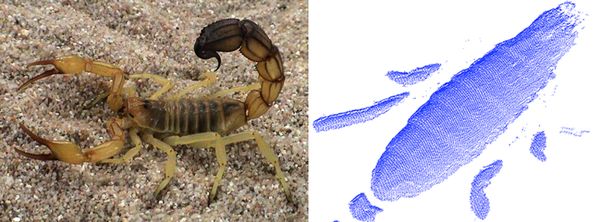
The yellow fattail scorpion (Androctonus australis) is an unpleasant creature, growing up to 10 cms in length, and capable of an envenomation that is dangerously and mortally toxic. But on their backs, they carry a bionic shield against sand abrasion, an exoskeleton that has bumps and grooves, the design of which cunningly deflects flying sand grains (illustration above, right).
All this has been recently revealed by a group of researchers at the Key Laboratory of Bionic Engineering, Jilin University, China, and published by the American Chemical Society. Erosion Resistance of Bionic Functional Surfaces Inspired from Desert Scorpions describes how these scorpions use microtextures to achieve erosion resistance, and how the researchers used Computational Fluid Dynamics to understand how these patterns work. The results have significant implications for the mechanised military (not to mention, perhaps, Toyota and Land Rover). Here’s the account from Science Daily:
Taking inspiration from the yellow fattail scorpion, which uses a bionic shield to protect itself against scratches from desert sandstorms, scientists have developed a new way to protect the moving parts of machinery from wear and tear.
A report on the research appears in ACS’ journal Langmuir.
Zhiwu Han, Junqiu Zhang, Wen Li and colleagues explain that “solid particle erosion” is one of the important reasons for material damage or equipment failure. It causes millions of dollars of damage each year to helicopter rotors, rocket motor nozzles, turbine blades, pipes and other mechanical parts. The damage occurs when particles of dirt, grit and other hard material in the air, water or other fluids strike the surfaces of those parts. Filters can help remove the particles but must be replaced or cleaned, while harder, erosion-resistant materials cost more to develop and make. In an effort to develop better erosion-resistant surfaces, Han and Li’s group sought the secrets of the yellow fattail scorpion for the first time. The scorpion evolved to survive the abrasive power of harsh sandstorms.
They studied the bumps and grooves on the scorpions’ backs, scanning the creatures with a 3-D laser device and developing a computer program that modeled the flow of sand-laden air over the scorpions. The team used the model in computer simulations to develop actual patterned surfaces to test which patterns perform best. At the same time, the erosion tests were conducted in the simple erosion wind tunnel for groove surface bionic samples at various impact conditions. Their results showed that a series of small grooves at a 30-degree angle to the flowing gas or liquid give steel surfaces the best protection from erosion.
So just orient yourself appropriately to the wind, and scuttle off on your evil way.
[See also the Physorg.com report. Oh, and Richard, “envenomation” was especially for you…]
Comments
OK, I’m scuttling! Wind oriented, but it’s snow with which I must contend.
Thanks, Michael, I admired ‘envenomation’ even before I saw your note. Good of you to keep me in mind.
This study reminds me of the work on dolphin hydrodynamics and possible adaptations to reduce fluid friction on torpedoes and submarines: http://darwin.wcupa.edu/~biology/fish/pubs/pdf/2006B%26BGray’sParadox.pdf
Nature does good design. Like those tunnelling prisoners of war, nature has the resource of time.
I do hope that “like sand off a scorpion’s back” becomes a common saying.
Like the blog, appreciate the share!