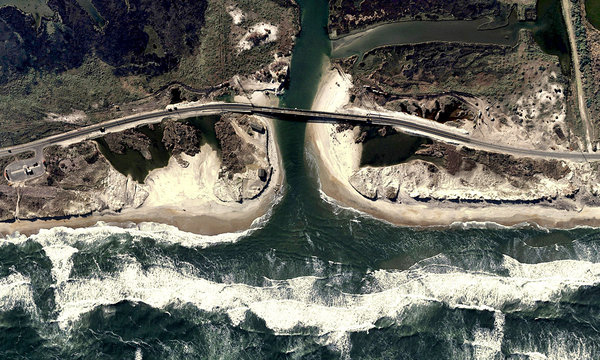
As someone who tries to write regularly on diverse topics that not only interest me, but, hopefully, interest others, an occasional gift horse appears, or, to mix metaphors, a whopping great drum that is just asking to be beaten – again. There have been a few drums over the course of this blog, but none appearing so regularly as the one representing the issues of coastal management – a veritable timpano, together with seductively large drumsticks just begging to be taken up and used. And here’s that drum again.
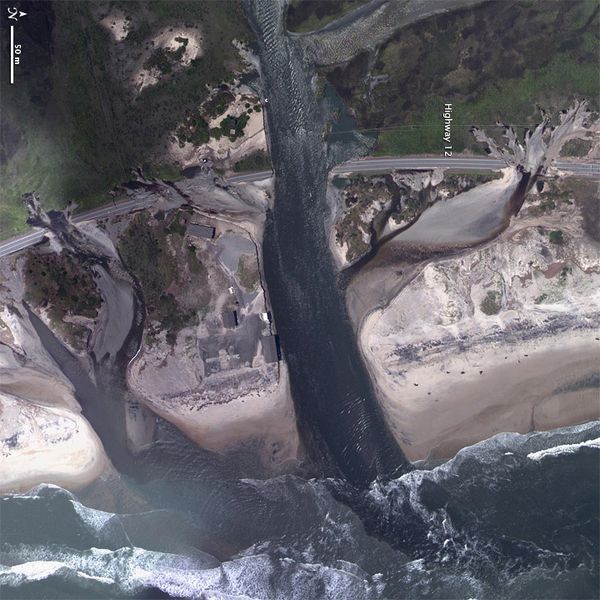
Last year, I wrote a short piece on the aftermath of Hurricane Irene on the barrier islands of the Outer Banks. By the time the storm hit Hatteras, it was no longer a major hurricane, but nevertheless, it played the game that storms and barrier islands have always enjoyed, dramatically re-designing the geography by creating new inlets that sliced and diced the thin strips of sand. Highway 12, the “lifeline” of the Outer Banks, was cut in two places. As described in this New York Times article (titled “A North Carolina Lifeline Built on Shifting Sands” and spotted by an alert reader, Stephan Bossert), a temporary bridge was quickly constructed and the highway was back in operation in October last year. But “temporary” just goes with the territory in the saga of a barrier island, and the bridge is already in trouble:
By January, engineers were reinforcing its southern approach with sandbags and rock trucked in from the mainland, in hopes of keeping the road open until a more permanent fix could be designed and built.
And, unfortunately, this is only one of a series of problems that afflict this shape-shifting chain of islands:
Last summer, the state confronted what engineers called “advanced deterioration” of the Herbert C. Bonner Bridge, which carries the highway from Nags Head to the Pea Island National Wildlife Refuge, on the north end of Hatteras Island… The state opted for a replacement bridge that will run right alongside the existing span; planning is under way.
Now I have cited on numerous occasions in this blog, the wisdom of Robert S. Young, a coastal geologist who is head of the Program for the Study of Developed Shorelines at Western Carolina University, in particular during the Gulf Coast berms fiasco. Young calls the replacement bridge project “our own little bridge to nowhere.”
They can engineer that bridge so well that it can withstand a Category 3 or 4 hurricane,” Dr. Young said in a telephone interview. “The barrier island it is connected to cannot."
And there is the nail (or the drum) hit firmly on the head. As the NYT article notes:
Barrier islands like the Outer Banks are inherently unstable. Waves typically strike these islands at a slight angle, creating currents that pick up sand and carry it along the coast. The wave energy along the Outer Banks is unusually strong; by some estimates 700,000 cubic yards of sand, enough to fill 70,000 average-size dump trucks, moves along that stretch of coast every year.
At the new bridge, evidence of this process appeared even on opening day, in the form of long-necked black water birds called cormorants perching on a spit of sand that had formed near the north side of the bridge. That spit had not been there a few days before, said Pablo Hernandez, the transportation department engineer who managed the bridge work.
“It’s very difficult,” he said. “This whole thing has been constantly moving and shifting.”
As he spoke, waves were already starting to cut sharply into the sand at the bridge’s southern flank, an area the engineers later reinforced.
and
Already, Highway 12 floods repeatedly and is often cut by storms. Maintaining it “is totally a lost cause,” said Stanley R. Riggs, a coastal scientist at East Carolina University who is an author of a new book, “The Battle for North Carolina’s Coast,” which describes in depressing detail the difficulties of keeping the road open. “It will bankrupt the state,” he said.
Now that book by Riggs and his colleagues is clearly one to add to the top of the list, another rational discussion of the science – what we know and what we don’t know – in managing complex coastal systems. But, as has been the case on so many occasions and in so many different places, the science is ignored and its proponents branded as pessimists in the face of vested commercial and residential interests. The loudest beating of the drum comes from lobbying groups who have the clout that mere academics do not. In this particular case, it’s the likes of NC20 and The Land Alliance of North Carolina. “Better Science for Better Policy” is the rallying cry of the latter group, and one of the former’s goals (mixed in with links to alternative views of man’s effect on climate change) is “To advocate for science based environmental rulemaking in all areas of environmental regulation.” These groups play the tired old game of “the science isn’t conclusive” to audiences who are not equipped to judge whether this is reasonable or even relevant. It’s a tired old game, but it’s an axe that grinds loudly (along with the timpani). These groups trumpet (is there no end to the orchestral references?) their major victory of persuading the North Carolina Coastal Resources Commission to emasculate the section in their recent planning document that addressed issues of sea-level rise.
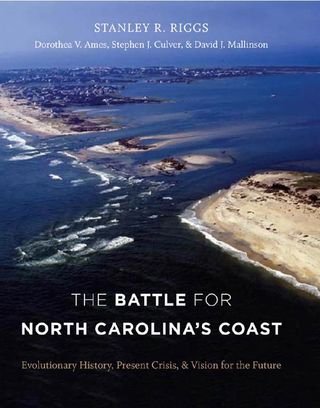 Sections of the book by Stanley Riggs et al. can be viewed online, and the first chapter, “Why is there a coastal conflict?” concludes with the following statement – one for which the biggest drum, the loudest axe, and the most brazen trumpet should be made available and listened to:
Our vision for the future of coastal North Carolina now requires the wisdom of policymakers and the concerted efforts of the public, coastal businesses, government agencies, and politicians to integrate science into management, informed by an awareness that our changing coastal system has natural limits to growth and development. If we are sufficiently farsighted, we can sustain a viable coastal economy in relation to the processes of change and, in doing so, preserve the natural resources on which that economy is based. As a result, more potential economic benefits would arise in the future than the current approach to coastal development could provide.
What are our alternatives? We must understand how the coastal system works and accept that reality. We must consider the challenges of coastal change to be opportunities. We can then determine the best ways to maintain our coastal economy and new ways to make a living on the coast. We should embrace the historical culture and the wild remoteness of the barrier islands and parlay those attributes into economic advantage.
Comments
What constantly amazes me is the level of investment in denial.
“When I first came here, this was all swamp. Everyone said I was daft to build a castle on a swamp, but I built in all the same, just to show them. It sank into the swamp. So I built a second one. That sank into the swamp. So I built a third. That burned down, fell over, then sank into the swamp.”
Amazing post and very interesting stuff you got here! I definitely learned a lot from reading through some of your earlier posts as well and decided to drop a comment on this one!