I chose the title of this blog to enjoy the symbolism of all that is evoked by the image of a sandglass (or hourglass – but many of them run for periods other than an hour). If ever there was a universal symbol of time, the sandglass is surely it, and time and change are very much what sand is about, on all scales. There was a time when a sandglass was placed in a coffin (in what would seem an unnecessary reminder that the sands of time had run out) and was a popular image on gravestones. There are times when a sandglass icon occupies our computer monitors to insist that we wait, whether we want to or not. And it is still the time when the classic opening of a long-running soap opera features an hourglass and the words, “Like sands through the hourglass, so are the Days of our Lives.”
The flow of time, the sands of time – powerful imagery, but sandglasses have always been useful, as well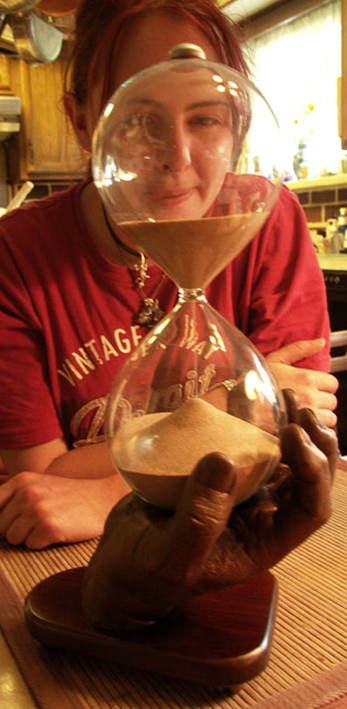 . The base is actually a cast of his hand – which caused me all kinds of problems at Philadelphia Airport security. The whole thing was carefully wrapped and secure in my backpack – which abruptly halted on its journey through the scanner. Security folk gathered round to examine the screen, with anxious looks gripping their faces. One of them turned to me and, in a strangled voice asked “Do you have a hand in there?”
It took some explanation.
Just sitting and watching the sand flow through a particularly spectacular hourglass is a strangely relaxing way of spending a little time – and, along the way, a lesson in fundamental physics and the laws of nature. Watch how the pile at the base behaves, building up in an organized way, but then re-organizing itself through a small avalanche – or a couple of small avalanches, or one large avalanche. Try to predict when and where the next avalanche is going to occur, and how big it will be, and you have no chance. Sort of like trying to predict an earthquake, and that’s because earthquakes and sandpiles demonstrate some of nature’s favorite behaviors – and provide some insights into the bizarre world of granular materials (more of that in a later post). The sandglass itself, to work properly, has to be a carefully designed conspiracy of sand, glass (which is made of sand) and geometry. Think about those intensely irritating timers that come with some board games and which always jam up when not watched, generally providing your opponent with advantageous extra time. They simply haven’t taken physics into proper account.
But coming back to the blog title, it’s obvious that I also, quite unashamedly, wanted to evoke Lewis Carroll’s Through the Looking-Glass, and What Alice Found There. My vision is of the interesting and exotic worlds we can find by gazing through a sandglass, never mind our old friends the Walrus and the Carpenter, weeping over “such quantities of sand.”

The Walrus and the Carpenter
Were walking close at hand;
They wept like anything to see
Such quantities of sand:
“If this were only cleared away,”
They said, “it would be grand!”
“If seven maids with seven mops
Swept it for half a year,
Do you suppose,” the Walrus said,
“That they could get it clear?”
“I doubt it,” said the Carpenter,
And shed a bitter tear.
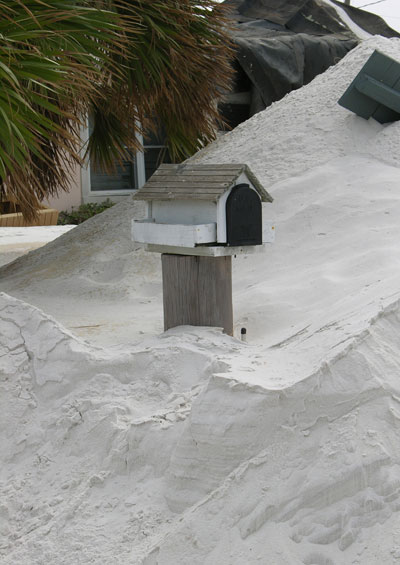
This dilemma is faced by coastal residents the world over, particularly following a major storm. The residents of Pensacola Beach, Florida, while having access to more resources than the Walrus and the Carpenter, no doubt felt the same way after Hurricane Ivan in 2004 (picture: US Geological Survey). Which raises the questions: why do so many members of our (arguably incompetent) species insist on living in some of the most dynamic environments on the planet? And why should they be surprised at the consequences? And who should pay for those consequences?
Comments
No comments yet.