Cue sounds of timpani, stage left and stage right. A couple of weeks ago, I wrote a drum-banging post about coastal management myopia; now, recent reports compel me to continue my instrumental activity. So let’s think a little about the implications of rising sea levels (emphasis on the word think).
It is a fact (which I choose to define as something supported by observation, measurement, and analysis – in other words, science) that sea levels have been rising and it is reasonable to infer that this will continue. The world is, in general, warming, and the laws of physics (if you choose to accept them) require that warming oceans expand in volume; the cause of the warming, and any so-called debate over human influence, is irrelevant. Expanding ocean volumes have to go somewhere, and that somewhere is, inevitably, low-lying coastal land. OK so far? Anything really to challenge here? Those questions are, of course, essentially rhetorical since I have good reason to believe that readers of this blog are capable of independent, rational thought. Now here’s the tricky bit: predicting the magnitude of future sea level rise at any place on the planet is not easy – there is (oh dear) some uncertainty associated with this. But perhaps we can, nevertheless, attempt to come to grips with this uncertainty, and plan accordingly? Unfortunately, the answer seems to be “no.”
In that previous post, I mentioned NC20, the lobbying organisation of twenty North Carolina counties, who declare that they “concentrate primarily on actions to prevent regulation and rule making not based on science.” That statement would imply that, in turn, they would support regulation that is based on science, yes? No. When presented with a report by the North Carolina Coastal Resources Commission (CRC) in which a group of nineteen scientists presented an assessment of sea level rise, the response by the NC20 Board Members (credentials) was as follows:
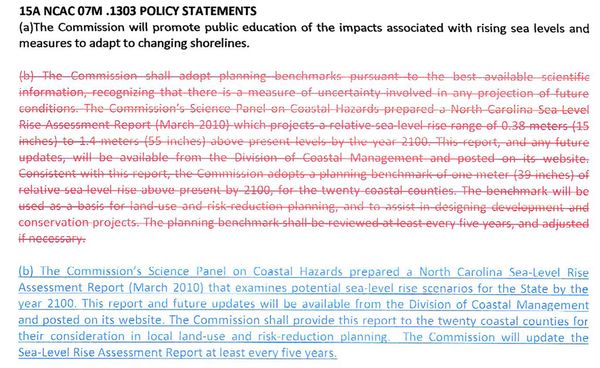
Perhaps the most impressive accomplishment to date was the complete reversal of the draft policy of CRC regarding Sea Level Rise (SLR). The draft policy presented by the Science Panel of the CRC mandated a planning component of 39 inches of SLR across the CAMA area. NC 20 Board members met in a private meeting with the Chair of the CRC and carefully laid out the unscientific assumptions used in the draft report, showing the numerous errors and inconsistencies. In the final presentation, all “mandates” were removed and the final document showed a sensitivity to the needs of the counties, the role of the CRC, and the need for a relationship characterized by scientific advice and assistance on the part of the CRC rather than ironfisted dictates. The “redlined” version of that final document is attached for your review.
Follow the link and you will see the original policy wording (deleted) and its replacement (I shall resist commenting):
And here, just for a laugh, are the “unscientific assumptions” on North Carolina sea-level rise (taken from the CRC report):
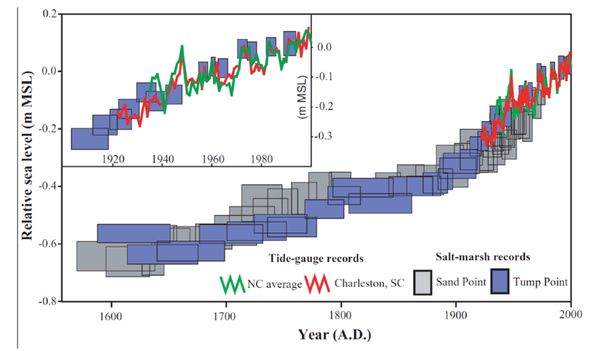
So this really is about noise: the decibels from the drumbeats and grinding axes of vested interest lobbying easily drown out the voices of nineteen scientists.
But for those who heroically maintain an interest in science and how it can inform planning and economics, let’s turn to the couple of recent reports that I mentioned, that address exactly this topic. First, there has been a fair level of justified (but not particularly cacophonous) buzz in the media about a report from Climate Central titled Surging Seas: Sea level rise, storms, and global warming’s threat to the US coast, published on the 14th March_,_ simultaneously with the research being published in the peer-reviewed journal Environmental Research Letters. Two pieces from the New York Times (grounds, I sadly realise, for them to be dismissed), one by Andy Revkin, the other by Justin Gillis, summarise the findings from the report. As Revkin quotes from the report, which makes it clear that it is not simple sea level rise itself, but associated storm surges that represent the threat:
Rising seas dramatically increase the odds of damaging floods from storm surges. For over two-thirds of the locations analyzed (and for 85% of sites outside the Gulf of Mexico), past and future global warming more than doubles the estimated odds of “century” or worse floods occurring within the next 18 years — meaning floods so high they would historically be expected just once per century. For over half the locations analyzed, warming at least triples the odds of century-plus floods over the same period. And for two-thirds the locations, sea level rise from warming has already more than doubled the odds of such a flood even this year….
Sea level rise has already cost governments and private landowners billions of dollars as they have pumped sand onto eroding beaches and repaired the damage from storm surges.
Insurance companies got out of the business of writing flood insurance decades ago, so much of the risk from sea level rise is expected to fall on the financially troubled National Flood Insurance Program, set up by Congress, or on state insurance pools. Federal taxpayers also heavily subsidize coastal development when the government pays to rebuild infrastructure destroyed in storm surges and picks up much of the bill for private losses not covered by insurance.
For decades, coastal scientists have argued that these policies are foolhardy, and that the nation must begin planning an orderly retreat from large portions of its coasts, but few politicians have been willing to embrace that message or to warn the public of the rising risks.
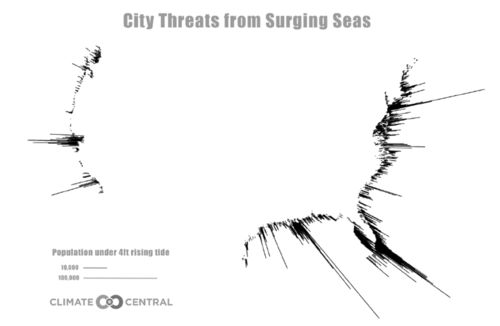
Some further selected key points:
- By 2030, storm surges combined with rising seas could raise waters to 4 feet (1.2 metres) or more above high tide lines at many locations; 4.9 million people live in 2.6 million homes in this vulnerable zone between the observed high tide and the top of expected flood waters.
- In 285 coastal cities and towns, more than half the population lives below the 4-foot mark, the Climate Central report found. Florida has 106 of these at-risk municipalities; Louisiana has 65, New Jersey and North Carolina have 22 each, Maryland has 14, New York has 13 and Virginia has 10.
- For two-thirds of the locations, sea level rise from warming has already at least doubled the annual risk of century-plus floods.
- The population and homes exposed are just part of the story. Flooding to four feet would reach higher than a huge amount of dry land, covering some 3.0 million acres of roads, bridges, commercial buildings, military bases, agricultural lands, toxic waste dumps, schools, hospitals, and more.
And a couple of quotes from Ben Strauss, one of the lead scientists authoring the report:
Sea level rise is like an invisible tsunami, building force while we do almost nothing. We have a closing window of time to prevent the worst by preparing for higher seas….
A lot of the state [of Florida] is built on porous bedrock, bedrock that’s like Swiss cheese. You can’t practically build a wall to keep the sea out. The water will come up through the ground….
Right now the projection for the end of the century is two to seven feet of sea level rise and seven feet would put a lot of Lower Manhattan under water if we didn’t build sea walls to protect it.
So, if the Board of NC20 were to read this report, what would they find about their state? Well, the report’s website has an excellent interactive map, and a series of fact sheets on each state; here are some headlines for North Carolina:
- Odds of a 100‐year flood or worse by 2030, with sea level rise from global warming: 24% (odds without global warming: 9%)
- Historic local sea level rise rate: 0.8 inches/decade; projected new sea level rise by 2050: 11 inches
- Population at risk: 76,000
- Homes at risk: 56,000
- Land area at risk: 1.2 million acres
- Towns and cities where at least half the population is at risk: 22
- Counties where at least 10% of the population is at risk: 9
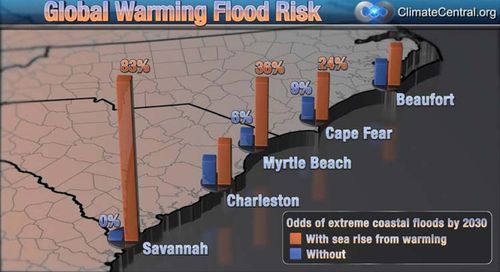
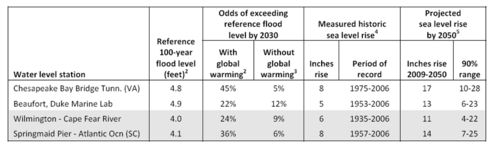 Perhaps grounds for a little planning effort? Supported by facts? Incorporating some science?
And then there’s the recently published study whose focus is on California; the study “Estimating the Potential Economic Impacts of Climate Change on Southern California Beaches,” is featured in a special edition of the peer-reviewed journal Climatic Change, and is the work of researchers at Duke University. The study again looks at the effects of sea level rise in the long term, and the short term effects of storms. As reported in Science Daily last month:
While some beaches may shrink or possibly disappear, others are poised to remain relatively large – leaving an uneven distribution of economic gains and losses for coastal beach towns, according to a study by researchers at Duke University and five other institutions.
“Some beaches actually stand to benefit economically from sea level rise, creating winners and losers among California beach towns,” said Linwood Pendleton, director of ocean and coastal policy at Duke’s Nicholas Institute for Environmental Policy Solutions. “We found, as relatively small beaches shrink more due to sea level rise, people will stop visiting them, opting for wider beaches.”
The same topic was addressed last year in a report by economists at San Francisco State University that examined the economic effects of sea level rise and storms on five California coastal communities:
The results suggest that visitor hotspots like Venice Beach could lose up to $440 million in tourism revenue between now and 2100 if sea levels rise by 4.6 feet (1.4 meters), a projection specific to the California coast, based on recent scientific studies. At San Francisco’s Ocean Beach, accelerated erosion could cause up to $540 million worth of damage.
“Sea level rise will send reverberations throughout local and state economies,” said Philip King, associate professor of economics at San Francisco State University. “We also found that the economic risks and responses to a changing coastline will vary greatly over time and from beach to beach.”
Here, as an example, are the estimated impacts on San Francisco’s Ocean Beach:
Ocean Beach (north of Sloat Boulevard), San Francisco County
Based on a sea level rise estimate of 4.6 feet (1.4 meters) by 2100, Ocean Beach could lose:
- $19.6 million in damages caused by a 100-year coastal flood damaging homes and contents. This is an increase of 200 percent from the present day risk of a 100-year flood, which is $6.5 million
- $82 million in tourism spending and local and state tax revenue losses (accumulated between now and 2100) caused by a narrower, eroded beach attracting fewer visitors
- $16.5 million in habitat and recreation losses, caused by erosion reducing the beach area by 92 percent (53 acres lost). Ocean Beach provides a habitat for native species such as the Western Snowy Plover, a bird that is federally listed as a threatened species
- $540 million caused by land, buildings and infrastructure being lost or damaged by erosion and subsidence
The facts, the predictions, the costs, the social implications, are there to be found, whether the result of work by universities, government agencies, or – as I happened upon – even the real estate “community.” The property site, World Property Channel, published the results of a “Special report: Long Island, Miami Have Highest Property Exposure to Storm Surge Damage as Hurricane Season Approaches” that was accompanied by dramatic graphics and the following figures:
Of the metro areas studied in the report, Long Island was found to have the highest exposure to risk, valued at $99 billion, followed by the Miami-Palm Beach region and Virginia Beach. Projected exposure to storm surge damage for the ten geographies is as follows:
Long Island, NY - $99 billion, Miami-Dade, FL - $44.9 billion, Virginia Beach, VA - $44.6 billion, New Orleans, LA - $39 billion, Tampa, FL - $27 billion, Houston, TX - $20 billion, Jacksonville, FL - $19.6 billion, Charleston, SC - $17.7 billion, Corpus Christi, TX - $4.7 billion, Mobile, AL - $3 billion
But, silly me, I’m forgetting that all this work, all these “facts," are flawed by “unscientific assumptions… showing the numerous errors and inconsistencies.”
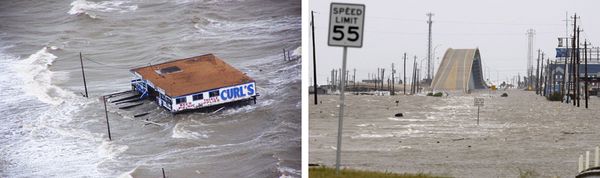
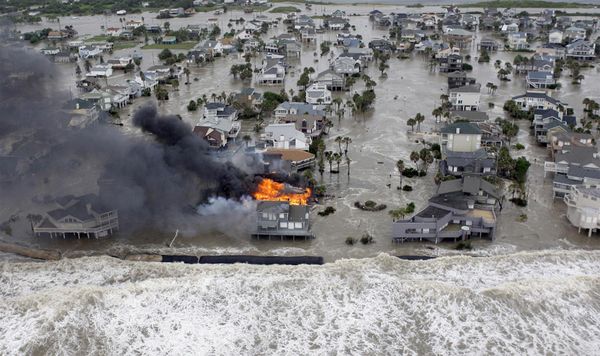
[Photographs: the surge before the storm swamps Galveston Island, Texas, and a fire destroys homes along the beach as Hurricane Ike approaches. (AP Photo/David J. Phillip). Flooding over access road 523 to Surfside beach, caused by Hurricane Ike forming in the Gulf of Mexico, is seen near Surfside Beach, Texas. (REUTERS/Carlos Barria). And http://myhydros.org/more-about-water/storm-surge/]
Comments
Michael- well summarized… OnPointRadio had a discussion on this topic of building near the coast - http://onpoint.wbur.org/2012/03/19/rising-tides. building near coasts is just not being discouraged, not just by real estate developers but by government policy as well…
Suvrat - thanks. This link is to a great radio report, including an interview with Ben Strauss,who participates for the entire program, and really compelling commentary from a variety of people, including on the insurance aspects of these issues. A must-listen-to program.
Michael, did the original report mention any impact on sea-level in NC of the effect of isostatic rebound following the last Ice Age? I suspect that the NC coast would still be sinking as the vast area of Canada freed from ice continues to rise. Also, considering how slowly water is warmed by the air above it, I doubt that the 0.7 deg rise in “average” temperatures since 1850 has had much to do with changing sea levels. Unless, of course, the oceans have warmed following the Little Ice Age, thereby causing the rise in air temperatures. Water is warmed much more by direct sunlight. Didn’t the sun have a Grand Maximum for most of the 20th Century? None of this is to say that NC planners should ignore the risks of rising seas, simply that any human produced CO2 has stuff-all to do with it. Never forget that we get all our energy from the sun.
Love your blog. Does your financial security require belief in the AGW scam?
Ray, thanks for the long and thoughtful comment!
There are a few things to address here, so I’ll try to take them one at a time. First of all, of course, “sea level” is a complex phenomenon, and the equation includes a large number of variables. Therefore, there are two kinds of SL measurement components, one the global or eustatic SL that reflects the volume of the earth’s ocean basins and the total volume of the water in them; this is affected by climate, the amount of water locked up in land-bound ice, global temperatures,the rate at which mid-ocean ridges are spreading (and therefore the volumes they take up), and a whole host of other, global-scale factors. Then, for any place on any coast, there’s the local relative SL rate of change. The big eustatic signal is overprinted by local geological events, subsidence and uplift that can be caused by tectonics, melting or advancing ice sheets, withdrawal of groundwater etc. It’s clearly this local relative SL rise that is of relevance to local communities and planners.
Now, the effect of receding ice sheets is very apparent on the entire east coast of North America, and it’s not simple. As the ice retreated and because the earth’s crust is like an elastic beam, there is a moving bulge in front of the ice, with an associated moving depression. So relative SL will change in a given location depending on where it is relative to this migrating bulge/depression. The history of this has been documented for the Atlantic Coast (see http://pubs.giss.nasa.gov/docs/1990/1990_Gornitz_Seeber.pdf). For North Carolina, changes were large from 10,000 to 5,000 years ago, but for the last 2,500 years the changes have been small. Most (but certainly not all) SL change has been the result of eustatic SL rise and local effects such as the withdrawal of groundwater and the consequent subsidence. The CRC report contains the following statement: “The cumulative data from these four investigations indicate that RSL change varies as a function of latitude along the NC coast, with higher rates of rise in the north, and lesser rates of rise in the south. This is a function of the local geology as well as differential crustal subsidence and uplift.”
Most of the 0.7 degree rise has taken place very recently, and even a small temperature increase of the oceans, given their volume AND the vast areas of “land” that lie close to SL, will cause a measurable increase in eustatic SL. Solar maxima? Yes, they are a factor, but it doesn’t seem that the twentieth century was particularly extreme (see http://www.nasa.gov/mission_pages/sunearth/news/solarcycle-primer.html and http://www.swpc.noaa.gov/info/SolarMax.pdf) or at least, not sufficient to account for the documented changes.But I’m open to discussion of this - it’s certainly not my area of expertise.
You’re right, of course, we get all of our energy from the sun. But this is not a “real time” extraction - in using fossil fuels, we are harvesting the sun’s energy from long periods of the planet’s past.
But my point here (and in other related rants) is, like yours (but perhaps coming from a slightly different place) that communities and planners need only pay attention to the documented, measured, scientific, facts of SL rise, not the causes (about which they can do very little).
I’m glad you like the blog! And to answer your final question, I am determined that it be a place for debate around issues that relate (however loosely) to its theme, and topics about which I like to think that I am qualified to talk. For this reason, I have intentionally avoided the anthropogenic global warming issue (sorry, but I prefer that word to “scam”). My financial security has nothing to do with my position on how I manage my blog and its topics, or, indeed, what I believe.
But I’m always open to continuing this conversation!
Thanks again.
Michael, Thank you for the detailed reply to my comments. My apologies for the gratuitous attack on your motivation for the post. Yes, sea level is very complicated. Unfortunately, discussion of it in the public sphere has been badly damaged by the alarming predictions made by the IPCC. Those predictions are based solely on huge & unwieldy computer programs, which attempt to recreate climate trends from the recent past, then extrapolate those trends into the future. Sadly, there are no quality control provisions in place to ensure the data fed into these programs is handled correctly. Nor do the programs creators allow independent verification of their millions of lines of code, which means people like me do not trust their results.
Ray - thanks for continuing the conversation. And you know what? In many ways I agree with you. We seem to think that models are miniature, algorithmic, versions of reality with powers and certainty unsupported by the way they work and the assumptions that went into them. For some time, I have treasured a couple of quotations from eminent physicists, the first from Werner Heisenberg:
“We have to remember that what we observe is not nature in itself, but nature exposed to our method of questioning.”
The second is from Per Bak:
“Sometimes we feel that our modeling of the world is so good that we are seduced into believing that our computer contains a copy of the real world, so that real experiments or observations are unnecessary.”
There is absolutely nothing wrong with models, they are powerful tools. As long as we recognise and document their limitations and the uncertainty associated with their outputs, and don’t pervert them for axe-grinding.
Professionally, I am intimately familiar with dealing with uncertainty - and I find it fascinating and stimulating: a certain world would be an excrutiatingly boring place in which to live (and there, of course, thrives science). The problem comes, as you say, when that intrinsic uncertainty is ignored or manipulated in the media (largely through ignorance) and when science provides the media and the public with little help in coming to grips with it. Science becomes politicised.
In my view, there is nothing intrinsically wrong with the models used by climate scientists, or the work of the IPCC. BUT the conclusions drawn from them are over-simplified, melodramatic. And yet they don’t need to be. The science of atmospheric greenhouse gases is indisputable - and our pouring huge volumes of those gases into our atmosphere simply seems like a stupid (and somewhat selfish)thing to do. The exact numbers and the reliability of predictions is open to debate, but the activity is, as I said, stupid.
That is not to say that I subscribe to any kind of Gaia theory - as a geologist, to think that our planet in any way “cares” about our existence, or that the planet’s future depends on what we, motes of dust on its scale, do, would be nonsense.
My interest in uncertainty, its key role in science, and its misrepresentation in the public domain, led me to kick off a session at a Google “unconference” a couple of years ago. You can find a post or two on this back in the archives of the blog, but the interesting point here is that, in the process of this, I got to meet Judith Curry. Judith is a serious atmospheric and climate scientist at Georgia Tech, and she shares my views on the failure of climate science to describe properly the uncertainties. As a result, she has been vilified by a signficant segment of the “climate science community” but, at the same time, commands enormous respect in other segments. She keeps a very compelling blog at Climate Etc., http://judithcurry.com/. I recommend it, and I think you would find it interesting.
Judith is not a “sceptic,” but she simply wants to see the science done, and described, correctly, with the conclusions properly portrayed for anyone who is interested - or should be.
Special difficulties arise when science bears strongly on public policy and business practices, as for decades public policy and business practices have borne strongly on science, through research money and otherwise. The only scientific discipline for studying that intersection is sociology, itself barely beyond descriptive reports. (For the claim made by economics to scientific status, see http://www.gresham.ac.uk/lectures-and-events/greshams-law-in-economics-background-to-the-crisis
or look about you. Economics cannot explain why flood insurance–without which the beaches would be empty–although obviously unprofitable for insurance companies, should be taken on by the US government.)
Personally, I find the risks involved in possible climate change significant enough that I would like to see public policy stop or at least slow the digging of what could be a very big hole, while the data and the science grow more robust.
Personally, however, I doubt that the immediate needs and desires of 7 billion people will allow long-term risk, even if scientifically demonstrated, to limit short-term behavior, in public policy or in business practice. To hope otherwise, I fear, is to hope that intelligent design will prevail over evolution.
“Faced with the choice between changing one’s mind and proving that there is no need to do so, almost everyone gets busy on the proof.”–John Kenneth Galbraith
As the businessman said to the sociologist, “And yet there is a great deal of money made here, good morning, sir.”
The natural disasters we are experiencing nowadays can be considered as the wraths of nature due to man’s deeds. These could be effects of climate change. Flash floods, storm surge, typhoon and the like are some of them. SO, in order to mitigate the effects of these, we should find ways how to adopt climate change and government officials as well as every individual should find ways to protect the lives of the common people.