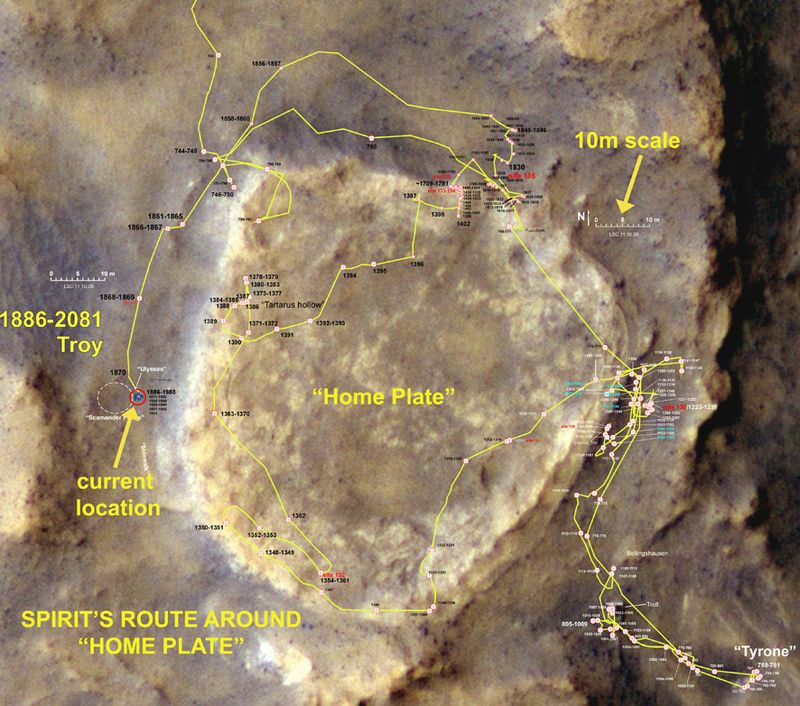
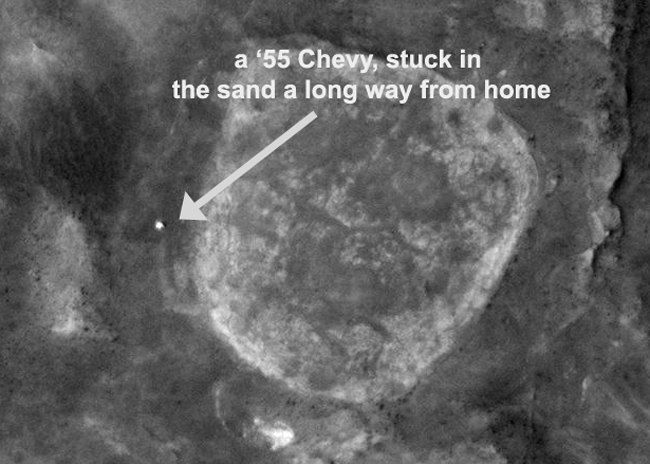
“It’s way out of warranty,” said Ray Arvidson, director of the Earth and Planetary Remote Sensing Laboratory at Washington University in St. Louis. “It’s like an old ’55 Chevy.” He was talking about the intrepid Mars Rover, Spirit, that has, along with its sibling on the other side of the planet, Opportunity, been trundling around for six years of a mission that was expected to last three months. In 2006, Spirit’s right front wheel stopped working and so it continued backwards, dragging the wheel behind it. Then, in April of this year, having been working around an area known as “Home Plate”, a miniature plateau just 80 meters (260 feet) across - see the image below - for more than three-and-a-half years, Spirit’s wheels broke through a poorly cemented sand crust and the rover became stuck in the very fine loose sand beneath. And, as I wrote back in May, it was seriously stuck - the images were enough to strike horror into the heart of a field geologist and Arvidson described the situation as “Murphy’s Law on steroids.”
NASA have spent much of the last months setting up a test bed of fine sand of the the same character as that which has ensnared Spirit (see video), and working on possible minute manoeuvres to extricate the rover. These have now been put to the test - sadly with minimal results. The image at the top of this post is taken from NASA’s report of a few days ago - and it looks awful. Total wheel movement during the attempt was 1.4 meters (4.6 feet) and “Analysis of data from the drive indicates that the center of the rover moved 0.5 millimeters (0.02 inch) forward, 0.25 millimeters (0.01 inch) to the left and 0.5 millimeters (0.02 inch) downward.” Spirit was just spinning its wheels and the trial was stopped when the inactive right rear wheel stalled again. And, as if this weren’t bad enough, communications with earth have been disrupted by problems with the Mars orbiting satellites.
But Spirit hasn’t just been sitting there twiddling its robotic thumbs. As the New Scientist recently reported:
Spirit has been immobile for the past six months, but it has not been idle.
The rover’s own observations have revealed the cause of its plight - a small crater filled with yielding, yellow-brown sand. The sand had been hidden beneath a dust-covered crust of weakly cemented sand particles.
Spirit’s wheels punched through this centimetres-thick crust, exposing soil with the highest concentration of sulphate minerals ever found by either Spirit or its twin, Opportunity.
Sulphates form in the presence of water, so the find further reinforces the idea that, billions of years ago, the area surrounding Spirit was rich in the liquid.
Researchers suspect Spirit’s stomping ground was once a site of intense hydrothermal activity. Pools of hot water and steam vents may have dotted the area, making it a good place for future missions to look for evidence of ancient Martian life, says Spirit scientist Ray Arvidson of Washington University in St Louis, Missouri. “If it were Earth with that kind of environment, it would be teeming with microbes,” he says.
Nonetheless, the rover team is keen to move on. “It’s an interesting area to be in over the summer,” says Arvidson, “but we’re ready to leave.”
Meanwhile, the other rover, Opportunity, continues its successful ramblings - it’s travelled 19 kilometers (nearly 12 miles) so far, 2.4 times the distance of Spirit’s trek. But Opportunity has also had its problems with sand along the way - in April 2005, after speeding along at a reckless 200 meters per day, it was stuck for five weeks on a ripple named “Purgatory Dune” but was successfully extricated. But lessons were learned: when, a year later it became embedded in a sandy spot nicknamed “Jammerbugt” (apparently the Danish for “bay of lamentation”), it was out and off again in no time.
For Spirit, the future is highly uncertain, with winter and dust storms approaching. The editorial in the New Scientist had the following comment about the '55 Chevy, something with which I think we would all agree:
NASA has been agonising over how to free Spirit from a sand trap for six months. That’s double the design lifetime of the rover, which landed in 2004. Now, with winter on the way, NASA’s hand is forced. Its plan is to backtrack slowly out of the mire. One could criticise the agency for investing too much effort in a mission that’s past its prime, but that would be churlish: Spirit has achieved more than anyone dared dream, and could deliver yet more. Besides, it would seem strangely cruel to abandon the plucky rover to its fate.
Comments
I was listening to a thing on the radio about Spirit. I know it’s totally anthropomorphizing, but I feel sorry for it, and somehow think of it as brave.
I know exactly what you mean - it’s why we use words like “plucky” and “intrepid.” You’ll see that, in the video of NASA’s trying to figure out how to extricate the rover, it’s referred to as female - and now it’s a “damsel in distress.” I had some other ideas to add at the end of this post, but I really liked the New Scientist editorial comment for exactly this reason - it acknowledges the satisfaction we derive from anthropomorphizing. And I will readily admit that I struggled to avoid over-anthropomorphizing sand grains in my book.
Sometimes anthromorphizing helps us to empathetically connect outside of ourselves or our species, whether it be with an in-antimate object or other life forms. It it is unique, endearing quality of our consciousness, that I think can be put to good and compassionate use at times.