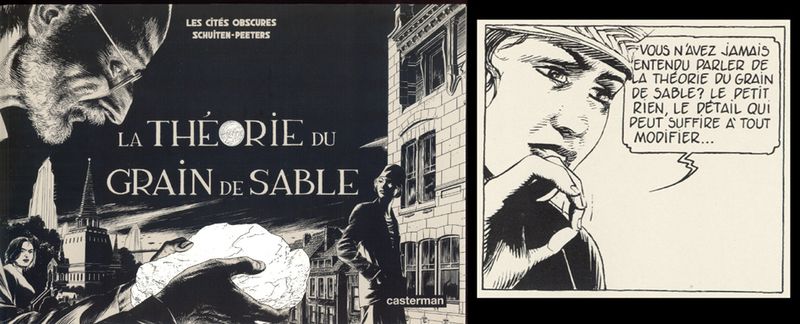
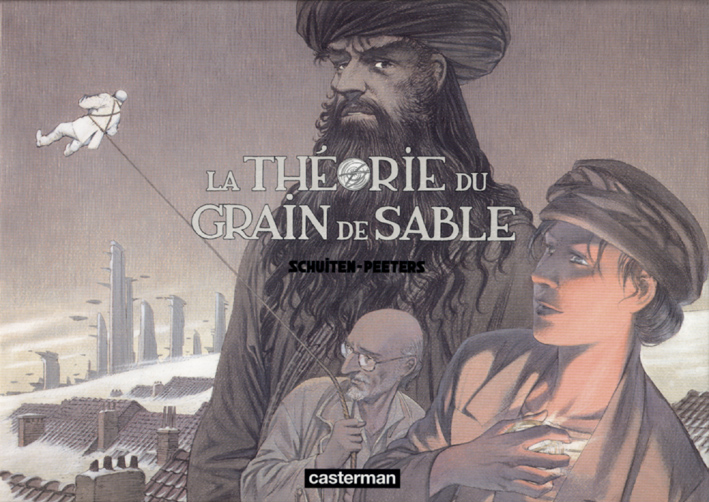
“You’ve never heard speak of The Theory of the Grain of Sand? The little nothing, the detail that can be enough to change everything…”
With a title like that, this was a book I had to have. In France, the bande dessinée or “BD,” the graphic novel, is an art form and hugely popular. All bookshops have shelf after shelf of BDs and the variety is spectacular, from the simple comics for kids to complex and sophisticated works for adults; more than 30 million BDs are sold every year in France. I had discovered the first volume of La Théorie du Grain de Sable a couple of years ago, and was frustrated to find that I had to wait for the second book; this Christmas, there it was.
The story takes place in a kind of parallel steampunk universe, and is part of a thematic series titled Les Cités Obscures, translated as “The Fantastic Cities” or, more straightforwardly, “The Obscure Cities.” The authors, François Schuiten and Benoît Peeters, have created a “counter-earth” made up of individual city-states that seem to be twinned in some way with their “real” equivalents – objects and people are occasionally translated between them. La Théorie is set in the fantastic city of “Brüsel” in some fantastic year 784; aspects of technology indicate that the time is in the future, but much of the architecture, faithfully and dramatically drawn, is of the classic Brussels, and many of the styles of clothing are distinctly retro. It’s an atmosphere characteristic of the Cités Obscures project, and following the very French philosophical approach of “it’s all very well in fact, but how does it work in theory?” the project has been the subject of detailed literary analysis. One can find discussions on the internet of “the city as a political and aesthetic model” and “obscurité as an ontological model.”
But what of the story? Strange events start happening in Brüsel, in some way associated with the visit, and untimely death, of a stranger from a strange land. In one man’s apartment, rocks begin appearing out of nowhere, each weighing precisely 6793 grams (a prime number……); their accumulation eventually reaches the critical mass of causing major structural problems with the building and, not surprisingly, a profound deterioration in the man’s relations with his neighbours. Not far away, a chef begins to levitate involuntarily, the condition progressively worsening as his stable altitude becomes further and further from the ground; he is forced to close his restaurant because he is frightening his clientele.
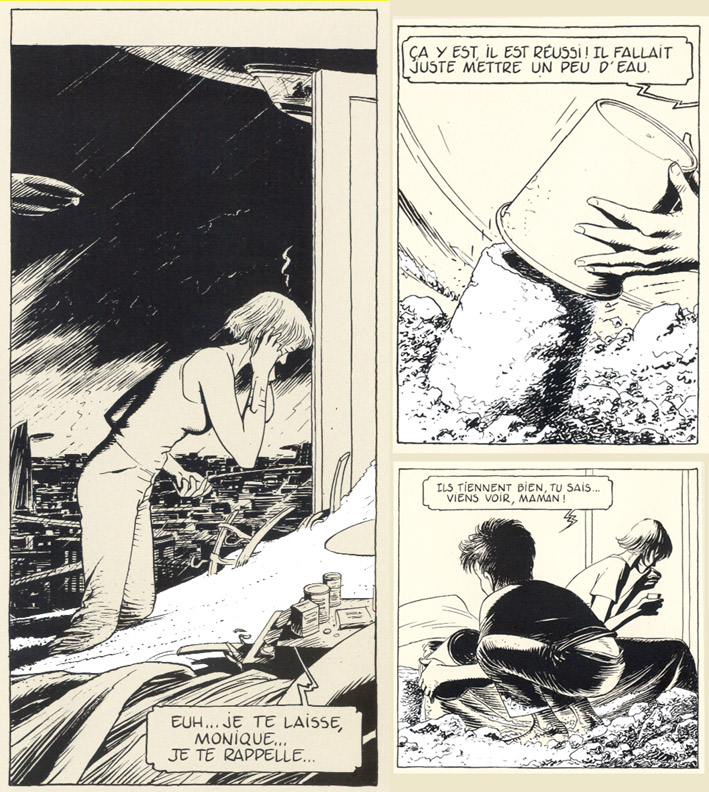
But most bizarrely, and of greatest interest, is the plight of a young mother who finds her apartment invaded, at first by a trickle, and then by a deluge, of sand. Sand pours from under the doors and cascades out the cupboards, accumulating as dunes in every room. While this drives the poor woman to despair (her attempts to dispose of it by surreptitiously carrying out bucketsful being completely futile), it delights her two young kids. They can now build sandcastles in their living room. In the graphic extracts below, as one kid empties out the container, he declares “success! It’s only necessary to add a little water…” and “they hold together well, you know – come and see, Mom!” (that’s Mom in the background, taking another pill).
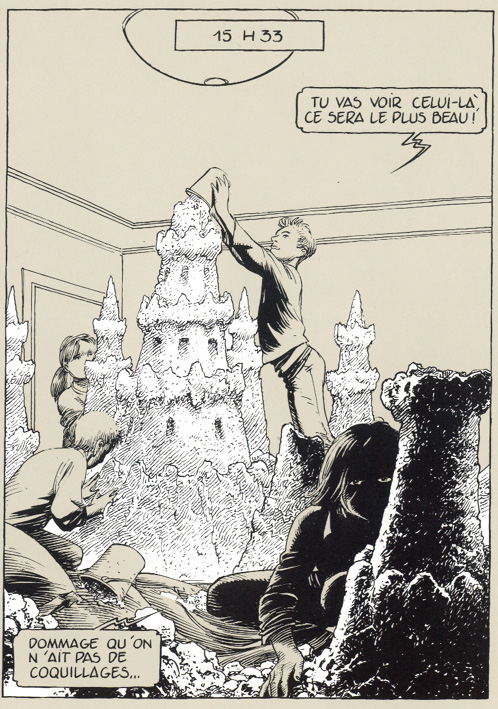
Friends are invited over for sandcastle parties - “this one’s going to be the most beautiful!” and the girl comments that it’s a shame they don’t have any shells.
But eventually, the fun, at least as it was for the kids, is over. Sand completely fills the apartment as the poor woman cries for help, pours out of the windows, and starts to bury the city.
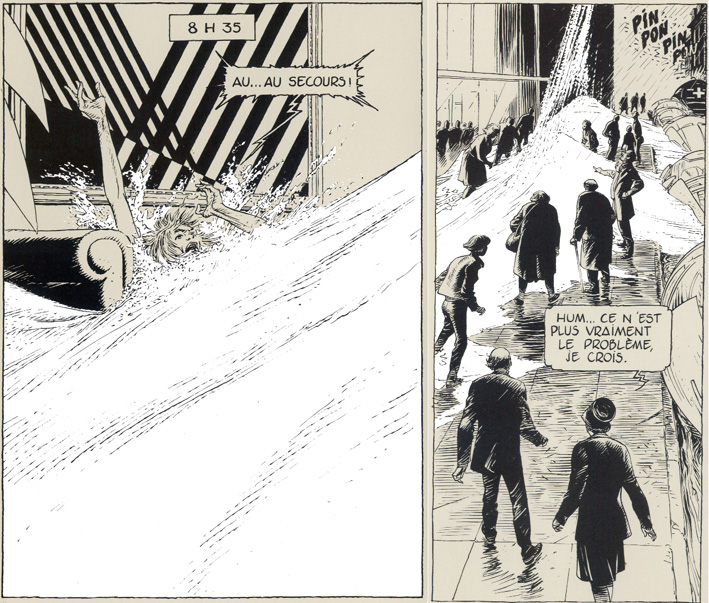
In the foreground of the graphic on the right is Mary von Rathen, who is a specialist in investigating bizarre events. She has arrived from another city in order to try to solve the strange phenomena that threaten Brüsel. Mary was known, apparently from earlier novels as _l’enfant penchée, “_the leaning child” – I have yet to figure out why. It is Mary who describes “The Theory of the Grain of Sand” and ultimately identifies the cause of the problems and the solution – linked, of course, to the mysterious stranger. The story is far more complex than I have outlined here and I won’t spoil it. It is, in every sense, fantastic, and the graphics are superb. And, not surprisingly, I derive great pleasure from every discovery of another example of how a grain of sand can penetrate our imaginations – and this one’s even good for my French!
Comments
No comments yet.