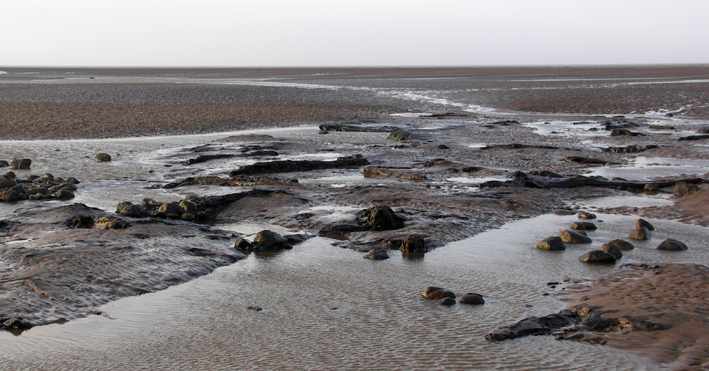
My kind hosts for the Café Scientifique event were Ann Lackie and her husband, John. They had set up the group originally and are to be commended for their devotion and the enthusiasm of the community that they have established. Ann (and the adolescent dog, Meg) were my companions for that exhilarating morning walk on the beach; the storms had scoured the sand away from an extraordinary sight - the submerged forest of the post-glacial Solway Firth. Ann is, amongst her many talents, a writer (see the end of this post), and a few years ago, under her alter ego, Ann Lingard, she had published an article on the forest for Cumbria Life magazine. It is with great pleasure that I can re-publish that piece here.
“NOW YOU SEE IT, NOW YOU DON’T”:
THE SOLWAY’S SUBMERGED FOREST
Ann Lingard
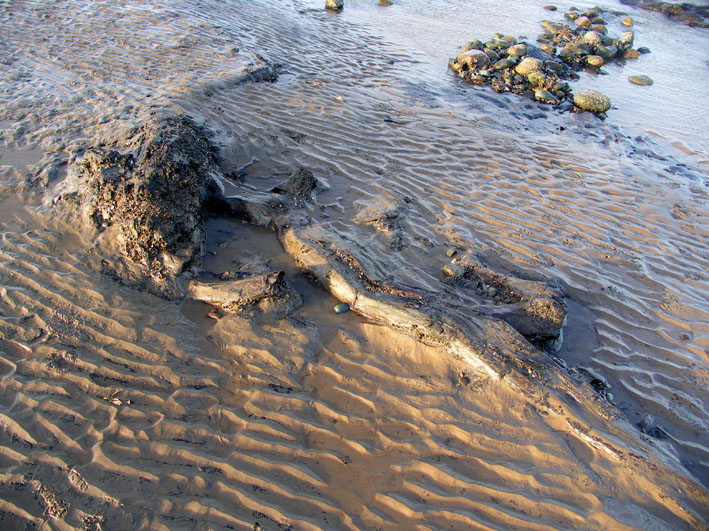
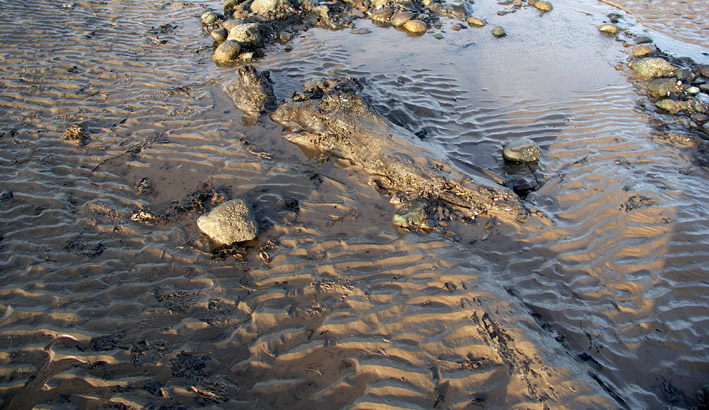
Leave your car at Beckfoot in the carpark amongst the dunes and walk down the track to the new wooden walkway onto the beach: stand there, on the pebbles, looking across the waters of the Firth towards the granite bulk of Criffel. If you are lucky, you may see low dark ‘cliffs’ on the shore, about 100 metres along your Criffel sight-line – a half-metre high, the patches of black are like shadows on the sharp edges of channels in the sand. Now walk down towards them, and the shadows resolve themselves into banks of peat. Poke them with your toe and feel how dense and sodden they are, smoothed by the friction of waves and sand. Walk on them and feel their sponginess. And gradually you’ll become aware that the dark organic mass is not only peat, but contains a horizontal tree-trunk, or even a stump that radiates roots. Wander around and you will find trunks and branches, single and entangled, embedded in the peat and sand; and erect stumps, 20-30 cms high, their tops flattened as though cut by a chainsaw. The wood is still fibrous, soft and dark; you can crumble it and tease it apart, as though it were any rotting log in a woodland. But the difference is that this woodland thrived about 8000 years ago.
However, the Solway’s tides and sands are capricious, and there will be many occasions when you go down to the shore and can find no sign of the ancient, submerged forest. One person I spoke to, who regularly surveys the Upper Solway’s shores, had never seen or even heard of the forest, and Brian Blake, whose excellent book The Solway Firth (published in 1955 and now, sadly, out of print) is illustrated by photographs taken by J. Allen Cash, notes that “Mr Cash went to Beckfoot … the submerged forest was not visible and I regret to say the residents he inquired from had not even heard of it.” Fortunately for us, Val Corbett had no such problems as her beautiful pictures show.
Norman Hammond, of Solway Shark Watch, who also leads guided walks along the shore, told me that, “The best time to see the forests will link in with extreme high water springs and a few days with a severe gale-force blow from the North-West or better still the North-East. The North-East severe gale will move the south shore sand away on a massive scale and reveal the forests - and usually a host of last war remains as well. It’s a case of dropping everything and getting down to the shore when conditions are okay.”
Well, I’m always happy to get down to the shore, even when conditions are not okay, and I have twice found the forest on Allonby Bay just South of the village, and once off North Lodge between Allonby and Dubmill Point. In the latter case, as at Beckfoot, there was no need to wait for the low Spring Tides – the forest was visible on the mid-shore, briefly exposed by the fierce northerly gales.
So how did a forest come to lie underneath the Firth? The obvious answer is “because the sea-level rose”, but of course the Solway has its own particular complicated version of events, which is explained beautifully simply at the Solway Discovery Centre at Silloth. The Centre is in the coverted red sandstone school, and the offices of the “Solway Area of Outstanding Natural Beauty” are at one end of the building in the former Headmaster’s House. Brian Irving, Manager of the Solway AONB, designed the exhibition and is almost evangelical in his enthusiasm for everything to do with the Solway. Our discussion ranges from topic to topic, with frequent interruptions to ferret through books, and to check the maps of the coast and the channels and the other nature reserves that are pinned to the walls. We also go through to the Centre to look at the models that Brian has commissioned to explain the protracted contest between the sea and the land.
During the last Ice Age, one huge glacier swept south and east to the Tyne from Scotland, meeting another glacier that ground its way North and West from the ‘Lake District’; as these melted, a large lake of glacial meltwater formed in the area bounded by the Scottish lowlands, the Pennines and the Fells. Then, as the ice retreated, so the shores of the lake were gradually colonised by plants and animals. What went on here was a reflection of everything else that was going on at that time in Britain, Brian tells me. “There was a wave of plant colonisation spreading North, a ‘tundra front’ moving North, with dwarf plants – dwarf willow and dwarf birch. The standard ecological colonisation.” I think about the tundra vegetation that I saw in Greenland a couple of years ago - juniper, and low flattened willow, dwarf birch and blaeberry blazing red and orange in the autumn, clinging to the sparse soil that was only inches above the permafrost - and try to imagine it spreading across from Silloth to Whitehaven and Dumfries. A fitting link with the Greenland Pinkfeet geese that now migrate here in the Winter.
Here on the Solway, around 8000 years ago, the air and soil started to grow warmer, and wind-blown tree seeds were able to survive and germinate. According to Brian, a pine forest gradually spread across our landscape, obliterating the tundra vegetation and lasting for a couple of thousand years. Mammoth, bison, giant deer and sabre-toothed cat grazed or hunted amongst the trees and on the grassland. Perhaps the landscape looked like that around Victoria Bridge just South of Rannoch Moor, where remnants of the ancient Caledonian pine forest still hang on? The forest there is sparse, the remaining trees scattered thinly amongst the rock and heather and pale tough grass, and beneath them lies an older forest, its ancient and bleached trunks and branches exposed where the peat has been cut to make a ditch. The “Solway” pines, though, began to disappear about 7000 years ago, succeeded by deciduous oak and alder and hazel. This new forest was low and dense with a thick understorey, Brian says: “You’d have found it almost impossible to walk through.” But perhaps you would not have wanted to, in any case, because this was a time when wild pigs were common. The forest would have been full of bird-song, you might have caught sight of elk or deer grazing, or even the now-extinct Auroch, Bos primigenus, a large ‘wild cow’.
We think of geological change in terms of blocks of time: 9000 years BP, 7000 years BP. But of course the process of change is gradual, and during this period the glaciers, here and elsewhere on Earth, were continuing to melt and pour their waters into the sea. The sea-level rose gradually and inexorably. It crept higher on the southern shore of the huge forested “Solway” basin, and the salt water oozed amongst the trees. Salt crystals blocked the water-channels within the tree-trunks so that the branches died of dehydration. “It was like beaver damage,” according to Brian Irving. “The twigs then the branches die and fall off, and you’re left with the spikes of stumps sticking up in the water.” Once the sea had made an entry it washed in further and invaded the immense freshwater lake and so the Solway estuary was born and broadened, fed by rivers of glacial meltwater, and flushed twice daily by the tide. The forest was drowned beneath the Firth, and should have been destroyed and lost forever. In theory, we should not even know it had been there.
The glaciers were melting. Imagine those huge masses of ice and boulders, weighing down and compressing the land; as they retreat, the pressure on the underlying land is released and the land rebounds and rises. This is what happened in the Solway basin, twice. The sea flooded in and drowned the land, but the land then rose; the still-rising sea encroached again but yet again the land rose. The evidence is there in the two “raised beaches” – the road from Allonby to Mawbray runs along the “Twenty-five Foot” or “Neanderthal” raised beach. But even this story is probably too simple. Frank Mawby of English Nature told me, “There would have been little islands at high water, and some quite dramatic drops in sea-level too. If you look at the marshes today, you can see little bits of raised beach all over the place.” In some places growing trees would have been overwhelmed by peat rather than by the sea. And Dennis Dickins, who runs Cumbria Environmental and Geological Services at Watch Hill, stressed the fluctuating climate and conditions: “There’d be a wet period when the woodland would retreat, then this would be followed by advantageous conditions for a couple of hundred years, so you get the trees re-invading. There was constant change.”
As for the drowned forest, each time the land rebounded some of the forest was lifted too. And with 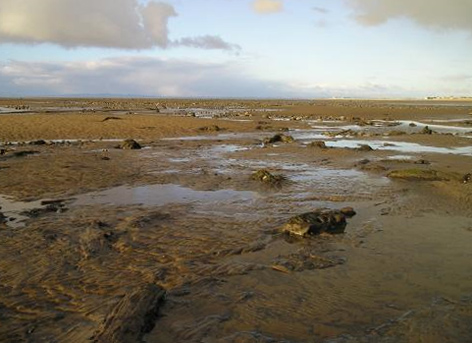 regard to that wet period, never complain that “it always rains in Cumbria”! About 7000 years ago, in the Atlantic Period of the Holocene, the climate was especially wet, the hills were almost permanently hidden in cloud and the rain poured down, day after day. Plants struggled to survive in the water-logged ground. These were perfect conditions for sphagnum moss to grow and accumulate water like a sponge. Reeds flourished but most of the other vegetation died and decayed and became compressed to form peat; the peat spread, blanketing the valley floors and creeping up the hillsides, burying the remains of the forest. On the raised beaches, the peaty “raised mires” formed. Hundreds of years passed, the mires or “Mosses” dried out, sedges grew, the moorland was colonised by woodland carr, silver birch and heather. The drowned forest was hidden deep down beneath the layers of peat and vegetation.
Peat is cold, oxygen-depleted, acidic, a good preservative. It preserved the “bog bodies” of Lindow, Tollund and Grauballe Man. Lindow Man (actually, only his upper half) was discovered in a Cheshire bog in 1984 and was probably a victim of a ritual sacrifice by ancient Celts. He died a three-fold death, finally being cast face-down into a peat-bog on Lindow Moss, a symbolic drowning. The two Danish peat-cutters who found Tollund Man in 1950 thought they had found the victim of a recent murder, his face was so “fresh” and well-preserved. This is characteristic of bog-bodies, their skin is “tanned” (a chemical process similar to turning hide into leather) and their internal organs and skeletal framework are thus often remarkably intact. Grauballe Man was found in a Danish bog in 1952, and is 2000 years old. Recently his body was analysed using computerised tomography (CT) scanning, a non-destructive technique by which X-rays generate 3D images. The computer is programmed to recognise different tissues according to their different densities in living patients, so it was a surprise to the researchers to find that the density corresponding to “skeleton” was absent from Grauballe man. The acidity of the peat had dissolved the calcium in the bones and tooth enamel, and the demineralised skeleton was more like rubber than bone. Even more surprising was the discovery that Grauballe Man had undergone some posthumous cosmetic surgery: his chubby cheeks had been padded out with plasticine by the museum’s curators in the 1950s!
Are there “bog bodies” buried in the Solway peats? Who knows? There were certainly humans living here 2000 years ago, but it is unlikely that humans hunted amongst the forests a few thousand years earlier. When I asked Frank if there were any “bog bodies” in the Mosses, he laughed and said, “No. But there was a cow found in Solway Moss!” Unfortunately it wasn’t accompanied by any ”bog butter”, the 2000-year-old parcels of butter and lard, packed in wooden boxes or animal skins, that have been found buried in Scottish and Irish bogs. (There is a very interesting story of the “soap woman”, whose fatty tissues were converted after death … but no, that takes us too far from the Solway.)
Returning to the Solway, Brian Irving told me that very little biological research has been carried out on the submerged forest. “The conditions were acidic so you wouldn’t get survival of calcareous shells, so there’s no evidence of land snails. Our information is based on things which survive the acidity – mainly plant remnants, pollen …” Apparently an attempt was made about 25 years ago to radiocarbon-date a fragment of wood from the forest that lies just South of St Bees’, but I have been told there was some problem with the sampling technique; “8000 years old” is the date that’s quoted.
And I cannot pin down whether the submerged forest was oak or pine. Dennis Dickins thinks it was oak. Brian Irving thinks it was pine. Brian Blake writes in his book that “I was told that from some of the remains, and the prone trees are more than stumps, hazelnuts sometimes are found.” When I put the question to Frank Mawby, he said at once, “Oh – probably birch!” and then added, “I brought up a hazelnut once from seven metres of peat on Wedholme Flow.” And at Wedholme he has found a layer of marine sediment overlying the peat, further evidence of that dance between the sea and the land. I’m really surprised that opinion is so divided about the trees. Would there be any DNA remaining in preserved cells deep within the wood that would make the identification possible, or would it be too fragmented? Tollund Man’s brain is apparently sufficiently well-preserved, after 2500 years, to allow extraction of genetic material.
A couple of weeks after finding the Beckfoot forest, I went down to the shore again. It was during the final weekend of February, when the Gaels and Celts were struggling through blizzards but Cumbrians were enjoying clear blue days and views of snow-dusted Fells. The Silly Bitch (our “failed” working-dog, the border collie) was, as usual, running her clockwise circles on the sand as we walked towards Dubmill, and a group of seals had apparently gathered for a meeting on the shore; except that the circle of bodies, heads raised, had been carved from banks of peat that had been tilted and tumbled together in a hollow, about 5-6 metres below the level of the road. Pieces of branch or root were exposed at the edges of the blocks and I was thrilled to find a football-sized lump of green slippery clay lay nearby – presumably the boulder clay above which the trees had grown, torn up from deep beneath the peat – but, as usual, there was nobody nearby with whom to share this exciting find! There was no way to tell whether the trees had been drowned by sea or by peat all those thousands of years ago, but now the whole thick organic mass had been finally overwhelmed by the Solway tides. The forest floor on which the Silly Bitch and I were standing extended inland, a layer of trees preserved deep beneath the fields and dunes and mire. Next time we go back to Allonby, the remains may have been buried yet again, beneath the sand and gravel on the shore.
And incidentally, there is a bank of peat and wood on the Beckfoot shore that is riddled with tunnels from which the white shells of long-dead piddocks protrude. Piddocks are bivalve molluscs that normally burrow in rock; “ship-worms” are the bivalves that are supposed to burrow in wood. What on earth has been going on? The Solway’s submerged forests are certainly full of mysteries.
[Solway AONB is based at the Discovery Centre, Silloth, where there is an excellent exhibition about the area’s geology, history and wildlife; the centre also runs guided walks along the shore. Tel: 016973 33055 www.solwaycoastaonb.org.uk]
Ann is the author of several novels, the most recent of which is The Embalmer’s Book of Recipes - I enjoyed it enormously and thoroughly recommend it. I posted a brief review on the Goodreads site:
, aspirations, agricultural challenge, and the arcane history of embalming and eugenics, into a haunting narrative. Humorous and human, full of insights - a thoroughly engaging read.
Visit Ann’s website at http://www.annlingard.com/
Comments
No comments yet.