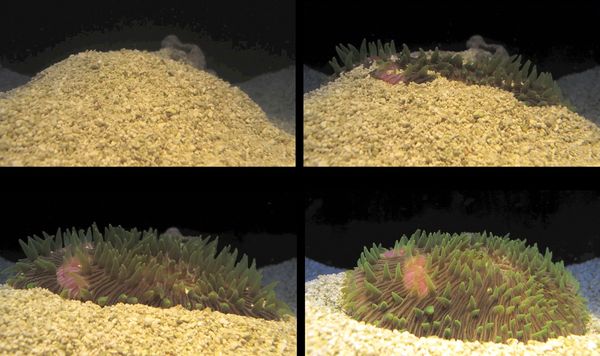
Imagine for a moment, if you will – or can – that you’re a coral. You find yourself in the lap of luxury, ensconced on a cosy bed of sand in a carefully maintained aquarium, far from the vicissitudes of life on the sea floor. And then, suddenly, this wretched scientist comes along and throws a pile of sand in, completely burying you. You’re entombed alive - what are you to do? Well, if you’re a fungiid, you simply shrug it off.
Of all the amazing things that I come across in this amazing world, the most startling are nearly always from new revelations about life on this planet. Whether it’s the constant discovery of new species, the seemingly daily expansion of the known limits for extremophiles, or simply how critters do stuff that we never realised they could, the news continues. And it is, of course, a couple of recent discoveries about how critters deal with sand problems that have caught my eye, and I will begin with a report that I just happened to see yesterday on the BBC News website, Corals inflate to escape being buried alive in sand. I have long ceased to be astounded by the frequency with which my favourite topic appears prominently in the mainstream media, but this is quite extraordinary.
For a start, if you think (like I did) of corals as static, colourful and sculptural installations on the sea floor, to be wondered at while snorkelling and protected from human depredations, then you’d be wrong. Some corals move. They may do it slowly and sedately, but they move – and the fungiidae, the so-called “mushroom corals” are the prime exponents of this skill.
So that’s a start – having been buried alive, you’re relieved to find that you’re a fungiid, capable of movement. But even so, just any old movement will hardly be sufficient to rid yourself of this burden of sand. So you flex yourself a little – and wow! You can do pulsed inflation! A few grains cascade from the pile, the burden is slightly relieved and you have even managed to get a couple of your cilia protruding above the sand. You pulse inflate again….
“Enough!” I can distinctly hear you exclaiming, dear reader, and you are quite right, enough of this anthropomorphised coral role-playing. Rather, first of all, just go to the BBC link above and watch the time-lapse animation there – it is absolutely extraordinary. It’s the work of Dr. Pim Bongaerts and his colleagues in Australia and the Netherlands, the evil scientists who buried the poor coral, and you can read - and reproduce - the authors’ personal copy of the paper here. It begins as follows:
Sedimentation represents a major stressor for scleractinian corals. Although many coral species exhibit the capacity of active sediment rejection (Stafford-Smith and Ormond 1992), only few are capable of freeing themselves after becoming completely buried. Fungiid corals appear to be an exception, as they can remove sediments through substantial polyp inflation (up to five times their normal size) in addition to mucus entanglement and ciliary action… Using time-lapse photography (speeding up time 300x), we observed that this inflation occurs in rhythmic pulses, allowing corals to completely exhume themselves after becoming covered in sand.
Ok, it’s speeded up (although really not that much) but, if you’ve already watched it, I hope that you share my astonishment. The complexity of what these apparently simple and passive critters are doing is mind-boggling - “mucus entanglement” and “ciliary action” don’t really convey what’s going on (although they are consistent with the science fiction image that comes to mind of this happening at full speed and on a large scale….).
It really is a wonderful world.

[The fungiid at the head of this post is Lobactis scutaria, the one below Herpolitha limax, and the images are screenshots from large movie files downloadable here.]
Comments
That certainly is an excellent survival mechanism. I think, though, that the corals shown in each film are a single polyp - a solitary coral animal.
Oops - thanks for the correction, shows how much I know about coral anatomy. Now corrected (I hope) to cilia. I guess I was just carried away with the whole image of “polyp inflation”…
“Shrug it off”–exactly! And behind this extraordinary behavior is some biochemistry that one would love to know more about. How does the fungiid know it has been buried? Presumably through sensors related to those that trigger stinging, but somehow it can tell the difference, in the same way that the inflation mechanism is presumably related to fungiid mobility but follows a remarkably different course. Possibly both depend on the number of cilia activated? Which would constitute higher-order processing. However–clever chaps.
Also this week another popular media mention of a topic familiar to your readers, from a location near you:
http://www.guardian.co.uk/environment/gallery/2012/feb/10/week-in-wildlife-in-pictures#/?picture=385782734&index=10