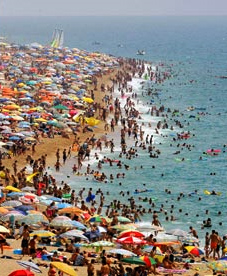
 The photo on the left is typical of those used by tourist boards to lure visitors to sun-drenched beaches, to escape to tranquility and commune with nature, feel the warm sand between the toes - “book now, before anyone else arrives!” The image is part of an advertising campaign to do the job for the Costa Brava on Spain’s Mediterranean coast. But, as revealed in the press last week, it’s not a picture of the Costa Brava, but rather - the Bahamas! On reflection, this is something that any self-respecting arenophile could have spotted - the sand is white, typical of a tropical beach of largely biogenic materials, fragments of coral, shells, and so on; the sands of the Costa Brava are, to put it bluntly, the usual sort of nondescript brown. The Girona tourist board even resorted to digital alteration of the image to dull the dazzling sands of the Bahamas, but it didn’t work too well. Having headlined the advertising with the remarkably appropriate question, “Where does the Costa Brava start?,” the board was unrepentant. “What we were looking for was the concept,” their director was quoted as saying, and claimed a lack of good quality
 .
.
And then there might be the problem that, if you find an empty Costa Brava beach, it’s empty of sand as well. Frenzied coastal development, dams and excessive water withdrawal (reducing sediment delivery to the coast), and random attempts at “coastal management” have all seriously busted the sediment budget - far more sand departs than arrives. After the winter storm season, many beaches are more rock than sand, and immense efforts are put into beach “replenishment.” Which raises the interesting question, important for philosophers and tourist agencies: when is a beach not a beach? After all, an expanse of shoreline rock within which lies a single grain of sand is clearly not a beach - so when does a not-beach become a beach? This is what is known, at philosophers’ cocktail parties, as the sorites paradox, a problem originated by Eubilides of Miletus in the fourth century b.c. Eubilides loved paradoxes (the classic “liar’s paradox” was his), and perhaps he loved the beach, or at least playing with sand. For he became concerned about what is, and what is not, a “heap” (sorites derives from the Greek for “heap”). If a single grain of sand is removed from a heap, it clearly remains a heap, as it does after the removal of the next grain. So, asked Eubilides, when does it become a non-heap? The reverse is the same problem—a single sand grain is obviously not a heap, but when does a non-heap become a heap? The problem, philosophically, is one of vagueness and the imprecision of word usage. So when does a beach become a non-beach, and vice-versa? Answers please on a digital postcard, below.
[images from the Guardian, 11 February 2009_,_ Albert Gea/Reuters and Dorgie Productions/Getty]
Comments
No comments yet.