It was tempting to make the subject of this entire post the egregious activities of the outstanding American buffoon, Donald Trump (plea to trans-Atlantic readers: if you can’t do anything else about him, could you please keep him away from our shores?). As documented in the recent film, You’ve Been Trumped (which I haven’t yet seen, but perhaps look forward to), an entire stretch of the natural Scottish coastal dune system has been destroyed by Trump’s typically megalomaniacal golf course development (aided and abetted, it has to be said, by the Scottish Government). It is, of course, ironic, that it was the topography of dune ridges that first brought the game to Scotland – as I described in Sand:
The Old English word for ridges is hlincas, from which the term links is derived, and it was in this terrain that small leather balls stuffed with goose feathers were first whacked about and the revered game of golf—or gouff, or goffe—originated. Many of the world’s finest golf courses, including the Old Course at the Royal and Ancient Golf Club at St. Andrews on the east coast of Scotland, owe their location to coastal dune systems.
A second irony (a word that hardly seems adequate) is that “The Donald” has the gall to Trumpet his scheme as environmentally beneficial. This, from an NYT interview with Anthony Baxter, the film’s director:
Q. _Mr. Trump is on the record as saying that his development would be “environmentally perfect ” and that the area would in fact be better off environmentally after the golf course was built. Were there any major environmental groups that supported the project?
_A. There was not one credible environmental group that supported this development. Friends of the Earth Scotland, Scottish Natural Heritage, the Scottish Wildlife Trust, the Royal Society for the Protection of Birds, the Ramblers Association of Scotland — all of these groups were dead set against this development.
The Royal Society for the Protection of Birds actually issued a press release when Mr. Trump was given the go-ahead saying that Scotland’s green policy had been sold down the river by this decision. Not a single expert was standing up and saying that it made sense to tamper with this very unique sand dunes system.
But the management of Britain’s coastal dunes raises questions far beyond the tragic activities of one aggressive clown.
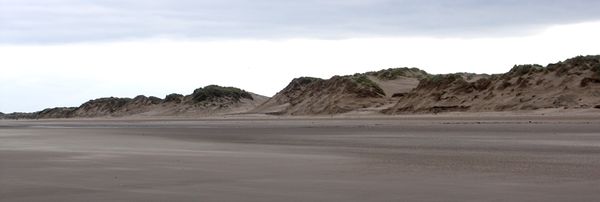
Coastal dune systems are, by nature, dynamic. On the front line of the power struggle between land and sea, pounded by winds and storms, they are almost always on the move. However, unlike their desert counterparts, the intervening quiet periods allow specialised – and hardy – vegetation to take root; there’s a remarkably diverse ecosystem of plants that enjoy a substrate of shifting sand. If the vegetative cover comes to dominate, then the dunes become stabilised, resistant to the day-to-day attacks of wind and waves, if not to powerful storms. And, because the mobility of coastal dune systems is inconvenient to the human inhabitants of those environments, who wish to bask in vistas that are static and benign, conscious attempts to stabilise with vegetation (if not completely remove) coastal dunes are common. This activity, combined with the reduction in free-range grazing of animal herds, and a fluctuating climate, have caused a wholesale change in the UK’s natural coastal dune systems.
I’m not someone who routinely consults the horticultural experts in the media, but I was struck by a piece in Friday’s Guardian newspaper that began:
What has happened to Britain’s sand dunes? My childhood recollections are of wild and windy places; of a fine spindrift of sandy particles streaming from the dune ridges; of marram grass etching precise circles in dry sand with the tips of their leaves; of wavering films of sand flowing across rippled sands. Fast forward 50 years, and … the golden sand has been replaced by a thick thatch of matted grass, burgeoning stands of bracken and scrub, and increasing groves of willow and birch. And as bare sand has become something of a rarity, so many beautiful sand dune species have declined to near-oblivion today. Many of our rarer plants and animals have spent millennia evolving to cope with shifting sands. Like carrot seedlings in an allotment, they need bare ground into which to seed, and simply can’t compete with choking blankets of coarse vegetation.
Written by Andy Byfield, one of the founders of the wild plant charity Plantlife, the piece argues that “Drastic action is needed to save the native plants that thrive on our sand dunes.”
It’s understandable to assume that flowering plants that thrive in sand must reflect desiccation and struggle in their appearance. But the opposite is often the case – for example, from my recent Australian desert trip:
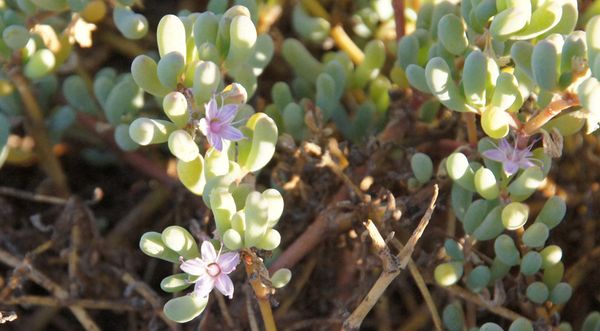
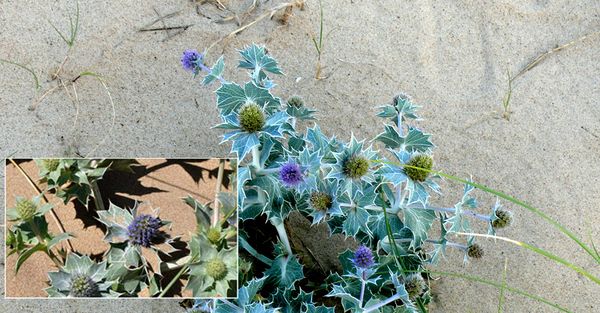
And this is as true of the British coast as it is of Australia’s red centre. The image at the head of this post is of the spectacular Sea Holly, Eryngium maritimum, that Byfield justifiably dubs the “king of the dunes”:
an architectural beauty of the sandy beaches and sand dunes around our shores. The plant’s central cone of flowers is reminiscent of members of the daisy family, such as echinacea or rudbeckia, but sea holly is a relative of the carrot. The ruff of petals is actually a ring of spiny bracts that encircle and protect the flowers like the plates of a Stegosaurus or the frills of a Triceratops. The whole plant is a metallic blue-green, seemingly verdigrised like a bronze garden statue in miniature.
He goes on to describe the sea holly as typical of the plants that need open, moving sand and are being extinguished by the overly (and coarsely) vegetated character of their favourite environment today:
Sea holly is supremely adapted to growing in mobile sand. Its deep-seated rootstock penetrates the substrate to a depth of 1m or more, and the plant takes a masochistic delight in being buried by an avalanche of sand…
Fortunately, as a species of the exposed foredunes (those next to the beach), sea holly is not faring as badly as some: indeed many other dune plants are faring badly. Take the fen orchid, an elusive green orchid of the South Welsh dunes: known to be locally abundant just a few decades ago, the species has declined from hundreds of thousands of plants at 10 sites to just a few hundred plants at one location today.
A typical stretch of South Welsh dunes is along the coast at Kenfig, the namesake settlement of which also figured in Sand:
Kenfig was established in the twelfth century as a small port and farming community on a river sheltered by the coastal dunes. It survived the attacks of marauding Welsh tribes, but not the forces of nature, provoked by grazing and the ensuing destabilization of the sand. These factors, probably combined with climate change as the cold period often referred to as “the Little Ice Age” approached, meant that the dunes were on the move. By the fourteenth century, large parts of the town and its fields were covered, and by the middle of the seventeenth century, it was completely abandoned.
But these days the dunes are no longer on the move and have become, possibly also as a result of the nutritious nature of polluted rain, vegetated and stable – hence the struggles of the fen orchid and the sea holly. And so a radical experiment has just been launched – the dunes are being bulldozed, not in the interests of a megalomaniac, but in order to restore the original biodiversity. The project is led by Byfield, who is Plantlife’s Landscape Conservation Manager, and involves removing all vegetation from ten acres of sand. The following is from the project website:
- Only 2% of the dune system at Kenfig now comprises bare sand, down from around 40% in the mid 1940s. Early plant colonists including sea rocket, sea holly and yellow horned-poppy need bare sand to colonise – and these suffer if a dune system becomes too stable.
- Regular ground disturbance and open patches of sand will reduce the dominance of vigorous plant species and allow rarer, less vigorous species to return. As well as fen orchid, other declining species which will benefit include round leaved-wintergreen, marsh helleborine and early marsh orchid.
- Plantlife will be introducing trial management work aimed at encouraging fen orchid and allowing better conditions for many other species including the rare dune bryums and petalwort to develop.
This will be a fascinating experiment in reversing natural and human-induced environmental change.
And, while I am discussing Eryngium maritimum, I must report some interesting commentary that I came across with respect to its truly extraordinary and diverse medicinal applications. It (particularly its root) is variously described as curing and stimulating flatulence, as an aphrodisiac, a diuretic, a potent inflammation modulator, and an inducer of extreme perspiration. The name of the genus Eryngium is supposedly derived from the Greek for eructation, and, furthermore, Plutarch is reported as telling the story that
‘They report of the Sea Holly, if one goat taketh it into her mouth, it causeth her first to stand still and afterwards the whole flock, until such time as the shepherd takes it from her.’
Perhaps someone could brew up some sea holly roots for The Donald?
[Photos of Sea Holly: Karen Davies and the National Education Network, Clive Hurford and the Guardian.]
Comments
Getting him off of our shores for a bit lets us all breath a sigh of relief on the western side of the pond. You’ll just have to do your share of babysitting :).
Thanks for the post on dunes plants, they are fascinating! But what a sad story – sounds like Scotland’s environmental laws need to be strengthened. Even if we kept DT at home, some other megalomaniac would arrive in the picture – far too many in the world. Maybe Nature and sand will take care of DT’s project one of these days!
unrelated – did you see where sand came in third in the Gates’ Reinventing the Toilet Challenge? if not, see Flushed with Pride in the Economist
http://www.economist.com/node/21560990
Yes, we need a real humdinger of a North Sea storm to illustrate to DT where the true megalomania lies! And I suspect that Scotland’s environment laws are perfectly adequate (the proposal was originally turned down) - it’s simply that good old human nature and vested interests entered the equation.
And on your “unrelated” link, no, I hadn’t seen this remarkable news. Another illustration of how sand can help with all kinds of clever stuff - the University of Toronto press release is at http://www.news.utoronto.ca/u-t-engineers-win-third-place-gates-foundation-toilet-challenge
Thanks for the link!
Golf courses are a huge waste of land, full stop. It doesn’t even matter if they are replacing a unique ecosystem or not, although that is, of course much worse.
I’d gladly beat Trump about the head and neck with a black pudding stick if it would help.
Oo er, say, Sandglass - ya gots to keep them periods off teh end of yer URLs. ;) In comment three, specifically.
1. I agree - don’t we have enough golf courses already? Why do we always need more???
2. Please go ahead.
3. Oops! and many thanks for pointing this out - it’s just that old habit of “finish a sentence, put in the period.” Now corrected, I hope (.)
The bulldozing is reminiscent of controlled burns(see e.g. http://www.sciencedaily.com/articles/c/controlled_burn.htm)
and the need in complex systems for frequent readjustments; golf fittingly expresses the human desire to control things–including burns.
“Chaos was the law of nature, order was the dream of man.” (Henry Adams)
This man Trump seems to want a hand in running our Country. Alex Salmond must speak up. How come a bankrupt be allowed to buy so much land here, ignore our laws and hold up possible employment in the turbine industry? A ridiculous state of affairs.