“We cannot sustain the shoreline in the future as we have in the past”
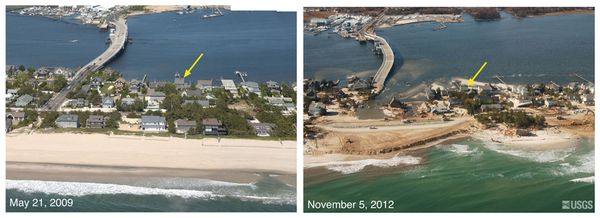
Oblique aerial photographs of Mantoloking, NJ. View looking west along the New Jersey shore. Storm waves and surge cut across the barrier island at Mantoloking, NJ, eroding a wide beach, destroying houses and roads, and depositing sand onto the island and into the back-bay. Construction crews with heavy machinery are seen clearing sand from roads and pushing sand seaward to build a wider beach and protective berm just days after the storm.
As the assessment of the devastation and reflection on the consequences continue in the aftermath of “super-storm” Sandy, a couple of provocative updates. The quotation above comes from a piece in the New York Times titled “Costs of shoring up coastal communities,” and are the words of S. Jeffress Williams, a coastal scientist with the United States Geological Survey and the University of Hawaii. The entire article – well-worth reading – begins:
For more than a century, for good or ill, New Jersey has led the nation in coastal development. Many of the barrier islands along its coast have long been lined by rock jetties, concrete sea walls or other protective armor. Most of its coastal communities have beaches only because engineers periodically replenish them with sand pumped from offshore.
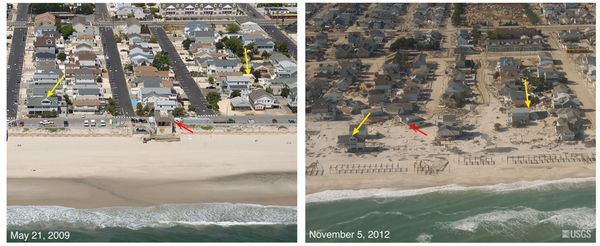 Oblique aerial photographs of Seaside Heights, NJ. View looking west along the New Jersey shore. Storm waves and surge destroyed the dunes and boardwalk, and deposited the sand on the island, covering roads. The red arrow points to a building that was washed off of its foundation and moved about a block away from its original location.
And now the USGS has published its initial post-Sandy report, accompanied by spectacular – and sobering – before-and-after photos of the coastline. As has been previously discussed on this blog, barrier islands are arguably the most dynamic and shape-shifting coastal landforms; they are simply piles of sand that are constantly on the move, dramatically so during storms. Their typical migration is landwards, storms breaching the islands and hurling gargantuan volumes of sand from the ocean beaches and dunes (where there are any left) across the islands and into the lagoons and waterways behind them. The USGS photos sampled here need no further explanation – these are simply the most stupid places to build (and re-build) anything.
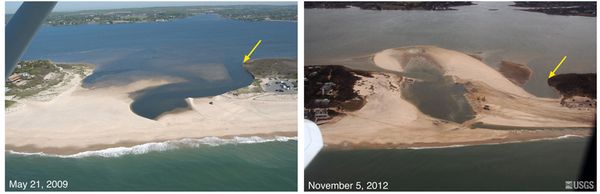
Oblique aerial photographs of Bridgehampton, New York. The view is looking northwest across the south shore of Long Island towards Mecox Bay. This location is a very narrow and periodically opens during large storms. Large volumes of material were transported into Mecox Bay when it breached during the storm. One week after the storm, the breach was being closed by mechanical means.
[Thanks to Steve Bossert for the NYT link, and Jim Jackson for the USGS report.]
Comments
Michael,
I can remember reading many articles about how the human desire to live near water was going to cause increasing problems as shore-based development exploded. Unfortunately, as part of our evolution was apparently spent on the East African shore – hence our finger/toe webbing and our ability to excrete salt, very unusual in a land mammal) managing that desire will be difficult. I imagine climate change will only exacerbate the situation, too.
Sobering pictures, thanks for highlighting them.
“I do know that climate change is occurring. And it is starting to exaggerate some of the hazards. Most notable in this area is sea level rise.”
--Andy Castaldi,Swiss Re’s head of catastrophe perils
http://www.pbs.org/newshour/bb/business/july-dec12/makingsense_11-21.html
which also notes, “For most primary insurers, the weather risk has now become so high, they have simply stopped writing flood insurance. So, government had to step in and is now on the hook for more than a trillion dollars in potential damages.”
Well, it’s one way of getting government dollars to working people, but I can think of construction projects more likely to be profitable in the long term.