At a time when there is a great deal of hand-wringing introspection, garishly coloured by the inevitable political posturing and empty but bombastic rhetoric, on what role the US will play as this century progresses, allow me to recommend one. Unfortunately, it’s one that is in complete conflict with the agenda of most of the rhetoricians.
Our world today would be a different place if it were not for the extraordinary contribution to society’s global knowledge by the US Government scientific agencies: the role that the USGS, NASA, NOAA, and others have played is, quite literally, unequalled by any other country. And the potential of their future contribution to our (shamefully imperfect) attempts to understand and manage our home planet is beyond value. The US is established as the world leader in providing open and comprehensive geoscience data (in the broadest sense), and has the capacity to build on that role in the future, to provide truly global benefits. And yet, in the bizarre political parallel universe of today, the support for the work of these agencies, never mind science in general, is already eroded and under further threat.
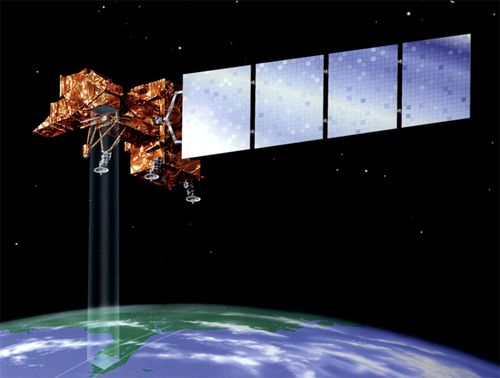
To illustrate my grand claim of scientific leadership, the obvious headline is that of Curiosity and the stunning achievement of the mission so far. But in the excitement of that event, it has been easy to overlook another that, in many ways, is of greater significance to us and our own planet: the Landsat mission celebrated 40 years of continuous operations last month. Forty years of recording the changing surface of our planet, seven successive satellites, and an unparalleled body of earth imaging data whose multitude of applications have demonstrably made a difference to our world. There are, of course, many other satellites, from different agencies of different countries, circling the earth, each with its own sophisticated technology dedicated to specialist imaging. But none have equalled the collective contribution of Landsat.
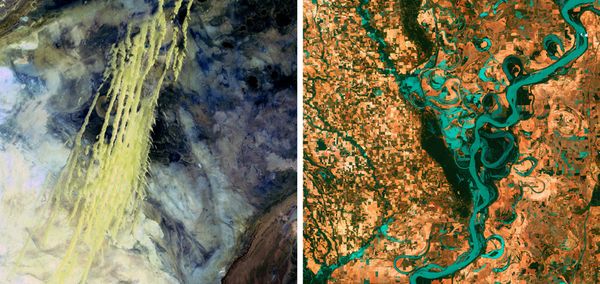
There are several excellent resources celebrating Landsat’s anniversary and browsing them is inspiring: of course, the Goddard Space Center and the mission home page, plus an excellent series in Wired Science, and videos and other material via Google’s Earth Engine. The power of monitoring 40 years of change is evident in many of the time-lapse videos – probably the Aral Sea sequence is the most dramatically depressing - but all are fascinating – see NASA’s top ten. And then there is the the Earth as Art image gallery – the two images at the head of this post (Algerian dunes and the Mississippi, credit: NASA’s Goddard Space Flight Center/USGS) are from the top five selected by popular vote:
Beyond the scientific information they supply, some Landsat images are simply striking to look at, presenting spectacular views of mountains, valleys, and islands as well as forests, grasslands, and agricultural patterns. By selecting certain features and coloring them from a digital palate, the U.S. Geological Survey has created a series of “Earth as Art” perspectives that demonstrate an artistic resonance in satellite land imagery and provide a special avenue of insight about the geography of each scene. We asked the public to vote on their favorite images from the more than 120 images in the online “Earth as Art” collection. We received over 14,000 votes and are happy to announce the top five winners.

However, this is a celebration that could have an unhappy ending. As reported in Wired Science in a separate piece - “Our View of Earth from Space Is in Danger” - earlier this year:
The nation’s Earth observing capability from space is beginning to wane as older missions fail and are not replaced,” according to a new National Research Council report, released May 2 as an update to a 2007 decadal report on Earth-observing capabilities.
While roughly 22 satellite or satellite systems run by NASA, NOAA, and the USGS are currently in orbit, that number could drop to only six by 2020. Of the 18 missions recommended in the original 2007 report, only two have specific launch dates.
This is a dire situation, considering that the U.S. relies on this network of satellites for weather forecasting, climate change data, and important geologic and oceanographic information – not to mention the thousands of amazing pictures of our home planet. Weather-related damage from wildfires, flooding, tornadoes, and heat waves resulted in nearly 600 fatalities and cost the economy approximately $50 billion in 2011, but this number would have been even greater without satellite observations.
There are many arenas in which the US can continue or develop a global leadership role as this century progresses, but to consciously abandon its leadership in acquiring and providing – free to every individual on the planet – the earth science data that we need if we are to have any hope of addressing issues that face us, would, in my humble view, be a crime against humanity.
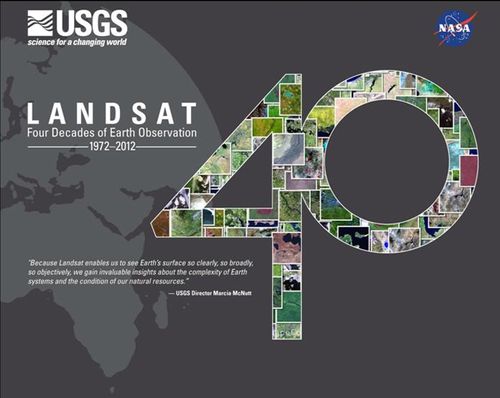
Here, for those interested, is the (slightly edited) summary of the Landsat program from the USGS:
Landsat Turns 40
The Long View of Earth from Space
The world’s longest-running Earth-observing satellite program — Landsat — turns 40.
NASA — working in cooperation with the U.S. Department of the Interior (DOI) and its science agency, the USGS — launched the first Landsat satellite on July 23, 1972. The resulting 40-year archive of Earth observations from the Landsat fleet forms an impartial, comprehensive, and easily accessed register of human and natural changes on the land.
Remote-sensing satellites, such as the Landsat series, help scientists to observe the world beyond the power of human sight, to monitor changes, and to detect critical trends in the conditions of natural resources. Data supplied by Landsat supports the improvement of human and environmental health, energy and water management, urban planning, disaster recovery, and crop monitoring.
Through 40 years of continuous coverage, the Landsat series of Earth observation satellites has become a fundamental global reference for scientific issues related to land use and natural resources. Landsat is valued all over the world as the gold standard of land observation. No other satellite program, in our nation or in any other country, comes close to having the historical length and breadth, the continuity and the coverage, of the Landsat archive.
A Versatile Perspective
Landsat satellites can give us a view as broad as 12,000 square miles per scene while characterizing land cover in units the size of a baseball diamond. In one instant look from over 400 miles in space, a single Landsat scene can record the condition of hundreds of thousands of acres of grassland, agricultural crops, or forests.
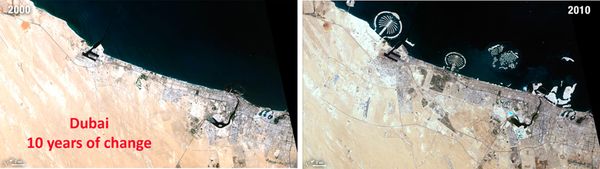
A comparison of the images illustrates the significant growth in the greater D.C. area. Major urban development can be seen the surrounding communities of Rockville, Greenbelt, and Suitland, Maryland. The expanded Woodrow Wilson Bridge, connecting Springfield, Virginia, with Oxon Hill, Maryland, is evident. The record of surface change is used by urban planners and local officials to evaluate the rate and direction of growth in the area.
Landsat images from space are not just pictures. They contain many layers of data collected at different points along the visible and invisible light spectrum. Consequently, Landsat images can show where vegetation is thriving and where it is stressed, where droughts are occurring, where wildland fire is a danger, and where erosion has altered coastlines or river courses.
Landsat images reveal subtle, gradual changes, such as Wyoming rangelands greening up after a drought, as well as massive landscape changes that occur in rapidly growing urban areas. Landsat can also provide inexpensive assessments of sudden natural or human-induced disasters, such as the number of acres charred by a forest fire or the extent of tsunami inundation.
Impartial information freely available
The Department of the Interior’s policy of releasing the full Landsat archive at no cost allows everyone to have access to this important resource, allowing researchers in the private sector and at universities to generate even more data applications — applications that serve commercial endeavors in agriculture and forestry, that enable land managers in and out of government to work more efficiently, and that define and tackle critical environmental issues.
Landsat and innovation
Landsat has sparked innovation in Earth systems research and in commercial applications of the data from its inception in the mid-1960s. Since 2008, when Landsat images were made available free of charge, there has been a remarkable burst of innovative science applications of the data.
For example, Landsat data played a central role in an award-winning type of mapping that tracks water use. Using Landsat imagery supplied by USGS in combination with ground-based water data, the Idaho Department of Water Resources and the University of Idaho developed a novel method to create water-use maps that are accurate to the scale of individual fields. Water-use maps help save taxpayer money by increasing the accuracy and effectiveness of public decisions involving water — for instance, in monitoring compliance with legal water rights. In 2009, the Kennedy School of Government at Harvard University cited Idaho’s original design for these maps as an outstanding innovation in American government.
The National Land Cover Database (NLCD 2006) produced by USGS and the federal interagency Multi‑Resolution Land Characteristics Consortium (MRLC) from Landsat imagery is a massive database that describes the surface condition of each 30-meter cell of land in the conterminous U.S. One such cell is approximately the area of a baseball diamond. The range and accuracy of the database enables land managers, urban planners, agricultural experts, and scientists with many different interests (for instance, climate change or invasive species) to identify critical characteristics of the land for a wide variety of investigations.
In the beginning
By the mid-1960s, some civilian geologists, geographers, and agronomists were familiar with imaging potential of classified Earth-observing satellites and had also studied the surprisingly detailed land-surface photos taken by early astronauts using hand-held cameras.
In 1966, with NASA still heavily committed to the Apollo Program in preparation for what would be a 1969 moon landing, the USGS convinced Interior Secretary Stewart Udall to hold a press conference announcing Interior’s new Project EROS, the acronym for Earth Resources Observation Satellites, and, furthermore, that Interior’s first satellite would launch in 1969!
In a statement that echoes true to this day, Udall said, “…the time is now right and urgent to apply space technology towards the solution of many pressing natural resources problems being compounded by population and industrial growth.” This bold announcement succeeded as a catalyst for what eventually became the world’s first civilian land-imaging satellite, developed by NASA and launched on July 23, 1972.
Six years earlier, Udall had said the satellite would be “…just the beginning of a great decade in land and resource analysis for a burgeoning population.” Today we celebrate not one but four great decades in Earth science from space.
On the horizon
NASA is preparing to launch the next Landsat satellite, the Landsat Data Continuity Mission (LDCM), on February 11, 2013, from Vandenberg Air Force Base in California. LDCM will be the most technologically advanced satellite in the Landsat series. LDCM sensors take advantage of evolutionary advances in detector and sensor technologies to improve performance and increase reliability. Once it successfully achieves orbit, LDCM will join the Landsat 5 and Landsat 7 satellites as Landsat 8 to continue the Landsat data record.
Comments
i got my initial training in image analysis on Landsat data so I really appreciate your summary! the entire archive of Landsat series is free to download. you can browse and download Landsat imagery for further image analysis and processing at http://landsat.usgs.gov/Landsat_Search_and_Download.php
Suvrat
Me too, Suvrat! A long time ago now, first of all working on Landsat images of the Basin and Range of Nevada; then comparing the Ouachita Mountains and the Makran accretionary wedge to come up with some outrageous analogue hypothesis…
We obviously feel the same way about the contributions of this program - and thanks for putting in the primary link.
This is an excellent perspective to add in a time of never-ending argument/debate … thanks
One reason to miss the USSR is that the USA felt it had to compete on this level to retain its leadership. (In the arts, as well): http://www.independent.co.uk/news/world/modern-art-was-cia-weapon-1578808.html
The new competitive barbarism of the technology-security complex may increase aerial surveillance, but alas seems unlikely to foster open publication.
Richard - that link to the article on the CIA and Abstract Expressionism is fascinating, and something I was completely unaware of.
It led me to hallucinate a traveling exhibition of NASA’s Earth as Art images that would emphasize their complete lack of competition from the legacy of the USSR - an antidote to competitive barbarism. But the idea is, of course, pure fantasy - the likes of Rockefeller and his “Mummy’s museum” seem to be in short supply these days.
An entertaining hallucination. That show would make a very strong point. The NASA site itself makes a similar point, strongly. Perhaps better, however, not to be too strong, or attract too much attention: Uncle’s museum is more susceptible than Millionaire Mummy’s:
http://www.seattlepi.com/ae/article/Seattleite-Subhankar-Banerjee-s-photos-of-Arctic-1176800.php