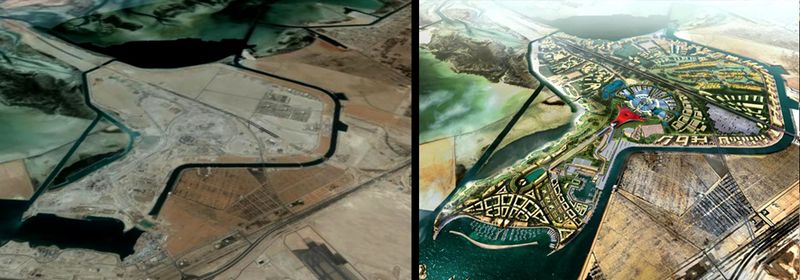
It rose out of the omnipresent sand of a natural island, and there remains a thin layer of the ocher substance almost everywhere: on the canopied grandstands, on the brilliantly lighted hotel at the edge of the track, on the seats and in just about every corner of the Yas Marina Circuit in Abu Dhabi.
So went the start of a New York Times article on yesterday’s finale to the Formula One Grand Prix season. Small armies of workers were sweeping the sand right up to the last minute and yet, as The Walrus and The Carpenter observed, it’s essentially an impossible task. Holding an extravaganza of highly sophisticated but delicate technology in this kind of environment brings many challenges. As the article went on to comment
It may play havoc with the engines of the cars and it will change the grip, lap by lap, for the drivers, even affect the lenses and other camera mechanisms belonging to the hundreds of photographers and journalists who will document the final race
For races in neighbouring Bahrain, it’s long been a problem, as explained by Red Bull’s technical director Gunther Steiner:
You have to be aware that it can get in to every part of the car. It literally sandblasts the car every time it goes on track and gradually erodes all the surfaces and the cooling fins on the radiators.
Unique measures are taken to protect exposed suspension and other parts of the cars, and specially designed air filters have to be used. And then there’s the problem with grip and tyre selection - after all, a motor race in which the drivers have to go slowly in order to stay on the track - and avoid whole sections of it because it’s covered in sand - detracts somewhat from the sporting attraction. David Coulthard, the now-retired driver, was quoted before the race as saying
It does seem to be very sandy. When I followed a car the amount of stuff coming out the back was incredible. What that does is two things: one, it makes the driver pay the price if he goes a bit off line, which is good because it favours ability, but it is also makes people not want to take the risk in overtaking. Sand on your tyre takes a good lap to be cleared out.
And so it proved. It was largely a risk-avoidance race with drivers clearly sticking very closely to a single driving “line,” conspicuously steering clear of the rest of the track - and often running into problems when they didn’t. Grains of sand influencing a sporting spectacle and, as The Times Online concluded, “Whoever wins the inaugural Abu Dhabi Grand Prix on Sunday will be fêted in a nation that can afford to buy its heroes — but the victorious driver might feel his name is not written in history, but in the sand.”
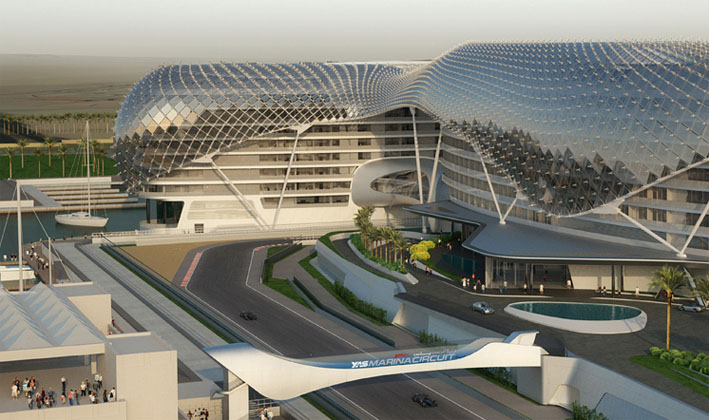
But if the sport was less than inspiring, the setting made up for it. This was the inaugural race at Abu Dhabi’s latest example of construction extravagance. Ras Island, just down the coast from the preposterous artificial island developments of Dubai, was but a sandy expanse a mere 30 months ago (see the Google Earth image at left of the image at the head of this post). It hardly seems to have been a natural island, but rather 25 square kilometers of coastal desert, sandbanks, and sabhka (salt flats) carved out and isolated from the mainland by manmade waterways. After several tens of billions of dollars, and the efforts of tens of thousands of workers, things have changed. The image below is of the hotel complex across the track (as night falls, as it did for the Grand Prix, the whole thing glows in a succession of changing colours) and at the right in the image at the top is the way the whole place will look when finished.
The strange red object in the centre of the header image is “Ferrari World,” the largest indoor theme park on the planet, “like a megalomaniac’s pleasure dome” in the words of the NYT. Yas Island will boast 20 hotels, 3 theme parks, a “Super Regional mall”, golf courses, several marinas, and commercial and residential developments. You can read the full specs at the developer’s website, but in case you don’t here’s a sampling of the exuberance on this “island of dreams”:
There will be a Super Regional Mall that will house famous retail brands from
around the world in over 500 stores and 4 floors including lifestyle, fashion &
boutiques.
• There will also be room for a complete town centre concept, contained in a
number of adjacent buildings and built under a 88,100m2 roof
• The Yas Mall will have one of the largest free standing roofs in the world,
showcasing 296,000m2 of the world’s best retail space
• Adjoining the Yas Mall will be will be Abu Dhabi’s first Multi-purpose Retail
Park (100,000m2)
• Three major department stores will be accommodated.
• A large hypermarket covering an area of 17,000 m2
What I have not been able to determine is how much concrete goes into this monster (one hotel used 45,000 cubic metres of it, the racetrack 225,000) or, indeed, where all the sand came from for that concrete; presumably, as in neighbouring Dubai, local sources of non-desert sand were used (the windblown stuff being too rounded and smooth for good concrete), and the local natural sand budgets consequently profoundly changed. But it’s not just the natural sand budgets. Although sand prices around the world have fallen during the economic crisis, they peaked in 2007 at more than $40 per ton, and sand supplies were becoming difficult. The Economist recently ran an article (pleasingly titled “The hourglass effect”) that began:
“LOOKING for sea-sand for reclamation project in Singapore. Prompt reply is greatly appreciated.” Many such pleas can be found on Alibaba.com, a popular Chinese trading-website. Malaysia banned sand exports as long ago as 1997. Indonesia followed suit in 2007 on environmental and, some say, political grounds. Ever since, it has become harder for Singapore to secure supplies for its booming construction industry and sea-fill plans.
Singapore has turned to Cambodia and then Vietnam for its sand, but both have now banned exports. It seems that Myanmar may be the replacement supplier, so I will see my favourite material propping up, through, of course, western contractors, a loathsome dictatorship. The need is clear for a more widespread development and use of advanced forms of concrete that not only use less sand, but also can be manufactured without the associated emissions. And considering that every man, woman, and child on the planet “consumes” forty times their own weight in concrete every year, the sooner the better.
And finally, still on sand budgets and still in the news, today’s Guardian newspaper carries a piece titled “Tide turns again for Cancún in shifting sands row.” The 800,000 cubic metres of sand that were used to replace beaches washed away by Hurricane Wilma a few years ago lasted only a few months, and the current project is only the latest in a series of failed attempts at beach nourishment.
A huge project to replenish eroded beaches in Mexico’s main Caribbean coastal resorts, including Cancún, has been suspended after legal action by environmentalists.
Campaigners claim the $75m (£45m) plan – involving taking 6.2m cubic metres from a sandbank just off Cozumel island, 50 miles from Cancún, to hotel beaches – is based on incomplete assessments.
Critics say dredging the sandbank will alter currents and damage ecosystems, including coral reefs and breeding grounds for species such as the queen conch. They also fear Cozumel will become more vulnerable to hurricanes. “It’s absurd. We understand it is necessary to fill out the beaches but it needs to be done without sacrificing other places,” said Alejandra Serrano of the Mexican Centre for Environmental Law.
But Rodrigo de la Pena, president of the Hotel Association, criticised the delay: “We cannot sell ourselves as a place of sun and sand, if we don’t have the sand.”
Alejandra Serrano is right - it’s absurd. But then so many things are, including much of what I’ve just written about …
Comments
No comments yet.