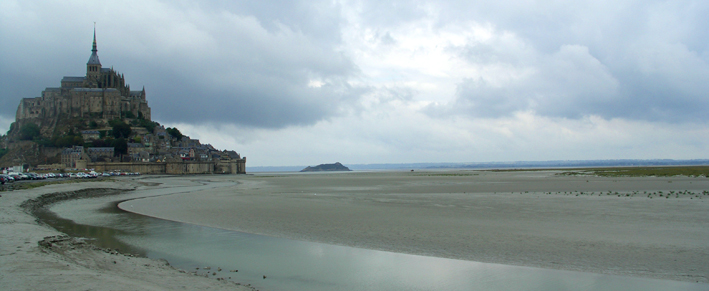
The bay of Mont-Saint-Michel, in the coastal corner of France between Normandy and Brittany, boasts the fourth-largest tidal range in the world – up to 14 meters (46 feet) and the sedimentary drama to go along with it. It is an incredibly complex system. The tides carry sand and silt into the bay and leave much of it behind, augmented by the sedimentary loads brought down to the bay by the three rivers that drain into it. Roughly 700,000 cubic meters of sediment are added to the bay every year – it is, quite naturally, silting up (or, more attractively in French, experiencing ensablement – sanding up). As a result, the iconic World Heritage Site of the monastery towering above its isolated rock is increasingly losing its magnificent isolation and becoming united with the mainland. But this natural process has been greatly exaggerated by human meddling over the centuries and the rhythms of the bay profoundly changed and subdued. The natural processes operate on a scale far beyond that of any human endeavour, but it is possible to mitigate the effects of our meddling and restore the bay to at least close to its unhindered condition and allow natural ensablement to take its course. And that is exactly what is going on today in the bay, after years of preparatory work and research by a syndicate of authorities and institutions – a grand experiment so that Mont-Saint-Michel “ recovers pride of place as the central feature of the Bay, amid a seascape of sands constantly being reshaped by tidal and river water.”
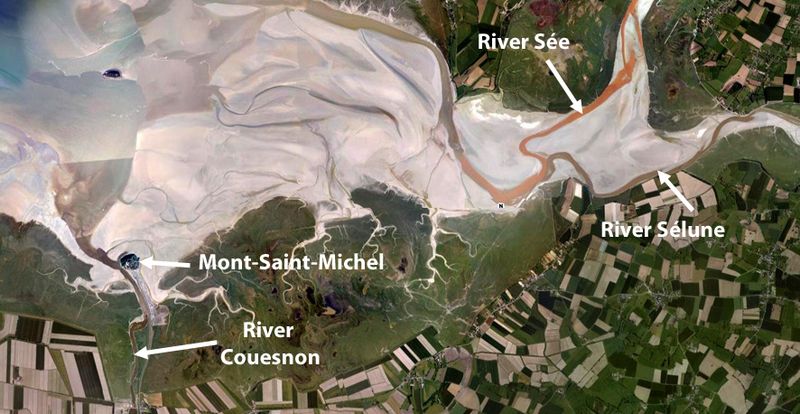
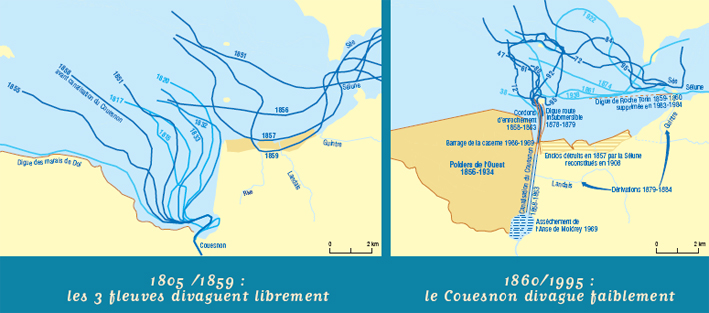
Mont-Saint-Michel began as an isolated rock remaining emergent from the bay as rising sea levels inundated the land following the end of the last ice age; it was periodically connected to the mainland by a natural spit of sand, a tombolo. But then, in 708 so the story goes, St. Michael approached the bishop of nearby Avranches, Aubert (later also a saint) and demanded that a monastery be built on the rock. Foolishly, Aubert ignored this request, finally setting about the task only after the irritated angel had burned a hole in the bishop’s head with his finger (now there’s a warning about procrastination and disobeying orders). The monastery and then abbey grew up over the centuries and then declined; after the French revolution, it became a prison that welcomed, among many anti-republicans, Victor Hugo – he described the tide as coming into the bay “with the speed of a galloping horse.” Along with this tide came the human one – pilgrims both religious and touristic. Today, it is the most-visited site in France outside Paris – three million people visit each year. It was teeming even in mid-September when I arrived, the massive parking lot and causeway (built where the tombolo used to be) filled with cars, camper-vans and buses. The causeway completely cuts off the natural currents and sediment movement of the inner bay, but it is by no means the only manmade disruption. In the 1850s, the channels of the Rivers Sée and Sélune were eroding the agricultural area south of where they entered the bay, and a dike (“digue”) was constructed to force their flow further north; over the following decade, the channel of the River Couesnon was completely controlled and “canalised” all the way out beyond Mont-Saint-Michel itself (the artificial banks for much of this were eroded or overwhelmed by sand by the 1960s). Critically, in 1969, a dam was built across the Cuesnon that effectively ended the power of the river to flush sediment out into the bay. The result of all these interventions was increased natural and manmade growth of the “polders,” the salt marshes that invade the bay and provide valuable agricultural land, together with accelerated sedimentation around the Mount itself. In modern times, the foundations of Mont-Saint-Michel were buried under two meters of sand that had built up since the nineteenth century - the entire sedimentological system of the inner bay was changed – dramatically illustrated in the two maps below showing the locations and changes to the river channels before and after these “management” initiatives.
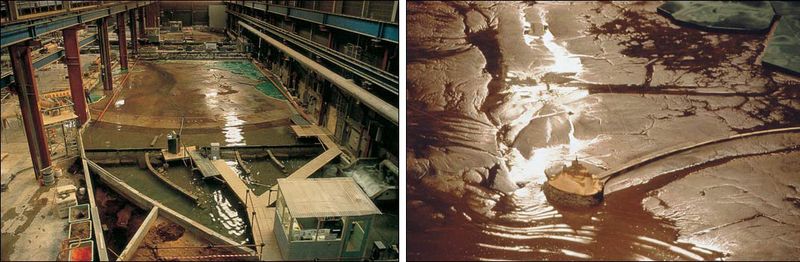
The project to restore as far as possible the nature of the bay has been comprehensive, evaluating hydrology and sedimentology, environmental factors, and the influence on tourism. It is is superbly described at http://www.projetmontsaintmichel.fr/en/, much of the site available in English. The sedimentology modelling alone was a four-year study, a key part of which was the construction of a huge physical model capable of reproducing and predicting sand dynamics (see photos below). The model covers 900 square meters (almost 10,000 square feet) and was used to model 45 years of annual cycles in the bay without further intervention and with a range of restoration options (see my earlier post for a natural version of such a laboratory and references to other such modelling projects).
Over a recent period of forty years, 27 million cubic meters of sediment have been added to the bay and a thousand hectares (four square miles) of new vegetated land encroached into it. The model demonstrated that, by 2042, the marine environment of the inner bay around the Mount would vanish completely. Nothing can stop this happening eventually, but it can be slowed down. There are two keys to delaying the inevitable: remove the causeway and restore the hydraulic power of the Couesnon river to flush sediment out of the inner bay. The projects to accomplish both of these, together with all the associated works, were commenced in 2006 and are due to be completed by 2015. The causeway will be replaced by a simple access structure raised above the sea floor to permit natural flow and sediment movement, and well away from the mouth of the Couesnon. The gigantic parking lot will be demolished, to be naturally replaced by 15 hectares of sand. The access to the Mount will be severed under the highest spring tides of the year, restoring the symbolic isolation of Mont-Saint-Michel.
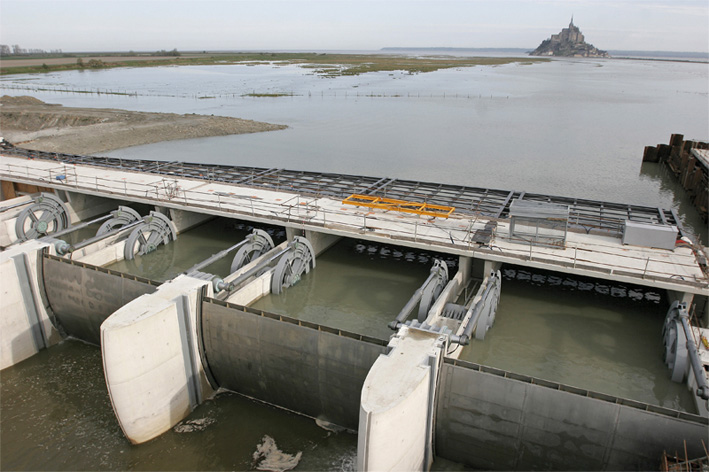
On the river itself, a barrage has been constructed that will allow the waters of each high tide to be stored behind it and then released, flushing sediment out into the bay – the hydraulic power of the river will be restored, even enhanced. The barrage, shown under construction below, has just been commissioned. The river below the barrage will also be dredged; the product of the dredging, 1.25 million cubic meters of salty sand full of shell fragments that is locally known as “tangue” will be used, as it has been for centuries, for local agriculture and polder maintenance. Importantly, the modelling demonstrated the importance of the river draining in two channels out into the bay, so a structure to split the flow downstream from the barrage opening will be constructed.
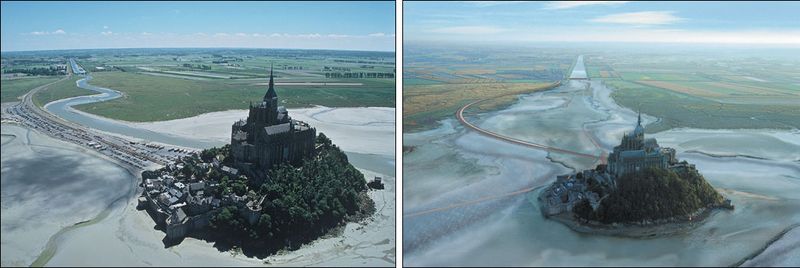
The effects of the project will be gradual, but in thirty years or so it is anticipated that the mean level of the sea bed around Mont-Saint-Michel will be 70 centimeters lower than today, millions of cubic meters of sediment will have been removed (much of it quite quickly), and the sea will have recaptured 50 hectares of today’s land. The scene today, below left, will have evolved into something like the view on the right. This is an extraordinary and ambitious project, a fascinating experiment in large-scale restoration of the natural landscape.
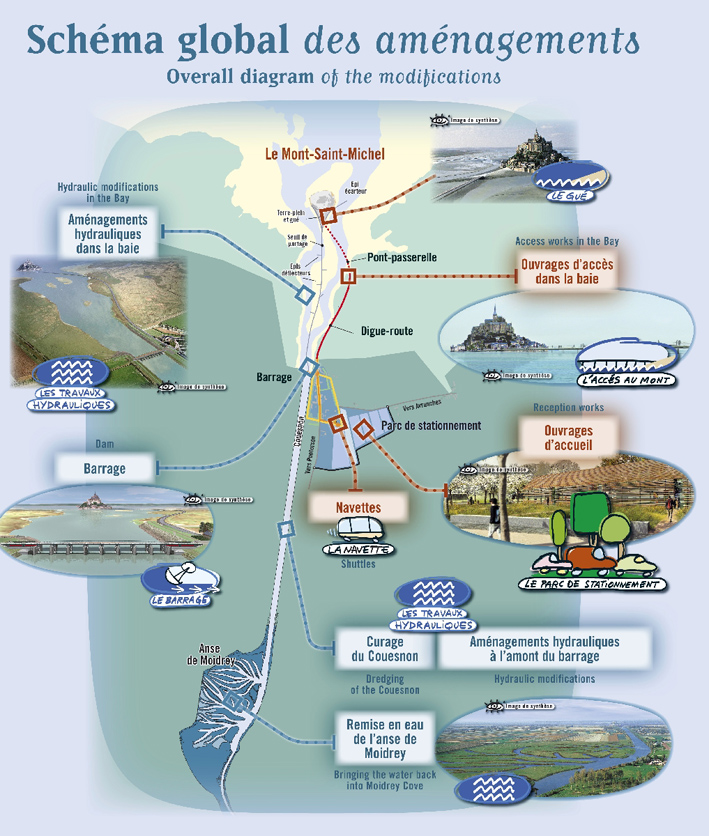
The site linked above is the source of much of the information and illustrations for this post, and includes a thorough documentation of the sedimentological work, downloadable as a pdf file here; it’s in French, but superbly illustrated. I have copied below a map of the main components of the whole Mont-Saint-Michel project for reference and further detail.
Comments
This is fascinating, because it is so opposite of the prevailing notion of sea level rise inundating polders. Thanks for sharing.