
It sometimes seems to me that managing my thoughts (and memories) resembles trying to control a pile of sand grains as they sift through my fingers. Now, new neuroscience research suggests that the analogy is not far off the mark. As reported recently in the New Scientist, it appears that the way in which our brain’s neurons connect to each other and communicate is very much like the way a pile of sand behaves, and it is this that bestows on our brain some of its “remarkable powers.”
Ten years ago, a Danish physicist, Per Bak, published How Nature Works: The Science of Self-Organized Criticality, a book that I devoured and still refer to (the paperback cover has an image of sand ripples; it’s now, sadly, out of print and used editions seem to be going for either $130 or £130!). Bak used sand pile avalanches as an illustration of the ubiquity of scaling or power laws in nature: the frequency (or its logarithm) of occurrence of something is proportional to a measure (often size) of that something multiplied by itself a specific number of times (raised to a certain power, mathematically speaking). Newton’s law of gravity is a power law; the pull of gravity on an object decreases with distance to the object squared. Since it decreases, Newton’s law is an inverse power 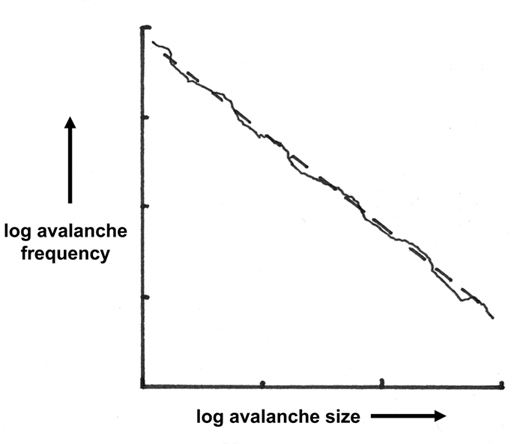 to describe this condition_._ It would now seem that the brain operates in this apparently precarious realm, but generally manages it rather well - and powerfully.
SOC is definitely not characterised by randomness, and, thankfully, neither are our brains (contrary to occasional appearances). If the connections between the neurons in the brain were random and structureless, then the organ would be instantly overwhelmed by the sheer numbers of useless but energy-sapping events. Nor are the neuronal connections simple - the new work makes the comparison with “small-world” networks, more flexible and powerful than simple networks, but perfectly manageable compared to randomness.
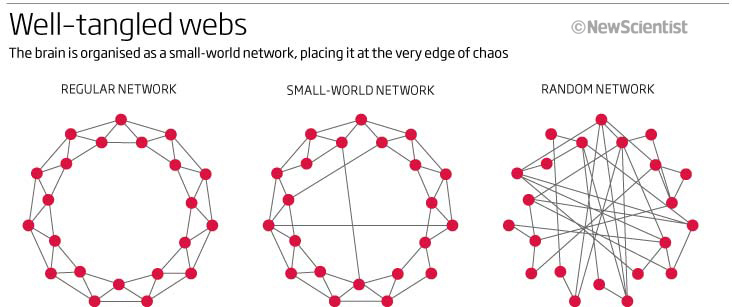
Such a network of connections allows powerful “avalanches” of neuron communication across relevant regions of the brain, often with synchronised “phase-locking” of large groups of neurons firing at the same frequency; these groups operate effectively but independently of other groups. These episodes of phase-locking alternate with periods of much greater disorder, “blizzards” of activity in which significant reorganisation seems to take place. The durations of these phases and the avalanches of firing neurons at different frequencies all seem to fit with the characteristics of SOC, apparently providing the brain with its amazing capacity to process information and with its adaptability. And also a great new excuse - “sorry, that part of my brain’s phase-locked right now.”
It’s worth noting that power laws and SOC are compelling phenomena, but often easier to hypothesise than conclusively demonstrate. Phillip Ball has an excellent discussion of the phenomena and the problem in his new book Flow, one of his new trilogy on nature’s patterns (plus lots of other good stuff about granular materials).
This fascinating topic has also been discussed on the Neuronarrative blog which includes a link to a piece on which I can’t possibly comment, Why a Woman’s Brain is Like an Avalanche, a Landslide, an Earthquake, or a Hurricane.
Oh, and there’s also real “brain sand” - small quantities of grit often found in the pineal gland, composed of various calcium minerals, referred to as corpora arenacea, and believed by some swamis to carry holographic rhythms of the body’s spatial and temporal existence.
Comments
Very nice! I wonder how often the “blizzards” occur, and how they might seem to those of us experiencing them. And I’ll have to remember that phase-locking excuse, sounds much more sophisticated than anything else I’ve heard!
Speaking for myself, the blizzards seem to occur quite frequently and they come with a sort of blurry sensation. And I had a phase-lock at the end of the post - a couple of links now added that you might enjoy.
Ah - was that a snow flake or just a floater?
Thanks, maybe that’s why Stevie Nicks sings about landslides! :)