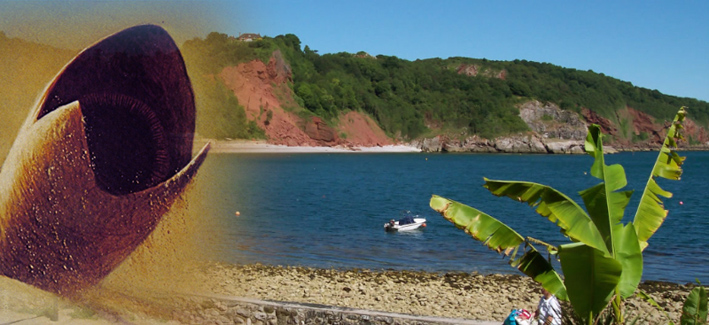
What a headline - how could I resist? It’s from the UK newspaper, The Telegraph, earlier this year - it’s not the paper I read, so I only just came across it on the web. Torbay is on England’s southwest coast, a popular holiday resort boasting sun, sand, and surf, but also, reflecting its diverse and important geology, the area has been designated “The English Riviera Geopark.” Geologist Kevin Page, of Plymouth University, is deeply involved in the preservation and recognition of the region’s geodiversity; it’s one of his projects that led to the headline and reports such as “Traces of an unknown lifeform have been found in rocks in a secret location in Torbay” and “Scientists have found evidence of a giant prehistoric sand worm in an English seaside resort” (but the image above is purely my own fabrication).
Torbay is in Devon, the only county in Britain to lend its name to a geological period, and Devon’s geological fame is in part linked to its inspiration for the establishment of the original Devonian System in 1836 by Sir Roderick Murchison and Professor Adam Sedgwick, two of Europe’s great geological pioneers. 400 million years ago, Devon lay in balmy tropical latitudes, the legacy being great tracts of limestones containing abundant reefs, corals, trilobites and other key critters of the times. But Torbay gradually drifted into desert latitudes and this, combined with general climatic deterioration, resulted in the environment changing dramatically. Flash floods hurtled down desert wadis, scree blanketed the flanks of newly formed mountains, and seas of dunes invaded the landscape; the rocks, from the Permian period, are almost uniformly red sandstones, gravels and conglomerates, recording the dire and extreme conditions that ultimately presaged one of the planet’s 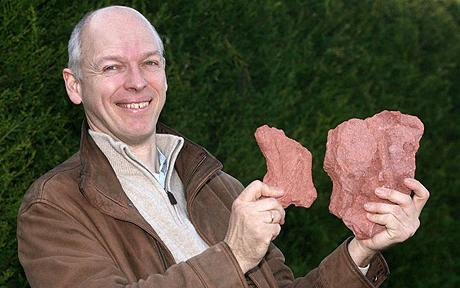 reports:
It really is quite extraordinary. Nothing like this has ever been found before. The underground area is peppered with these burrows. There is no supporting evidence to suggest they were made by creatures we know about, so what were are looking at is an entirely new life form. It is very, very strange. They were made at the end of the Paleozoic period before dinosaurs came along when the earth teemed with creatures which are now extinct. We have found the holes but as yet we haven’t found the animals which made them. They would have looked like the worms from the film Dune. It is science fiction meeting science fact. We know about giant millipedes at the time but this is something quite different. They are unknown to science and a completely new species. It is life, but not as we know it.
The obvious reference to Frank Herbert’s book and the classic science fiction movie (not to mention the cult classic, Tremors) has provided fodder for some of the more lunatic fringes of the internet, with sites devoted to the paranormal and the “unexplained” enjoying fantastic speculation. The science, once the analysis is complete, will be published later this year.
Trace fossils, while providing only a vicarious view of life, are, nevertheless, immensely important; they often the only view we have of certain life forms at certain times and they yield insights into lifestyles and locomotion. The recent issue of Earth magazine carries a short piece illustrating this from the Cambrian (also named by Sedgwick) of Wisconsin, in sandstones from perhaps 500 million years ago. Adolf Seilacher, now in his eighties and perhaps the greatest reader of the runes of trace fossils, and James Hagadorn, report how early visits to the land may have been possible.
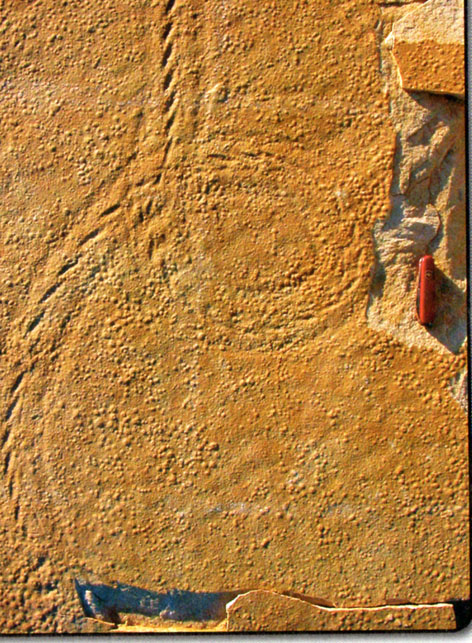
The trace fossil they describe (above) could be the track of a small 12-legged marine critter that, like a hermit crab, kept its gills moist by coiling itself into a shell, and set out onto the beach. If this is the case, then “hermit-like” behaviour originated 290 million years earlier than had been previously thought.
And then, of course, there are the most popular and evocative trace fossils - below, the longest dinosaur tracks in the world, in Bolivia - strolls in the lake, side-by-side, 70 million years ago.
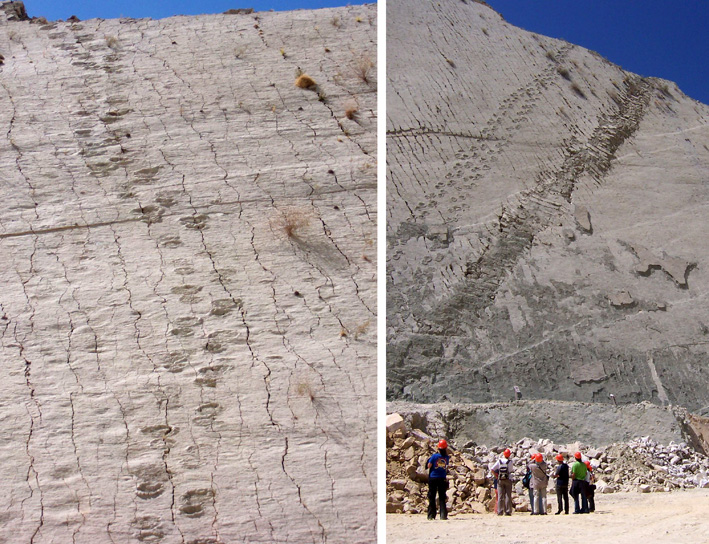
[Torbay worms http://www.telegraph.co.uk/science/science-news/4995386/Giant-sand-worms-lived-in-Torbay-scientists-claim.html; http://www.thisissouthdevon.co.uk/news/280m-year-old-worm-new-species/article-769879-detail/article.html. Bolivia tracks images, Jerry Daykin, Cambridge, Creative Commons Attribution License, http://images.google.co.uk/imgres?imgurl=http://upload.wikimedia.org/wikipedia/commons/0/03/Dinosaur_tracks_in_Bolivia_1.jpg]

Comments
No comments yet.