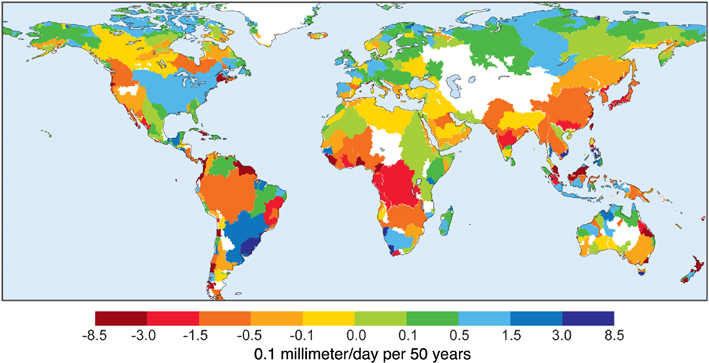
This map shows the change in runoff inferred from streamflow records worldwide between 1948 and 2004, with bluish colors indicating more streamflow and reddish colors less. In many heavily populated regions in the tropics and midlatitudes, rivers are discharging reduced amounts into the oceans. In parts of the United States and Europe, however, there is an upward trend in runoff. The white land areas indicate inland-draining basins or regions for which there are insufficient data to determine the runoff trends. (Graphic courtesy Journal of Climate, modified by UCAR.)
I’m trying to catch up somewhat on my backlog of reading, working away at the pile of _Earth Magazine_s, _New Scientist_s, and sundry other strata. Now, I admit that I’m doing this under quite idyllic conditions in France, so the task is not exactly a burden. But it does, inevitably, exercise the mind. The July issue of Earth, contains a brief report titled “Rivers Run Dry” and describes a publication from the National Center for Atmospheric Research in Boulder, Colorado, that is an analysis of more than fifty years of streamflow data from the world’s major rivers. The map that accompanies the article is reproduced at the head of this post. The press release on the report is titled “Water Levels Dropping in Some Major Rivers as Global Climate Changes” and the piece in Earth begins - “Some of the world’s major rivers are losing water - and climate change is to blame.” The press release also contains the following statement:
Many factors can affect river discharge, including dams and the diversion of water for agriculture and industry. The researchers found, however, that the reduced flows in many cases appear to be related to global climate change, which is altering precipitation patterns and increasing the rate of evaporation.
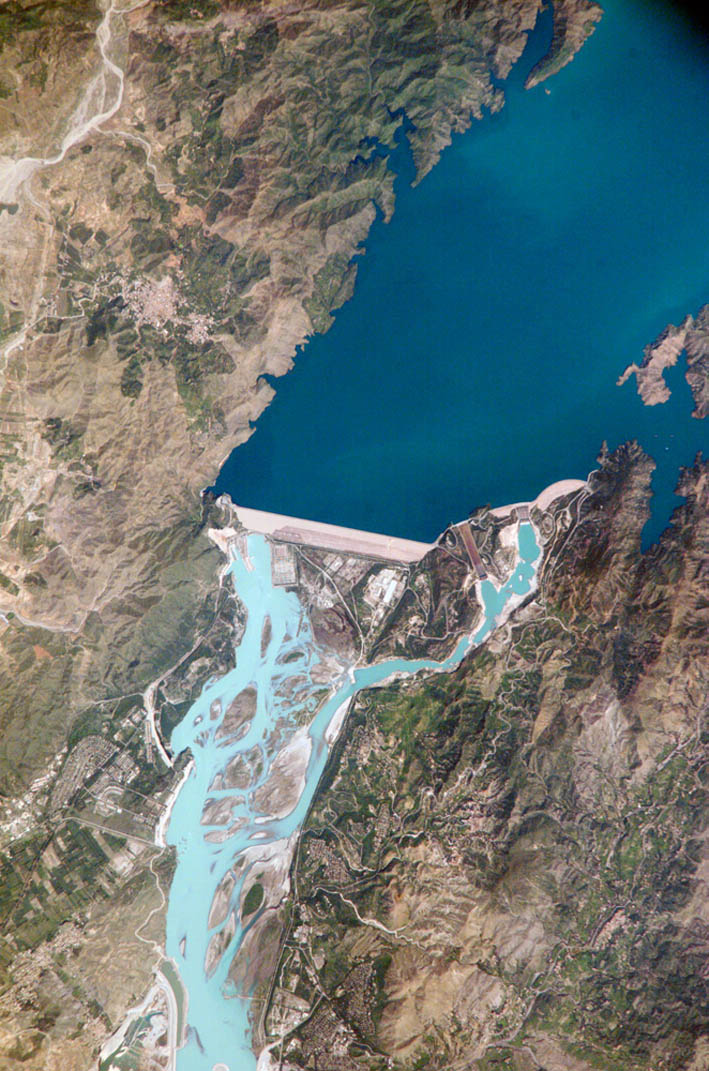
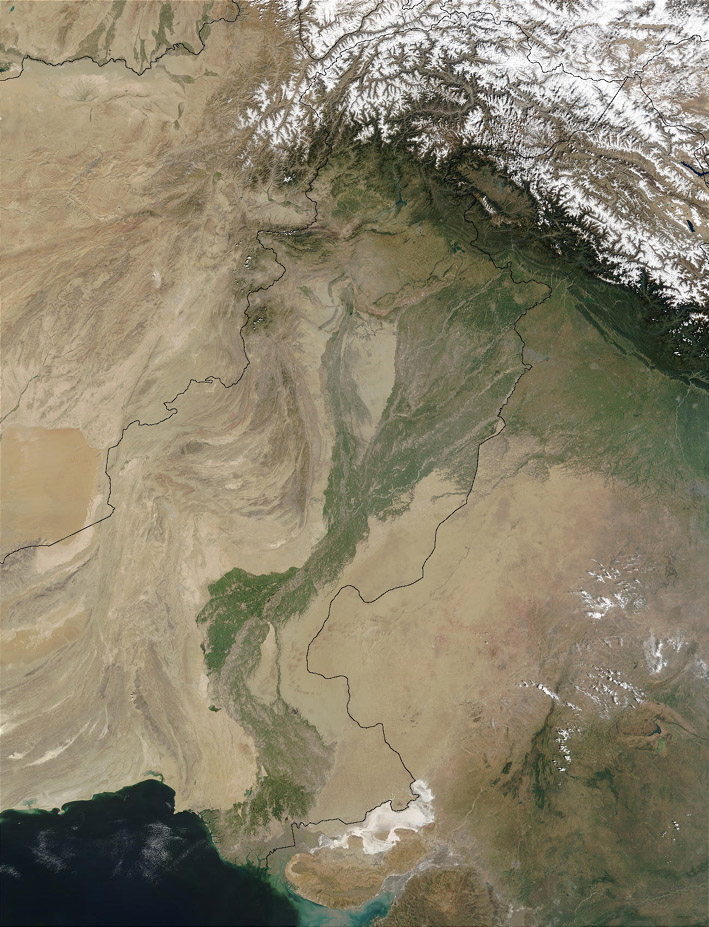 Many factors indeed affect river discharge, and I recalled some material I had collected a while ago when I encountered the astonishing fact that one of the world’s great rivers, the Indus, for large periods of the year delivers no water at all to the Indian ocean. The population of the once fertile delta has plunged as a result of migration driven by environmental degradation - fish stocks have plummeted, cultivatable land declined dramatically, salt water invasion spread, and the supply of agriculturally nutritional sediment to the sixth largest delta in the world is now a fraction of what it used to be. In the past, the Indus typically carried more than 400 million tons of sediment, much of it sand from the interior deserts, to its delta, which was growing oceanwards at rates of 4-30 meters per year. Not any more: sediment delivery is at most 30 million tons per year and the delta is shrinking. Why? The primary reason is the frenzy of dam-building on the river and its five major tributaries in both India and Pakistan over the last few decades. And this frenzy shows no signs of calming down, more major projects being under construction and planned. An example is the Tarbela dam, below, built as the largest earth-filled dam in the world in 1976; it’s estimated that the reservoir will be filled with sediment and the dam rendered useless by 2060.
Now of course this is a major social, political, and environmental issue, and not one that I shall get involved in (a selection of detailed resources are listed below). My point is simply that river discharge of water and sediment is complex and multi-faceted but water availability is a crucial and immediate issue for the majority of the world’s population; it’s not just the residents of the once-fertile but now rapidly desertifying Indus delta whose lives are ruined by changes to their water supplies. I was also reading recently that the much-heralded early success of restoring Iraq’s marshes, the most important wetlands in the Middle East, is threatened by dam-building upstream along the Tigris and the Euphrates. My point is simply that, for an issue as vital and complex as water supply, the statement that “Some of the world’s major rivers are losing water - and climate change is to blame” is misleading and dilutes the focus needed on the immediate problems and their possible solutions.
[the NCAR news release is at http://www.ucar.edu/news/releases/2009/flow.jsp; initial resources that I have found on the degradation of the Indus Delta and water management issues along the river are at http://internationalrivers.org/node/3601, http://www.uicnmed.org/web2007/cdflow/conten/3/pdf/3_5_Pakistan_Indus.pdf, http://www.worldsindhi.org/waterenvironmentalcrisis.html, and http://ipsnews.net/news.asp?idnews=46111; the situation in the Iraq marshes is described at http://news.bbc.co.uk/2/hi/middle_east/7906512.stm]
Comments
I agree. Much of India’s current water problems as regards river discharge are management problems - over extraction, allocation deals not having anticipated population growth and local politics. But climate change will likely play a role in the future especially for the Himalayan rivers if glaciers continue to shrink as predicted. so that would mean all water budgets and projections of hydroelectricity need to be re-calculated. Unfortunately this new data and water budgets are not being taken into account in the haste to build these dams. that really calls into question the viability of these new dams.