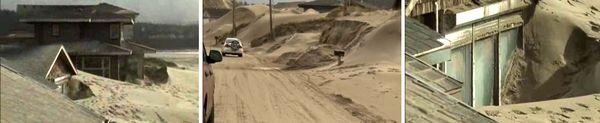
The owners of otherwise delightful beachfront homes on the Oregon Coast near Waldport, Oregon, must feel like responding as the Walrus and the Carpenter did – except that their situation is much, much, more serious.
Many thanks to Howard Allen for spotting this recent report by Dan McShane on his “Reading the Washington Landscape” blog. It shows homes literally half-buried in sand and such disastrous events were reported last year by KCBY in Coos Bend, from where the images above were taken. A winter storm had “left sand piled up to the roof level of some homes in Waldport.” But can we disengage from the human component of the equation and observe this simply as another example of naturally dynamic coastal geology? Probably not.
Inevitably on this blog, I have commented a number of times on issues of coastal processes, our attempts (generally futile) to “manage” them, and on the feedback between nature and human activities; “nourish or retreat?” was a relatively recent example, “Coastal change and saving sand - the state of the art” looked at meticulous work on this topic by the USGS and others, then there was the impact of Hurricane Irene, and a discussion of sediment budgets (and I have omitted my series of fulminations on the lunatic schemes for the Gulf Coast following the Macondo catastrophe). But I was reminded also of the publication of Orrin Pilkey’s book on beaches in August last year, when I wrote as follows:
I have referred several times in the past to Orrin H. Pilkey, James B. Duke Professor Emeritus of Geology at Duke University. Now, together with colleagues from the US and Northern Ireland, he has published what promises to be an informative, entertaining, and provocative read - The World’s Beaches: A Global Guide to the Science of the Shoreline. I haven’t, of course, got my hands on a copy yet, but a review in the New York Times simply confirms that anything by Pilkey is required reading. The review is titled “Shorelines, Sandy or Otherwise, That May Not Last.” The conclusion echoes the issue that I posted on a couple of months ago:
But, the authors conclude, unless society chooses beaches over buildings the result will be a world in which parks like the National Seashores retain natural beaches, but beach resorts elsewhere are “heavily walled and beachless.” Rising seas will make sand-pumping operations “untenable,” they predict, and tourists will amuse themselves by “promenading on top of a seawall” — already the principal activity in too many coastal resorts.
If they are right, by then the beaches this book describes will be a nostalgic memory.The book is published by the University of California Press, to whom I will ever be grateful for publishing mine, and the New York Times review is by Cornelia Dean, whose own book, “Against the Tide: the Battle for America’s Beaches,” also falls into the required reading category.
Now the hazards of owning a beachfront home in Waldport Oregon remind us dramatically that it’s not simply shifting shorelines that are impacted by human activity (and, regardless, represent an entirely natural threat). Invariably, when beachfronts are developed, the first things to go are the dunes (after all, they obstruct the view). But dunes are an integral and vital part of the shoreline system – remove them and that system is destabilised. Once destabilised, it is then vulnerable (as are properties) to windblown movement of sand on a massive scale.
Being, as ever, curious, I went online to try to find more on coastal dynamics at Waldport. I’m sure there are more recent studies, but this piece of work from 1975 by the Oregon Department of Geology and Mineral Industries proved fascinating and more than sufficient: “Recent Shoreline Changes of the Alsea Sandspit, Lincoln County, Oregon.” Written by James Stembridge of the Department of Geography at the University of Oregon, it provides some historic portents.
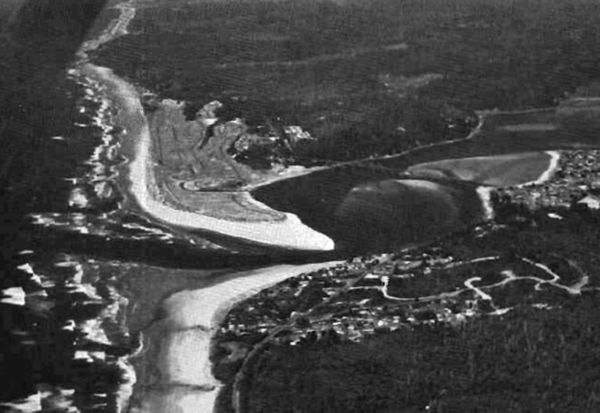
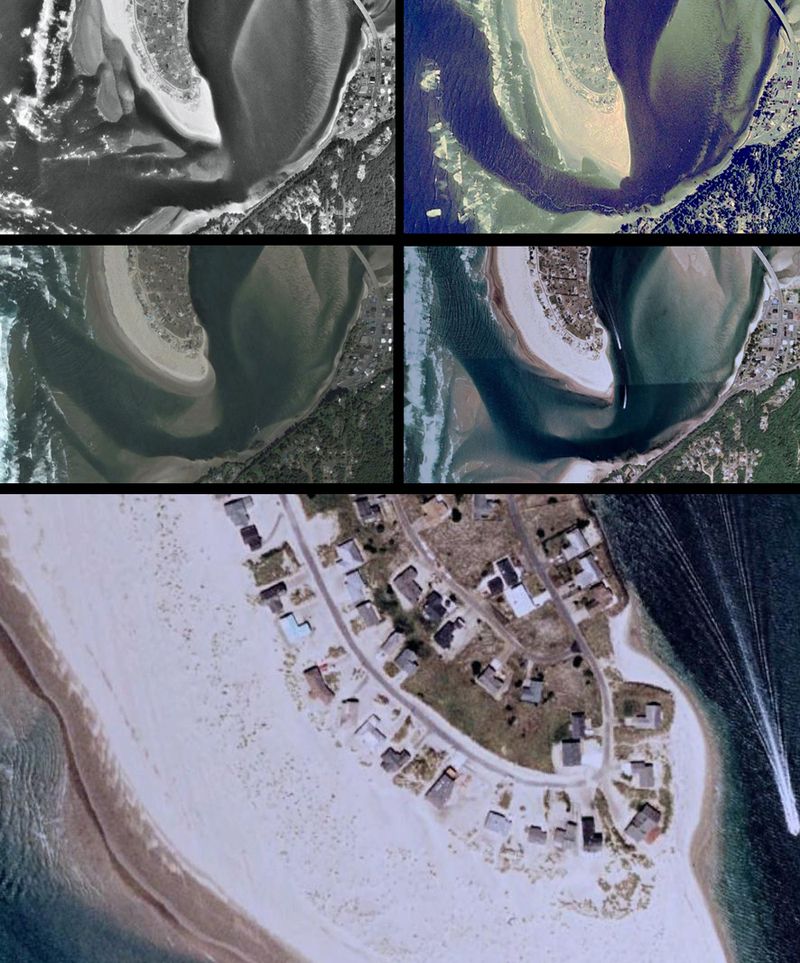
The buried houses are built on a shape-shifting promontory of sand, the Alsea Sandspit, and here is a photo of it from 1975 (compare with the Google Earth images below):
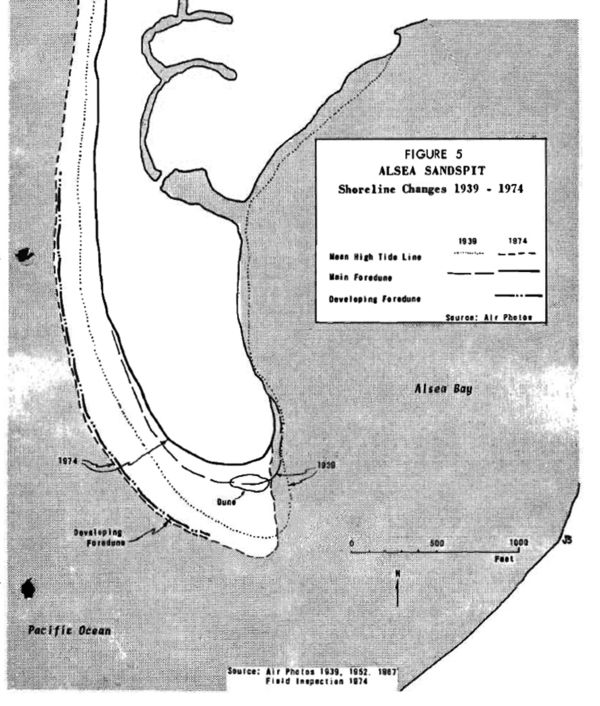
And here, from that publication, is a compelling map of changes to the spit over the period from 1939 to 1975:
I have extracted some informative passages from the publication (remember, this was 37 years ago – before anything like the scale of today’s development):
Erosion of coastal sandspits has been a recognized hazard in Oregon since the demise of the resort community of Bayocean near Tillamook, which was slowly eliminated by the sea beginning in the late 1920’s. Currently, the sandspit at Siletz Bay is undergoing severe erosion which is critically endangering structures along a three-mile beach front. Partially as a result of these experiences with eroding sandspits, some planning agencies, such as the Oregon Coastal Conservation and Development Commission, have considered limiting the construction of housing units on sandspits.
This study is a preliminary analysis of a third Oregon spit, the Alsea near Waldport, with respect to recent shoreline changes, human modifications, and potential impact on current and future settlement.
Unlike the Tillamook and Si letz spits, the Alsea sandspit is presently accreting at a rate as great as 10 feet per year at its southwest margin. Erosion at a rate of as much as 2 feet per year is occurring on the bay side of the spit, however, as well as along the northwestern margins of the spit, where the underlying terrace of semi-consolidated Pleistocene dune deposits is exposed to ocean wave action.
… This main foredune is at least partially bulldozed into shape and rests at a position of up to 100 feet inland of its 1939 location. It is well stabilized with European beach grass (Ammophila arenaria), except where breached for home sites and by trails from the residential area to the surf zone. Its present height is approximately 35 feet above mean high tide level, increasing at a rate of about 0.5 feet yearly as sand accumulates in the vegetation. The extreme high tide line has moved as much as 300 feet seaward since 1939 (Figure 5). Part of this general accretion is the building of what appears to be a new foredune as much as 300 feet seaward of the 1939 foredune… Blowing sand will continue to be a problem where the foredune has been breached and where there are expanses of unvegetated sand.
Sandspits have been described as oscillatory in that they may experience irregular cycles of erosion and deposition. If the spit at Alsea is currently prograding, the situation could reverse at any time.
Note the last two paragraphs – it seems unnecessary to say anything more. The coast is a good teacher, we are just lousy learners.
Comments
“The coast is a good teacher, we are just lousy learners.” …and real estate developers are just great salesmen. ;-)
Quite - and perhaps a further comment on insurance companies???
Well, you know, every last scrap of land has to be owned by someone, and it can’t be just sitting there doing nothing. Nothing amusing or economic for humans, anyway.
This looks like a fascinating book. And thanks for the link to the Oregon Explorer.