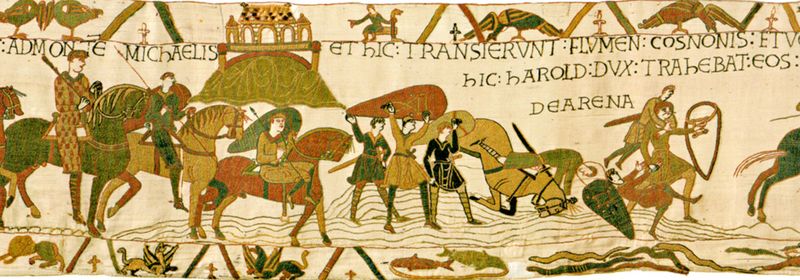
My daughter is a great fan of The Simpsons (recently celebrating their 20th anniversary), and enjoys challenging anyone to name any topic for which she cannot quote an episode in which that topic featured. Sometimes, I feel as if I’m getting that way about sand, given the diversity of contexts in which it shows up, but I’m really not up to her professional level. However, until recently, if someone had challenged me to link the Bayeux Tapestry (which is not, incidentally, a tapestry, but more of an extravagant piece of embroidery) and sand, I would have been stumped: but not now.
I recently had the experience of seeing the Tapestry for the first time. The word “spellbinding” is not one I use often, but it seems the only way of describing it. The Tapestry, all 70 meters (230 feet) of it, is displayed in low light to preserve its extraordinary colours, and this adds to the magic as you walk along the story. It’s an ancient graphic novel, an elongate comic book, almost an animation; you half expect to see Spiderman intercepting the Norman invaders, or the Sandman attacking their fleet. Such thoughts did not detract from my sense of wonder, but my reverence was briefly tested when I spotted Harold riding along with a hawk on his arm (as, I suppose, such noble folk generally did in those days); I was suddenly struck by a memory of my father reciting to me the comic monologue from music hall days (does anyone reading this remember Stanley Holloway?) of the Battle of Hastings, in which Harold was routinely depicted “on his 'orse with his 'awk in his 'and.” Chuckling would have seemed entirely inappropriate, so I controlled myself.
But, back to the point. The early scenes depict Harold being captured in France by Duke William and, having sworn allegiance to him and giving his guarantee that he would not declare himself king, taking off on a campaign with William against a revolting member of the local aristocracy. In doing so, they had to pass by Mont St. Michel and cross the River Couesnon. Now in those days, the river was still behaving naturally, since it was long before human interference changed the regional sedimentology (see my piece on the massive experiment underway there). And the river contained quicksands. The scene that I’ve reproduced at the head of this post shows Norman horses struggling in the quicksand and Harold saving a couple of soldiers by dragging them out by hand (he carries one on his back). The Latin description reads “hic Harold Dux trahebat eos de arena” - “here Duke Harold pulled them from the sand.” The round hill with the structure on top of it (upper left of centre) depicts Mont St. Michel.
The story goes on to describe how Harold went back on his word and declared himself King, thereby incurring the wrath of William, who proceeded to invade England and defeat the Saxon army at the Battle of Hastings, in the course of which Harold was shot in the eye by an arrow:
And after the battle were over
They found 'Arold so stately and grand,
Sitting there with an eye-full of arrow
On his 'orse with his 'awk in his 'and.
And thus was our vocabulary doubled - but no need to sweat or perspire over that.
Comments
Michael,
I am familiar with some of Stanley Holloway’s work and saw a delightful 1953 British movie this year with him in it on the cable network, Turner Classic Movies called “A Day to Remember”
http://www.imdb.com/name/nm0391361
http://www.imdb.com/title/tt0045672/
Jules - I wasn’t at all sure that anyone else would know that name, but I didn’t reckon with your encyclopedic knowledge! Thanks for the links - I honestly had no idea how many movies he’d been in and will have to check out a couple of the classics. Thanks!
Thanks Michael,
Not sure about my encyclopedic knowledge, but I am definitely a fan of old movies. The TCM network has helped preserve,fund restortion and introduce to perhaps millions of new viewers many wonderful movies from Hollywood’s(and other world studios)golden past.