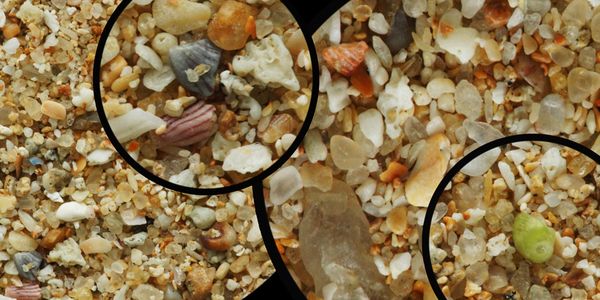
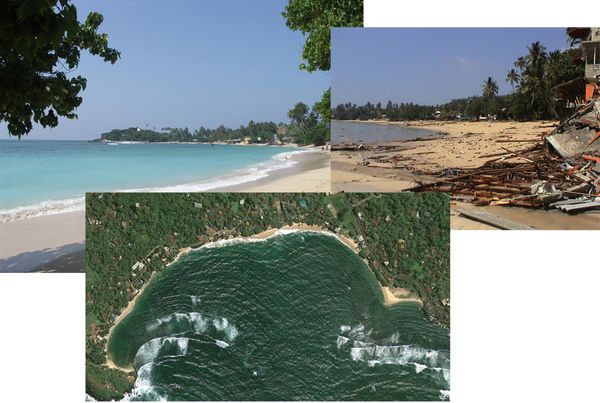
Heralded as one of the finest beaches in the world, Unawatuna lies close to the southern tip of Sri Lanka. The sand contributes to the heralding – on every scale – but this sand must have tales to tell. The resort was devastated by the 2004 tsunami, and a quick search of the internet reveals harrowing stories typical of those from around the Indian Ocean that appalling day. The before and after images below do not begin to evoke the full extent of the catastrophe that hit the residents that day, but the Google Earth image (from before the tsunami) shows the complex way in which the shape of the coast refracts and focuses even normal ocean waves – the chaos of what this natural lens created when successive tsunami surges hit can only be imagined.
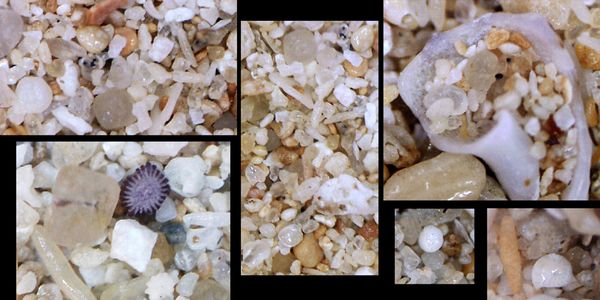
Many stretches of Sri Lanka’s beaches lost huge amounts of sand, but nature seems to have achieved effective beach nourishment and restoration. I can find no evidence of a human contribution to the re-supply of sand, only the opposite – extensive sand mining that reduced the coastal supply and inhibited the natural processes. So who knows exactly what stories these sand grains tell? In all likelihood some were sucked from the beach, only to be thrown back as the tsunami surged, joined probably by others that had been residing peacefully offshore, among the coral reefs whose fragments we see in the sand. But this is a spectacular and diverse sand: the ubiquitous quartz grains there, but overwhelmed by biogenic detritus. Sponge spicules, coral fragments, sea urchin spines, the inevitable forams, bits and pieces of shells as well as tiny complete ones, all testimony to the great organic engine of the tropical ocean. And what exactly that little beautiful blue and grey “cogwheel” is, I really don’t know.
All in all, a sand and a beach whose character belies their witness to chaos and tragedy.
[Thanks – once again – to Connie for collecting the sand. The immediate post-tsunami image is from Muddled Clarity, the tranquil beach scene from HolidayCheck.com]
Comments
Hi, Michael-- I think you’ll find that your little “cogwheel” (lower left photo) is an echinoid (sea urchin) spine in cross-section.
I suspect that you’re right, Howard - it’s just that I had never seen a blue one before, nor one that has broken this perfectly!