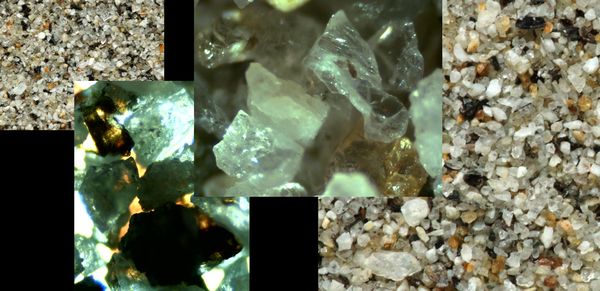
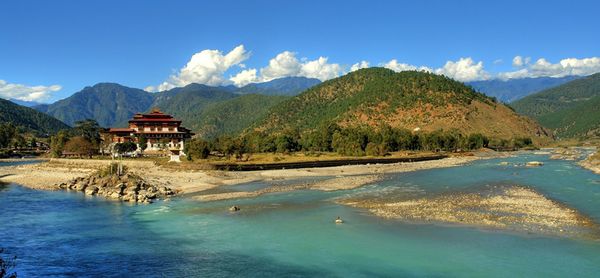
I was delighted (but envious) when my friend Patricia brought me back a sample of sand from her recent visit to Bhutan. The sand came from one of the country’s most sacred places (and its old capital), Punakha, at the confluence of two great rivers, the Mo Chu (the mother river) and the Pho Chu (the father). The Palace, the Punakha Dzong, is also known as Pungtang Dechen Photrang Dzong, the palace of great happiness, and this magnificent structure originally dates from the 17th century. But happiness has not reigned continuously during its long history. It has been re-built many times over the centuries after fires and earthquakes, and it is regularly threatened by floods, the most recent severe event occurring in 1994.
And there’s a good reason for the floods, created not by the mother river, but by the father. Follow the Pho Chu upstream from Punakha, and you climb rapidly into the high Himalayas, towards the snow caps, the ice fields, and the glaciers that provide the source of the river. Now glaciers are environmentally careless, dumping and reworking the great loads of rock and sediment that they carry with no regard for landscape maintenance. The great piles of glacial litter that remain (moraines) can often act as dams for the glacial melt water, and lakes build up behind them. In the lower images, below, there are four glaciers feeding the upper reaches of the valley down which the Pho Chu flows:
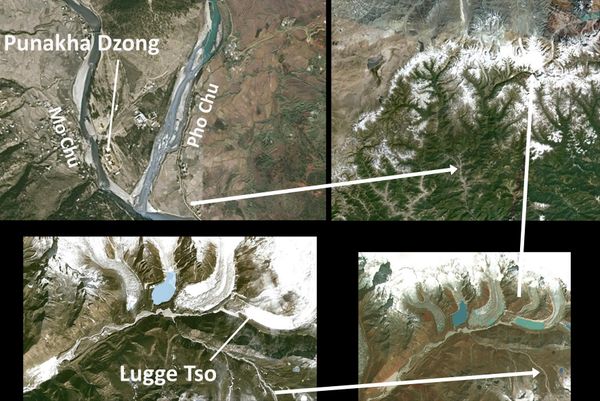
Partly frozen in the image on the left, open and melted on the right, are a series of such glacial lakes. Most of the time, such lakes are benign, simply adding an extra element to the grandeur of glaciated mountains anywhere in the world. However, as the Nova article on glacier hazards notes, “Once such a lake has formed, melting and retreat of the glacier front accelerates because water transports heat much more efficiently to the ice front than air can.” And, ultimately, that’s when a benign landform can turn nasty. The natural dams reach the point that they can no longer hold back the waters accumulating behind them, and burst, letting loose a massive torrent of floodwaters charging down the valley. Such was the case on October 7th, 1994, with the lake, Lugge Tso, seen clearly in the satellite images. Also clearly visible is the breach in the moraine dam and the flood channel downstream of it. Such an event is known in the trade as a glacial lake outburst flood, or “GLOF.”
At Punakha, the typical average river flow is perhaps a couple of hundred cubic meters – around a thousand bath tubs – per second. In October 2004, the peak river flow measured downstream from Punakha, and more than a hundred kilometres from the lake, was 2500 cubic meters per second. And this is what Punakha looked like (with a normal view for comparison):
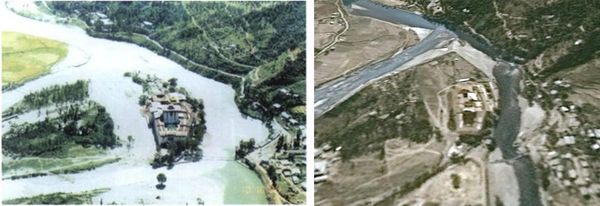
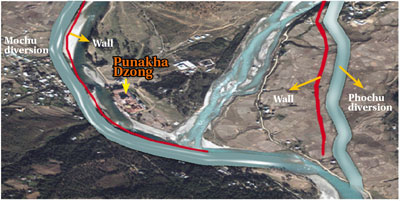
The father river has adopted a second channel, and unimaginable tons of sand are being re-distributed along the valley – a re-sculpturing of the landscape that will change everything for the flow of the river in both normal times and flood. But there are man-made changes in the works, too – given that there are another 2500 glacial lakes besides Lugge Tso in the Bhutan Himalayas, a grand scheme is underway. The defences put in place after the 1994 flood are regarded as inadequate, and the current project is to move the confluence of the mother and father rivers 300 meters downstream of its present location:
As described in an article on kuenselonline.com a couple of years ago:
The department of geology and mines (DGM) has a proposal to divert the Phochu and Mochu rivers to protect Punakha dzong in case of a glacial lake overflow flood (GLOF) and cyclone floods.
It proposes moving the confluence of the two rivers more than 300 m downstream.
“We’ve sent to the dzongkhag an estimate of Nu 508,310 to survey and study the river basin area,” said Ugyen Wangda, chief geologist of DGM. If approved, construction would take around three years.The present defenses of the Punakha dzong, built after the 1994 floods, can withstand only 18 million cubic metres (cu m), according to DGM. “The proposed diversion will protect the dzong from even a 53 million cu m flood, if the Lunana lakes of Rapstreng and Thorthormi burst,” said Ugyen Wangdi.
The proposal came up in a May 2009 home ministry meeting after the GLOF false alarm in Punakha, when an underground lake in Tshojo glacier had burst. “The main concern was on how to evacuate the holy relics of the Ranjung Kharsapani and the Machen to a safer place,” said Ugyen.
The main danger is from the headwater of Phochu, where there is a chance of GLOF, if the Rapstreng and Thorthormi lakes overflow into each other, according to DGM.
“We plan to divert the Phochu two or three kilometres before the dzong and take it over the paddy fields, which are currently on the left banks,” said Ugyen.
A kilometre long and three metres broad giant wall could be built further away from the dzong’s current wall. The enlarged area, behind the wall, is proposed to be converted into a large park. “If there is GLOF and the river overflows its banks, there should be no impact as the river basin will be very large,” said Ugyen Wangdi.
The classic and spectacular view of the Palace of Great Happiness will be consigned to history.
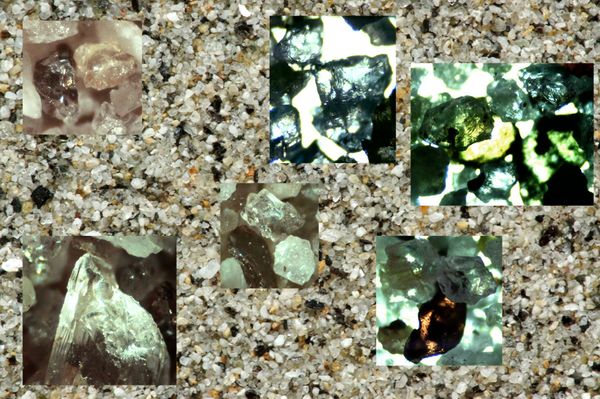
But back to the sand. These are raw, young grains, only recently ripped out of their Himalayan parent-rocks, tumbled downstream by everyday river flow and the occasional GLOF, witnesses to violence, but barely changed from their original crystal forms. Another lovely sand - thanks, Patricia.
[This is the second time I have been fortunate to have a Bhutan sample for the Sunday Sand series – see the other one here.]
{A very good summary of GLOFs of the Bhutan Himalayas: Chhopel, Karma (2006-03-15). “Flash Floods and Debris Flows due to Glacial Lake Outburst Floods” (ppt). Proceedings of the International Workshop on Flash Flood Forecasting coordinated by the U.S. National Oceanic and Atmospheric Administration’s National Weather Service and the World Meteorological Organization, San José, Costa Rica, March 2006.
Header image licensed under the Creative Commons Attribution-Share Alike 2.0 Generic license, http://flickr.com/photos/59731892@N00. Second photo of Punakha Dzong: http://www.globeimages.net/data/media/8/Punakha_Bhutan.jpg ]

Comments
No comments yet.