It was my intention to put together a more technical post on the challenges of measuring the shape of a sand grain - an apparently esoteric endeavour, but in fact of surprising importance in science and our daily lives. However, I not only realised that this would require more time for thought (including a probably vain attempt to comprehend fourier analysis), but I also became otherwise-occupied over the last day or so.
I suppose, since I have written the book, that, in the strict sense, I have long been an arenophile, but it was only in the course of writing that my arenophilia has extended to collecting my subject matter. Sand collecting is a serious activity for a large community of enthusiasts around the world, and the diversity of sands and the uniqueness of family of grains means that any collection is endless. It was, I suppose, inevitable that, spurred on by two charming and helpful arenophiles, I should start gathering my own collection. The first was Marco Bonifazi, whom I visited a couple of years ago at his wonderful old house in a village in the Swiss Jura mountains. Marco is a man of many interests and talents, among them collecting sand - he has more than 8000 samples:
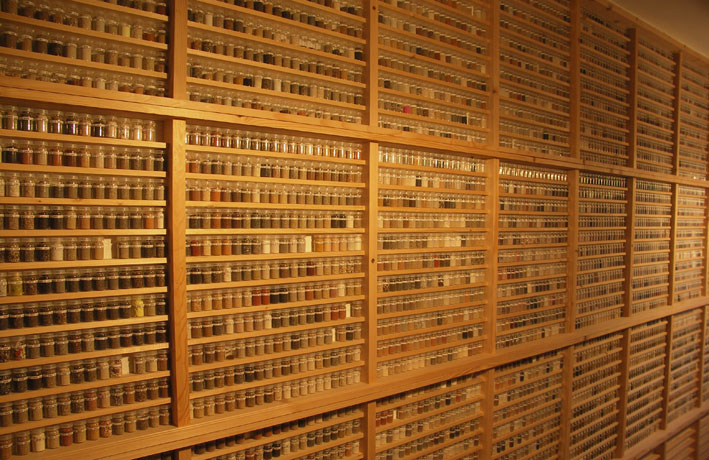
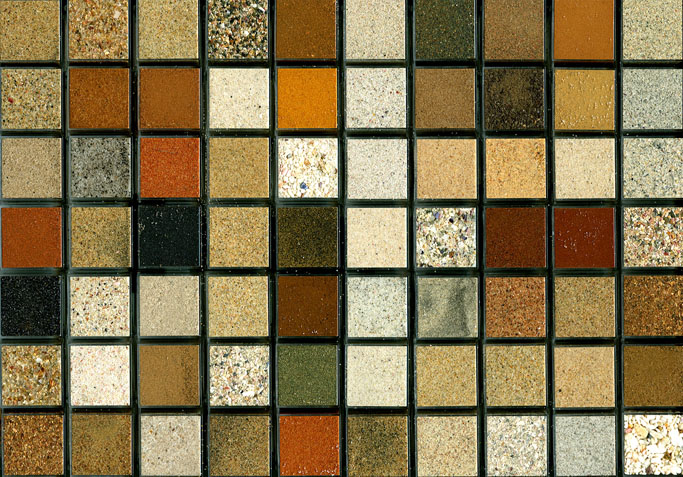
A few years ago, Marco helped organise an exhibition at the Natural History Museum in Neuchatel (set up by Louis Agassiz before he decamped to the US in 1846), simply titled Sable. The exhibition had to be extended because of popular demand - and is something that I would love to recreate at a museum in the UK or the US (see, in French, the Museum descriptions of the exhibition). Marco provided me with the start of my own collection and today my friends and family never leave home without a few ziplock plastic bags on my behalf. The second sand collector to whom I owe a great deal is Loes Modderman, who lives in the Netherlands and has a superb website on all things microscopic. I was captivated by some of the images on her site that demonstrated the beauty of the endlessly varying hues of natural sand, and she very kindly and enthusiastically allowed my to use one of these images as a plate in the book (the illustration at the top of this post, Sands of South Africa). And then, one day, I received an e-mail from Loes letting me know that I should expect a package; when it arrived, I was astonished and delighted to find that it contained dozens of sand samples from numerous far-flung parts of the world. This completed my conversion to a full-fledged arenophile, and, as further plastic bags arrived from family and friends, and as I filled many of my own, the question was how to do the spectrum of sands justice?
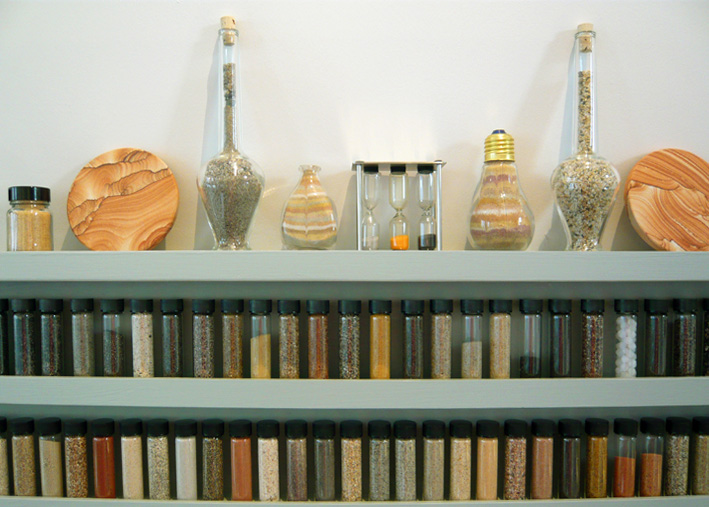
Fortunately, I have a long-suffering wife who has also been infected by arenophilia, whose life has unavoidably been deeply penetrated by sand over the last few years. And I’m also lucky enough to know Trevor, who builds things - extremely well and thoughtfully. The result, a few days ago was the installation in our apartment here in London of a set of shelves (of significant dimensions) specifically to display sands - interior decorating with an arenaceous motif. I had earlier found the ideal glass containers - in bulk, from a medical supplies website (heaven knows what they are supposed to contain). So fourier analysis went out the window and much of my time in the last day or so was devoted to filling and cataloguing the containers - a modest 150 of them. I think (and, wonderfully, my wife agrees) that the result is great - it’s certainly unique, it displays the subtle and ever-varying colours and character of the world’s sands, it’s thematic, and it complements the colour of the room.
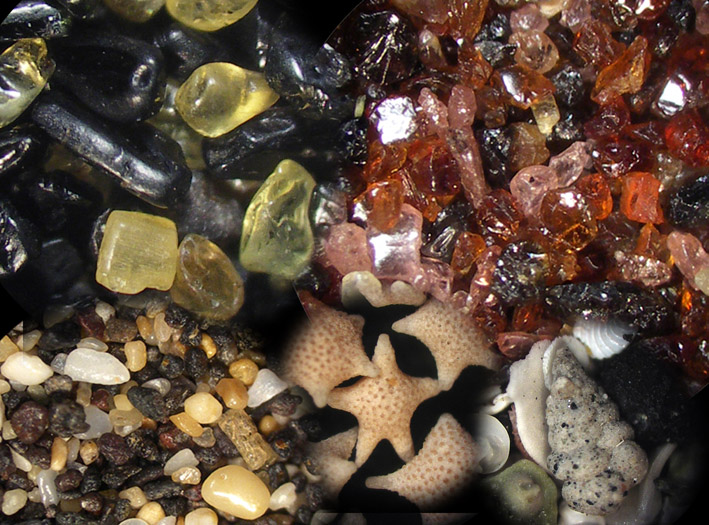
Now, of course, I’ll have to get the microscope out and continue with the exploration of nature’s wonderful debris.
Comments
arenophile! yes … love it!
How very neat! And arenaceously unique!
Did you ever find out what these were? http://www.flickr.com/photos/35426146@N05/3328156555/
I am still curious even after all this time.
Hi Mel - the simple answer is no. I know they are quartz and were picked out from sands in a sand bar in the Upper Bikis River, NE Kalimantan. That’s it. No ideas on the origin of the extraordinary structure of these crystals - any suggestions welcome!
nicely done!