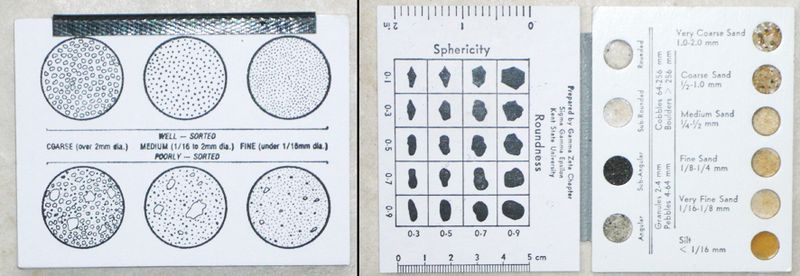
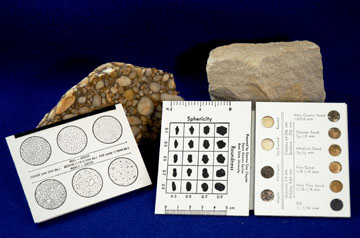
Concerned about the origin of the sand covering your car after the kids have borrowed it? Or where that cowboy builder is getting his supplies from? Curious about why the sands on one beach make much better sandcastles than those of the next one along the coast? Or why the sand traps/bunkers on one golf course are more deadly than another? Or, then again, maybe you’re a geologist. For you, the handy-dandy Pocket-Size Sand Grain Sizing Folder could be the solution. Is available from the Geological Society of America or directly from SGE* at Kent State University for a bargain price, and I have recently become the proud owner of one. It’s a very visual reference for several ways of describing sand, first of all, of course, size. Size is the only character that defines a granular material as sand, and the size categories (from “very fine” to “ very coarse,” much like sandpaper grades) progress in multiples of two – 1/16 to 1/8 mm, 1/8 to 1/4 mm and so on up to 1.0 to 2.00 mm – simply because nature works in multiples rather than linearly (think of a square versus a line, a cube versus a square). Anything finer than very fine sand is silt or mud, and things coarser than very coarse sand are granules, pebbles, cobbles, and boulders. This scheme has a real physical basis: sand-sized materials behave very differently from anything bigger or smaller – and that behaviour is often quite bizarre (as I’ve described on several occasions – see, for example, the formation of convection structures). The Pocket-Size Sand Grain Sizing Folder provides a direct reference to sand size categories by including small samples of real sand (see the illustration at the top of this post).
But the folder does more than give a reference for size – it provides graphics of poorly-sorted and well-sorted sands in three different size categories, a key character of how uniform or otherwise is the range of size of the grains in a particular sample. Sorting provides clues as to the transportation biography of a sand – wind-blown sand will contain a much smaller range of grain sizes (i.e., better-sorted) than a river or shoreline sand simply because the capacity of the wind to transport larger grains is much lower than that of water. But it’s not that simple: sand transport is a complex process that continues to occupy researchers in fluid dynamics as well as sedimentology. The two sands below are from, on the left, a beach and, on the right, dunes just a few meters away. Not only are they different in size (in this case, oddly, the dune sand is coarser than that of the beach), but the beach sand is more poorly-sorted than that in the dunes.
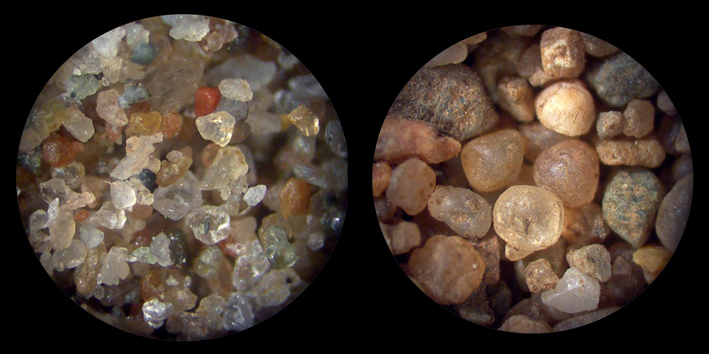
But there’s another clear and dramatic difference between these two sands: the shape of the grains. The dune sand grains are both more rounded and smoother than those from the beach. Here, the Pocket-Size Sand Grain Sizing Folder is again helpful: it provides a visual reference and a scale for grain roundness and sphericity (the central panel in the image at the top). Roundness roughly reflects how angular and sharp the edges of the grain are, sphericity how closely its shape approximates that of a sphere. All of these characters, size, sorting, roundness, and sphericity, are characters that serve to distinguish one sand grain, and one family of sand grains, from another – regardless of what they’re made of. And these distinctions are testaments to the varied origins and biographies of those sands . But describing accurately the shape of something as irregular as a typical sand grain is a challenge that continues to vex geologists – after all, how would you measure the shape of one of those knobbly tomatoes or a banana? In part, the way you approach the problem is determined by what you want to get out of it, and so there a multiple different methodologies. For example, another esoteric measure of grain shape is rollability – how easily the grain tips over_._ And the closer we look, the more complex – but fascinating – things become. Below is the face of a single sand grain half a millimeter across; the right hand image is the surface of the grain as seen through a scanning electron microscope. Magnified 1500 times its original size, an entire miniature landscape opens up to us.
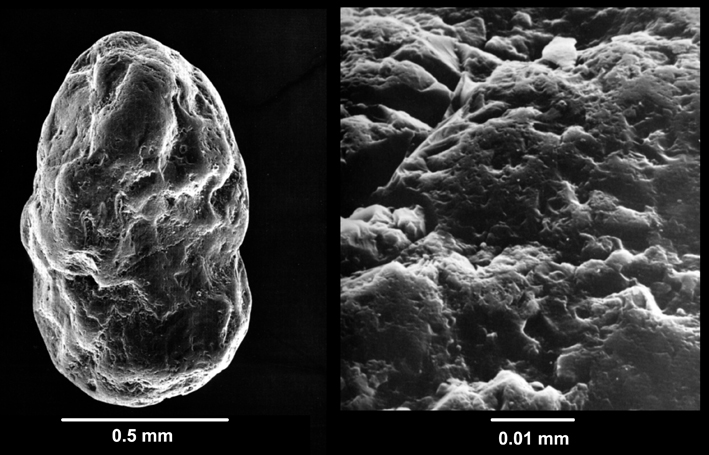
In some ways, the character of the face of a sand grain is similar to human physiognomy – it contains all sorts of biographical clues. And to push this analogy a little further, there’s a similar “nature versus nurture” question: which surface characters of a sand grain reflect its origins (weathered out from a rotting granite versus an old sandstone, for example) and which its subsequent life story and journeys?
The extraordinary ways in which the shape and character of a sand grain can tell us about its history and help reconstruct episodes and environments in the chapters of our planet’s history are fodder for all kinds of future blog posts. Suffice it to say, for now, that these things are vital for the geological sciences. And the shapes of sand grains are vital to our daily lives – as an admittedly non-vital example, the shapes (and the sorting) of different beach sands contribute fundamentally to whether or not they make for good sandcastles. Today’s methods for measuring sand grain shape become progressively more sophisticated. Take an image of the outline of a sand grain, find the centre, and measure the radius as it changes around the shape; this generates a mathematical curve that can be subjected to Fourier analysis – the mathematical construction of a complex wave form from the combination of a series of simple ones (I’m just about reaching the limits of my mathematical comprehension here). The result uniquely describes the shape and can be used to compare shapes of different grains. This method has been in use for some time, but continues to produce surprises – for example, workers at Scripps Institution of Oceanography have recently described how, regardless of the origins of their samples, grain shapes conform to a common power law, that seemingly ever-present way in which nature works (see, for example, earlier posts here or here). This means that grain shapes can be reproduced mathematically that precisely mimic natural ones, hugely useful for modelling the mysteries of packing, the ways in which sand grains fit together depending on their shape; this may seem esoteric, but it’s of fundamental importance for sand as a construction material, for understanding the porosities of sandstones as reservoirs for water and oil and gas – not to mention the behaviours of sand traps on the golf course.
The analysis of sand grain surfaces and shapes then moves into three dimensions, both via Fourier analysis and through other techniques; meticulous measurement of the way in which nitrogen gas is adsorbed onto the surfaces of sand grains can provide very precise information on three-dimensional shape and surface texture. These kinds of data can be invaluable not only in the everyday uses of sand, but also in criminal forensics.
All this is by now, of course, a long way from my simple Pocket-Size Sand Grain Sizing Folder, but the principles are the same. It’s extraordinary the stories that sand grains have to tell. I will leave you with an image from what has now become a classic, W.H. Mahaney’s 2002 Atlas of Sand Grain Surface Textures and Applications:
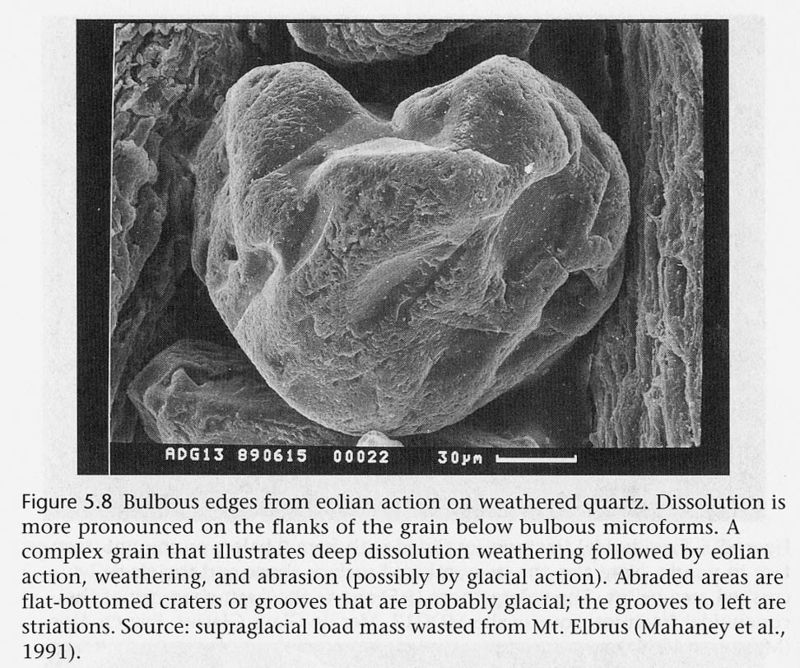
* SGE, Sigma Gamma Epsilon, is the US National Honor Society for the Earth Sciences; the Kent State chapter operate the sales of the sand-size folders as a long-standing and major fund-raising project.
[The image of the individual sand grain is courtesy of Dave Krinsley, who inaugurated the use of scanning electron microscopy to decipher the surface character of sand grains more than 35 years ago. For a basic discussion of grain sizes and shapes, see Sand and Sandstone, the Potter, Pettijohn, and Siever bible.]
Comments
That cool Michael…I think I will order one of those from Kent State. ( I see it is part of a fund raising effort.)
I finally figured out that I cannot log in and have a functional ‘post’ button, but everything works fine if I just use the email address form. :) So I’ll just mention that I do regularly enjoy your blog. I’m thankful that it is available on the internet.
Kent State University, you say? I live fairly close by. Interesting.
“But describing accurately the shape of something as irregular as a typical sand grain is a challenge that continues to vex geologists”
Aside from the rather interesting nitrogen adsorption measurements, do geologists characterize the shape of sand using fractal dimension?
Thanks for the comment - and for following the blog! Clearly, the comment system worked OK, but please let me know if there’s a problem with the blog.
Yes, the fractal dimension approach has long been one of the methods used. Here’s an example abstract from a paper in the Journal of Sedimentary Research:
A Comparison of Fourier and Fractal Techniques in the Analysis of Closed Forms
Stephen K. Kennedy, Wei-Hsiung Lin
Journal of Sedimentary Research
Volume 62 (1992)
ABSTRACT
Forty-one samples of quartz sand grains derived from four different sources are analyzed using Fourier grain-shape and multi-component fractal techniques. The results from the two techniques are sufficiently similar to demonstrate clearly the potential usefulness of the fractal-based technique in the analysis of sedimentary particles. Additionally, the fact that the fractal technique is shown to extract information from shapes suitable for analysis via a radius expansion method lends credence to the expectation that it will yield comparable information when applied to more complex shapes not amenable to the radius expansion Fourier technique.