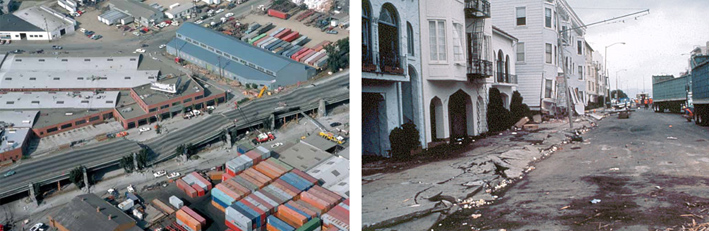
Candelstick Park famously survived the earthquake of October 17, 1989 for one simple reason: its foundations were firmly anchored to solid bedrock. But for large areas of central California, the advice against building a house on sand was dramatically and tragically justified. Areas built on young sands and silts, or on reclaimed land, were fine until the waterlogged sediments were shaken - all cohesion and strength in the sediments was lost and they turned to liquid, in the same way that apparently firm patches of beach suddenly suck at your wiggling feet. Liquefaction, this loss of strength in water-saturated sand, is notorious for being often the major cause of severe damage as a result of an earthquake; the sand not only becomes like a liquid but compacts and expels its water. The foundations of structures sink, rotate, and deform, with catastrophic consequences - in the Loma Prieta earthquake some buildings in San Francisco foundered to the point where their third floors were at ground level. The earthquake that devastated the region around Bhuj in northwestern India in 2001 was one of the most damaging in the country’s history. Twenty thousand people were killed and the havoc caused more than $3 billion of damage, much of it as the result of liquefaction - huge cracks in the earth appeared, and water and sand erupted in volcanic fountains as the ground collapsed back on itself. This fickle behaviour of granular materials is the subject of intensive research by engineers and physicists - and microbiologists. As I described earlier, a humble soil-dwelling bacterium, bacillus pasteurii, can make sandstone out of loose sand, gluing the grains together in a way that offers promise for offsetting the threat of liquefaction.
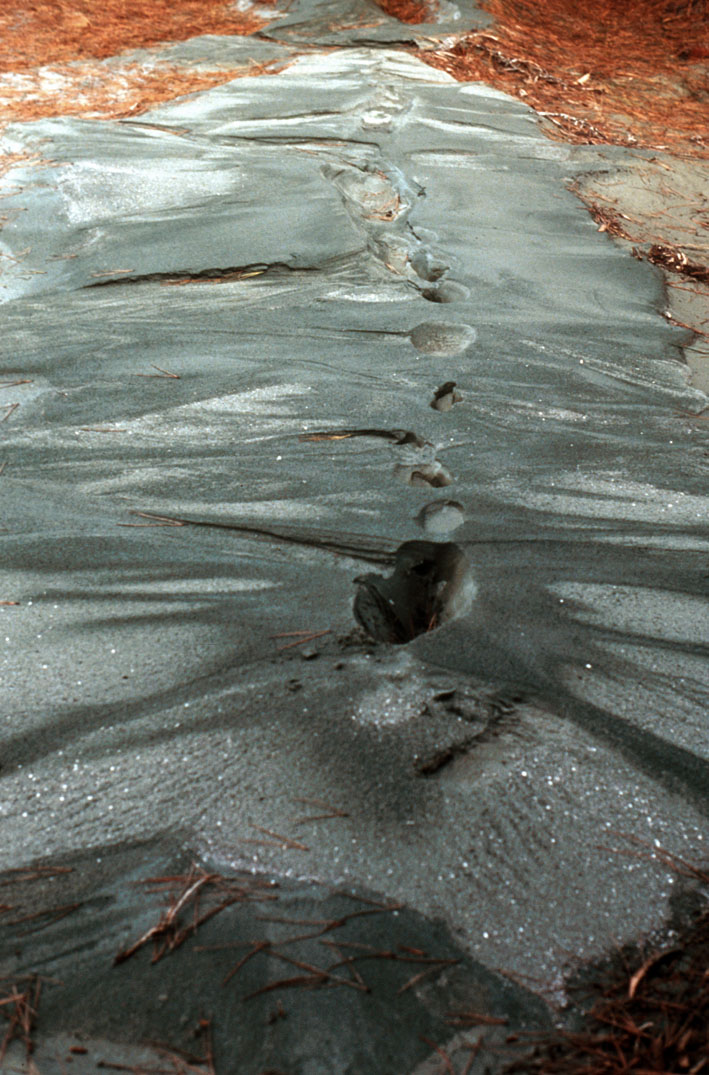
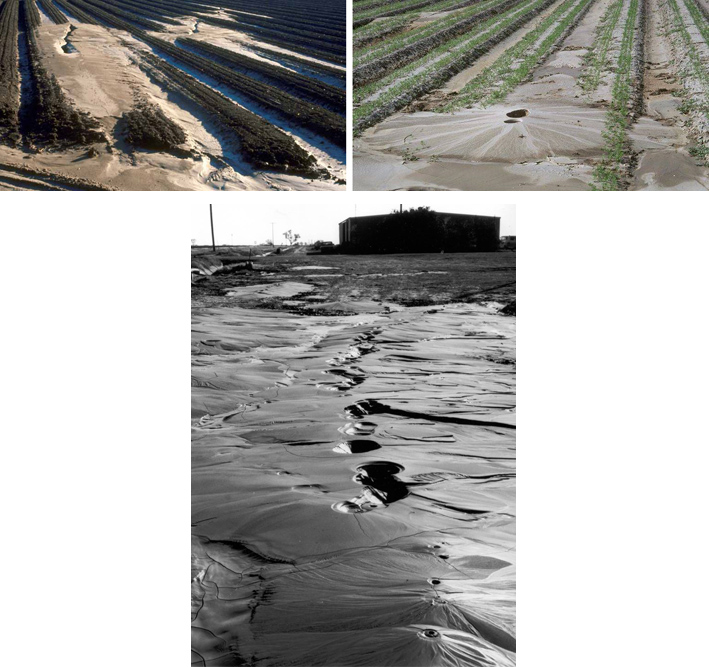
As in Bhuj, liquefaction during an earthquake also shows up in bizarre ways. Layers of sand below the ground surface will liquefy and, under the pressure of the overlying sediments, will exploit any fissure or other line of weakness to flow upwards and burst out on the ground surface as an eruption of sand and water. Known variously but descriptively as sand volcanoes, boils or blows, these can appear anywhere. The image at the head of this post shows a sand volcano that erupted during the Loma Prieta earthquake in the median of Interstate 80 west of the San Francisco-Oakland Bay Bridge toll plaza. The images below are of sand-inundated fields after the Loma Prieta event (left) and, right and below, the Imperial Valley earthquake of October 15 1979 (this seems to be a good week for California earthquake anniversaries).
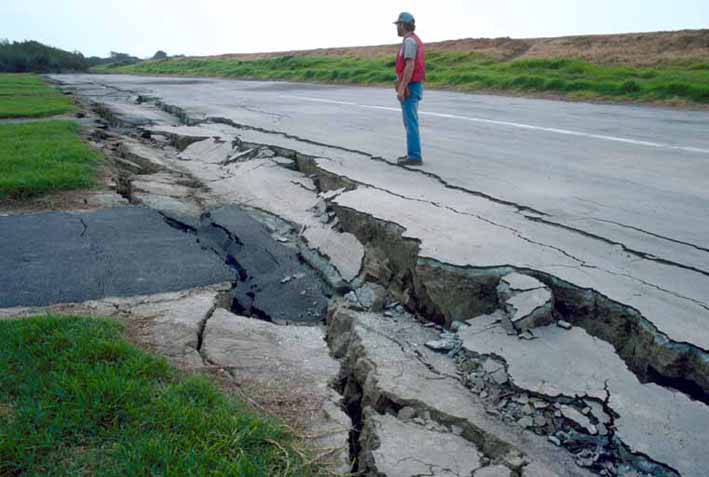
A principle cause of damage by liquefaction is the phenomenon of lateral spreading as the liquid sand spreads out, clearly demonstrated in the photo below (also after the Loma Prieta earthquake) where the road surface has been torn apart by the movement of underlying sand from right to left.
And liquefaction was also amply demonstrated in the most powerful series of earthquakes to strike the lower 48 in recorded history—not in California, but in New Madrid, Missouri, between 1811 and 1812. New Madrid at that time was, fortunately, a small town of four hundred inhabitants, none of whom were aware that they lived above an ancient system of deep fractures in the Earth’s crust beneath the Mississippi River Valley. The fractures do not exercise themselves very often, but when they do it is with extreme violence. In the early hours of December 16, 1811, the terrified residents were awoken by violent shaking, accompanied by an appalling roaring sound. They later reported that the surface of the Earth moved in waves and that cracks opened in the ground from which water and sand erupted. One resident, Eliza Bryan, wrote that “the surface of hundreds of acres was, from time to time, covered over in various depths by the sand which issued from the fissures, which were made in great numbers all over this country, some of which closed up immediately after they had vomited forth their sand and water”
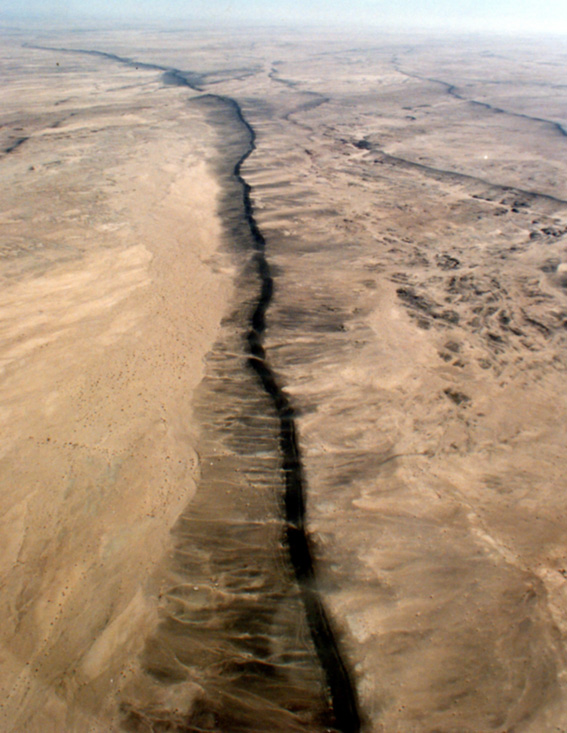
If we excavate a sand volcano and examine its plumbing, the sand-filled fissures through which the eruption took place are revealed. This is again analogous to volcanic eruptions of molten rock, where a volcano is fed via underlying cracks through which the magma forced its way. When the molten rock cools and solidifies, these filled feeder cracks are called “dikes”, often harder than the surrounding rock and now forming long walls across the landscape. The examples below, cutting across the Namibian desert, record the igneous activity associated with the opening of the southern Atlantic Ocean (photo by the author).
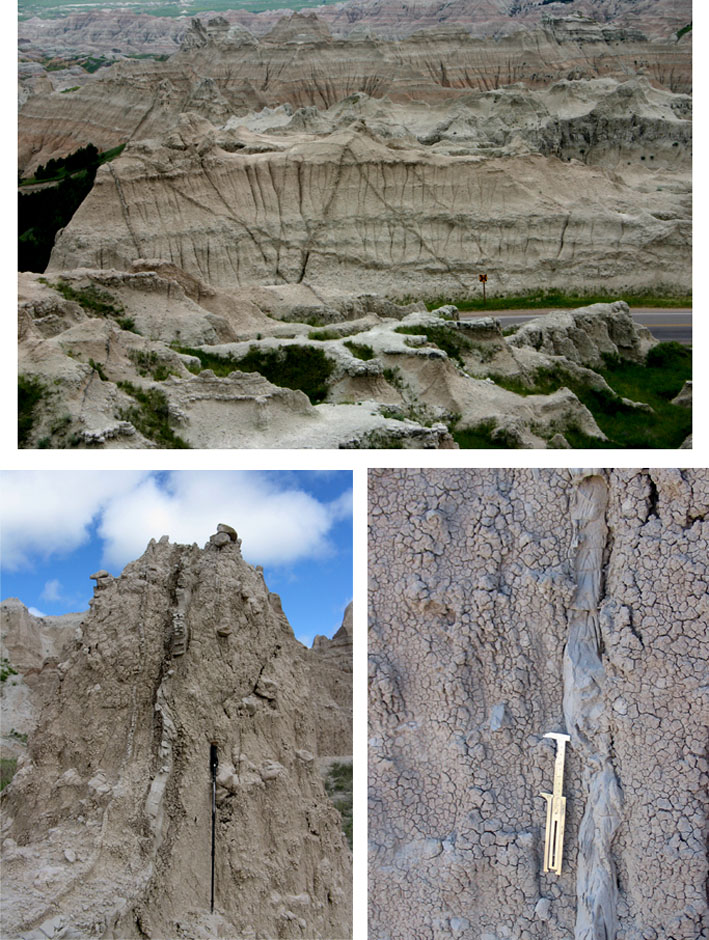
The same process, on a more modest and cooler scale, can be seen below sand volcanoes, where the fissures are plugged with sand, silt, and mud. We see these things too in the geological record - clastic dikes (since they are formed of clastic, fragmentary, sediments0 cutting through the surrounding rock. They record past episodes, sometimes on a large scale, of sediment liquefaction. The examples below come from the Badlands National Park of South Dakota (from a good article by the University of Nebraska at Omaha, Dept. of Geography and Geology). These things, for obvious reasons, are sometimes also referred to as injectites.
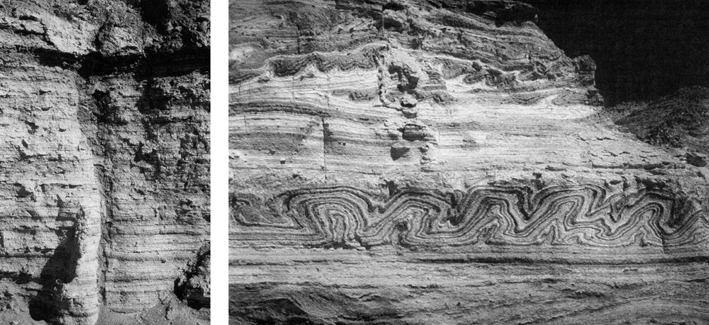
And then there’s Sodom and Gomorrah. We are often tempted, for dramatic purposes, to compare the destructive power of natural events such as earthquakes to the biblical demise of the twin cities. Ironically, work by David Neev of the Geological Survey of Israel and K.O. Emery of Woods Hole Oceanographic Institution, together with research by engineers and geologists in the United Kingdom, has suggested that, assuming the cities existed at all, they may well have been destroyed by earthquakes and liquefaction. The area around the Dead Sea, the likely location for Sodom and Gomorrah, lies across the boundary of two rapidly shifting segments of the Earth’s crust and has experienced significant earthquakes over recorded history. Lying below sea level, it is also the ultimate destination of vast volumes of sand and mud, and in many of these ancient layers are the telltale signs of violent water expulsion from the sediments. The photos below show two examples - a sandstone dike on the left and, on the right, incredible folding of the sand and mud layers as a result of sliding like a crumpling table cloth. Altogether, these forensic clues point to an obvious culprit for the destruction. But what about the fire and brimstone? Bitumen, natural asphalt or tar, was much prized during ancient times for medicine, the caulking of boats, and the preservation of mummies, and sulphurous bitumen, together with lighter oil, has for thousands of years been leaking from fractures around the Dead Sea, seeping into the ground and the water. All that would be required would be gas leaking along with the oil and a spark as the ground catastrophically gave way—fire and brimstone?
So, from the Loma Prieta earthquake to Sodom and Gommorah - wherever will sand take us next?
[There is lots of information on the internet and the geoblogosphere about the Loma Prieta anniversary; Andrew Alden on About Geology has been collecting personal stories of the event. For liquefaction, there is, as always, no better resource than the USGS - go to their website and enter “liquefaction” or sand plus “volcanoes” or “boils” or “blows” and you’ll find excellent articles and images; for images of the Loma Prieta earthquake, go to the USGS gallery]
Comments
New Madrid isn’t the only place in the midwest where you can find evidence of past liquefaction.
This publication has some nice pictures of old sand boils:
http://pubs.usgs.gov/of/1998/of98-488/
Erik - thanks for the link. Yes, there are many other locations where liquefaction features are testament to the history of seismicity and enable reconstruction of prehistoric events. The publication has some great images.
Also what I didn’t mention is that there are other ways in which sand blows can originate and there is some debate around the possibility of alternatives to earthquakes for the origin of some of them.
New earthquake.
What a disaster.A lot of inocent people can be in danger.
http://www.viewheadlines.com/News/Article.aspx?i=9879&t=Strong-quake-hits-Indian-islands